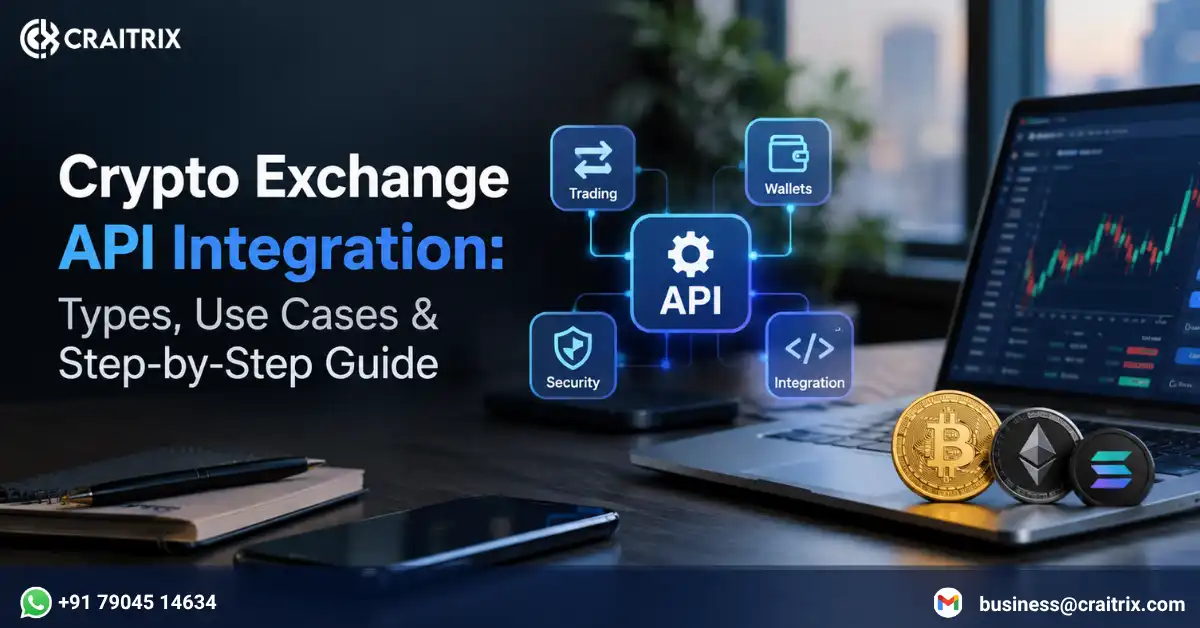
A crypto trading platform needs more than a user interface to show real-time prices, execute orders, and manage accounts. It also needs a reliable connection to exchange infrastructure. Crypto exchange API integration creates that connection, allowing applications to pull market data, place and manage orders, and access account information directly from an exchange.
From a simple trading bot to a multi-exchange platform, the right crypto trading API setup affects execution speed, data accuracy, security, and scalability. Developers also need to handle different API formats, authentication methods, rate limits, WebSocket connections, and exchange-specific trading rules.
A successful integration depends on choosing the right API model, handling authentication, connecting market data, managing orders, securing credentials, and monitoring the connection in production. It also requires deciding when direct exchange APIs make more sense and when a unified solution such as CCXT is a better fit.
What is Crypto Exchange API Integration?
A crypto exchange API consists of endpoints and communication mechanisms that enable an application to engage with a cryptocurrency exchange. Using the exchange’s API, a connected application can use the API to access market data, balance information, make trades and orders instead of going to the exchange’s website.
The APIs that are available for exchanges are typically both public and private. There are public endpoints that return prices, trading pairs, volume, and order book; private endpoints are available for operations such as placing orders, checking balances, and performing holding histories. For private endpoints, authentication needs to be required and typically will be done via API credentials. Features vary from exchange to exchange so developers should check the corresponding documentation for each exchange before they integrate.
How Does Crypto Exchange API Integration Work?
Crypto exchange API integration connects an application to an exchange so they can exchange data and instructions. A typical flow is:
Application → Request → Exchange API → Response/Data
For example, to display the latest BTC/USDT price, the application sends a request and receives current market data. When a user places an order, the application authenticates and signs the request, sends the order details, and receives the resulting order status.
For real-time updates, WebSocket APIs maintain a live connection so the application can receive market and trading events without repeatedly polling the exchange.
Types of Crypto Exchange APIs: REST, WebSocket & FIX
Crypto exchange APIs mainly use three communication methods: REST, WebSocket, and FIX. REST handles request-based operations, WebSocket delivers continuous real-time data, and FIX supports institutional trading workflows.
| API Type | Connection Model | Best For | Typical Use |
| REST API | Request/response | On-demand operations | Orders, balances, trade history, market data |
| WebSocket API | Persistent stream | Real-time data | Prices, trades, order books, account events |
| FIX API | Persistent session | Institutional trading | High-volume order flow and professional connectivity |
REST API for Trading and Account Operations
A REST API uses standard HTTP requests to communicate with an exchange. A REST API for crypto trading will provide access to market data, order placement and cancellation, balance and history of trades made.
For applications that require a response to a particular request, like placing a limit order or finding out if an order exists, REST can function appropriately.
WebSocket API for Real-Time Market Data
A WebSocket API maintains a persistent connection between the Application and Exchange. In previous versions, before version 2.3, applications would keep asking for updates, but now it can retrieve updates when the exchange publishes them.
WebSocket streams are ideal for live account events, trades, and order book updates, as well as live prices. The vast majority of trading platforms have sloped WebSocket streams for live data, supported by REST endpoints for other operations.
FIX API for Institutional Trading
FIX (Financial Information eXchange) is a protocol that is used widely in the financial markets. There are some exchanges that provide FIX services for institutions who require standard messaging and lots of transactions in order volumes.
The reasons for not using FIX are that for the most part it is not necessary for retail-focused applications, due to REST and WebSocket APIs meeting those needs. Let’s see the relevance of FIX in the context of the institutional connectivity and high volumes of orders.
Crypto Exchange API Use Cases
Crypto exchange APIs can do more than just place orders. They are used by businesses to relate trading platforms to exchange infrastructure, get the information and market details, automate trading processes, and keep track of account activity.
Automated Trading Bot and order execution
APIs enable trading bots to provide access to market information and automate particular trading methods. Ordering, modification and cancellation are fully automated and order status tracked.
Multi-Exchange Trading Platforms
Multi-exchange platforms are the platforms built to link a number of exchanges and provide a single interface to the markets of those exchanges for traders. Users can analyze and compare prices, make orders and handle positions without needing to switch platforms.
These systems usually normalize exchange information by a common API or abstraction layer in the corporate code.
Market Data and Analytics Platforms
Market data APIs include OHLCV candles, trades, order book data, trading volume, and prices. This information can help power charting tools, trading dashboards, market analysis platforms and analytics products.
Portfolio and Asset Management Applications
Read-only API access can return balances, trades and account activity from integrated exchanges. Users can keep track of all the positions and track any portfolio performance but still do not let the application make trades.
Liquidity and Arbitrage Systems
The exchange APIs offer access to prices, order books, and trades for various exchanges and are typically leveraged by liquidity or arbitrage systems. Applications can use the market to weigh up conditions, pinpoint price disparities and direct orders as per the market strategy.
This also makes crypto exchange liquidity management important for systems connecting multiple markets. Execution speed, trading fees, and transfer times all influence whether an arbitrage opportunity remains profitable.
Benefits of Crypto Exchange API Integration
A proper API integration gives a trading product a direct connection to exchange infrastructure and improves access to data, execution, and automation.
- Real-time market data: Applications receive current prices, trades, and order book information.
- Automated trading: Orders can be executed according to predefined trading rules.
- Multi-exchange liquidity access: A single platform can connect to liquidity across different exchanges.
- Automated workflows: Data retrieval, order tracking, and account monitoring require less manual effort.
- Scalable architecture: API-based architecture makes it easier to add exchanges, markets, and trading features as the product grows. This makes crypto exchange scalability an important consideration.
- Tailored trading experience: Businesses control the interface, workflows, and features presented to users.
How to Integrate a Crypto Exchange API Step by Step
A successful crypto exchange API integration moves through requirements, exchange selection, authentication, data connectivity, order management, testing, and monitoring. The exact process varies by exchange, but these stages cover the core requirements.
Step 1: Define Your API Integration Requirements
Decide what the application needs from the exchange, including exchanges, trading pairs, market data, order types, account functions, and expected request volume.
A portfolio tracker may only need read-only account data, while a trading platform needs order execution, real-time updates, and stronger error handling.
Step 2: Choose the Exchange and API Access Model
Evaluate exchanges based on supported markets, liquidity, API functionality, documentation, rate limits, WebSocket support, sandbox availability, and reliability.
For multiple exchanges, decide whether direct integrations, a unified API, or a custom abstraction layer best fits the product.
Step 3: Create API Keys
Generate API credentials through the exchange’s developer interface and review the available permission levels. Give each key only the access required by the application and store credentials securely.
Step 4: Implement Authentication and Request Signing
Private endpoints require authentication. Depending on the exchange, requests may need an API key, timestamp, nonce, and cryptographic signature such as HMAC.
Generate signatures exactly as the exchange specifies and keep server clocks synchronized because exchanges may reject requests with stale timestamps. Keep authentication logic in a separate module to isolate credential handling.
Step 5: Connect Market Data and Order Book Streams
Connect market data endpoints for prices, trades, volume, and order book information. For real-time applications, use WebSocket streams where supported.
A common approach is to fetch an initial order book snapshot through REST and then apply WebSocket updates to keep the local copy current. Reconnection and stale-data handling should be included from the beginning.
Step 6: Implement Trading and Account Operations
Build functions to create, modify, cancel, and monitor orders. Track order states, fills, and balances instead of assuming that a submitted order was completed.
For multi-exchange platforms, map different exchange responses and order states into a consistent internal data model.
Step 7: Test, Deploy, and Monitor the Integration
Test the integration in a sandbox or testnet before going live. Validate authentication, market data, order execution, rejected orders, partial fills, and connection failures.
Add rate-limit handling and retry logic with backoff. Where supported, use client order IDs so retried requests do not unintentionally create duplicate orders.
After deployment, monitor API availability, failed requests, WebSocket connections, latency, and order-state mismatches. Logging and alerts help identify problems before they affect users.
Crypto Exchange API Security Best Practices
A crypto API integration can provide access to exchange credentials, account information, and trading functions. Security should therefore be addressed from the beginning.
Protect API Keys and Secrets
Use a secrets manager or encrypted environment variables instead of hardcoding API keys into application files. Never expose credentials in frontend code, public repositories, or logs.
Restrict access to credentials and rotate keys periodically. Replace them immediately if exposure is suspected.
Use Least-Privilege Access and IP Restrictions
Give each API key only the permissions it requires. A market data service may need read access, while a trading service may require order permissions. If withdrawals are not required, disable withdrawal access.
If supported, use IP allowlisting and separate keys for different services and environments.
Monitor API Activity and Review Access
Monitor unusual activity, unexpected orders, repeated API errors, and unauthorized access attempts. Revoke and replace compromised keys immediately.
Regularly review permissions and remove unused keys to reduce the attack surface.
Crypto Exchange API Integration Models
There are typically three different architectures for businesses integrating multiple exchanges, including direct exchange integrations, a centralized API, and a bespoke abstraction layer.
Integrate with Direct Crypto Exchange API
Such an approach will be directed towards each exchange API. It offers access to features and order types specific to exchanges but each integration is individual and requires an individual adapter and maintenance.
Unified API Integration with CCXT
A unified API will mean that there’s a common interface on all supported exchanges. A popular open source library to reduce and standardize the most common exchange operations, named CCXT.
Also, there are some features that may not be naive enough for the integrated exchange to expose, in such cases advanced use cases may require direct integration.
Larger products also have the option of building a custom abstraction layer to provide normalization of incoming exchange-specific responses to a common internal data model.
CEX vs DEX API Integration
CEX integration seamlessly links applications with the centralized exchange APIs, which facilitate placing orders, gaining access to accounts, and accessing market data.
Integration with DEX has a different approach as trading typically requires blockchain networks, smart contracts, wallets, and on-chain liquidity. Thus, it needs blockchain and wallet infrastructure, and API or RPC connection.
The architecture should be consistent with how the product is being stored, how the networks are constructed, where the liquidity will come from, and the execution plan.
Common Crypto Exchange API Integration Challenges
Connecting to an exchange API is only the first step. Production integrations also have to handle differences between providers, unstable connections, API limits, and unexpected order states. Planning for these issues early helps keep trading data and execution reliable.
Exchange-Specific API Differences
API conventions, such as symbols, authentication mechanisms, order types and response formats vary from exchange to exchange. There are also variations in the sizes of the smallest orders accepted by different exchanges and on different rules of trading, which can make orders a success on one exchange but fail on another.
WebSocket Disconnects and Data Synchronization
WebSocket connections are not guaranteed to be successful due to network issues, server timeout, or maintenance issues with the exchange. Therefore, the logic necessary for reconnections, plus stale data, are vital.
An incremental update does not always occur, which can lead to a synchronization issue for order books. The sequence numbers need to be verified, and a new snapshot taken if needed.
Rate Limits, Timeouts and API Downtime
There could be end-point, API key or IP limits on our rate. Requests can be temporarily prevented from exceeding these. Adds more points of failure when used with timeouts and exchange downtime, use only a controlled backoff rather than repeatedly send failed requests.
Partial Fills, Duplicate Orders and Order State Issues
If the network fails, it’s hard to determine if an order was received by the exchange. You can also place partial orders, have orders turned down and orders can expire.
Applications to reconcile order status with exchange and use client order IDs, if available, to help minimize duplicate execution and inconsistent records.
Best Crypto Exchange API Providers for Integration
The right provider depends on the product. Trading platforms often prioritize order execution, market coverage, WebSocket support, and reliability, while analytics products focus on market-data depth and historical coverage.
| Provider | Protocols | Testing Environment | Best Suited For |
| Binance Spot API | REST, WebSocket, FIX | Spot Testnet and Demo Mode | Spot trading apps and bots |
| Coinbase Advanced Trade API | REST, WebSocket | REST sandbox | Trading and market-data products |
| Kraken API | REST, WebSocket, FIX | Derivatives demo; Spot UAT on request | Spot, derivatives, or FIX products |
| CCXT | Unified library over exchange APIs | Depends on exchange | Multi-exchange applications |
| CoinAPI | Market data and trading products | Varies by product | Market data and analytics |
FIX is not available through Coinbase Advanced Trade. Coinbase offers FIX connectivity through Coinbase Exchange for institutional clients.
How to Choose a Crypto Exchange API Provider
Choose the provider based on the product’s requirements:
- Single-exchange trading product or bot: Use a direct exchange API for exchange-specific features.
- Multi-exchange application: CCXT or another unified approach can reduce adapter and maintenance work.
- Market-data or analytics product: A dedicated provider such as CoinAPI can simplify aggregated market-data access.
- Institutional or high-volume trading: Check FIX availability because support varies by provider and account type.
Always verify the current API documentation before implementation because endpoints, limits, testing environments, and account-level availability can change.
Why Choose Craitrix for Crypto Exchange API Integration?
Crypto exchange API integration takes more than connecting endpoints. It has to fit your trading workflow, exchange requirements, and security model. Craitrix, a crypto exchange development company, builds integrations around these requirements.
Craitrix scopes each integration around your exchanges, markets, and trading functions, covering market data, account operations, and order workflows. REST and WebSocket connections can bring live market data, order placement and management, balances, and trade history into your trading platform or bot.
For multi-exchange platforms, Craitrix can build an integration layer that normalizes different API formats, making existing connections easier to maintain and new exchanges easier to add. Authentication, key permissions, error handling, and sandbox testing are addressed before production deployment. Businesses that need dedicated development support can also hire crypto exchange developers for exchange API integration and related trading infrastructure.
Planning an exchange or trading product? Talk to Craitrix about your API integration requirements.
Frequently Asked Questions
Q1. What Is Crypto Exchange API Integration?
Ans: It involves connecting an application with a cryptocurrency exchange API to access market data, account information, and order functions. Available features depend on the exchange and API type.
Q2. What’s the Difference Between REST and WebSocket Crypto APIs?
Ans: REST uses request-and-response communication for functions such as placing orders, checking balances, and retrieving trade history. WebSocket provides a persistent connection for real-time prices, trades, order book updates, and account events.
Q3. Can You Connect Multiple Crypto Exchanges With a Single API?
Ans: Yes, A unified solution such as CCXT provides a common interface across supported exchanges. Direct integrations provide more exchange-specific control, while larger platforms can build a custom abstraction layer.
Q4. How Much Does Crypto Exchange API Integration Cost?
Ans: Cost depends on the number of exchanges, API functions, trading complexity, security requirements, testing, and ongoing maintenance. A simple market-data integration requires less development than a multi-exchange trading platform with order execution and monitoring.
Q5. How Long Does Crypto Exchange API Integration Take?
Ans: A single exchange integration focused on market data or read-only account access generally requires less development than a platform with order execution, real-time data, extensive testing, and production monitoring. The final timeline depends on the integration scope.
Q6. Is Crypto Exchange API Integration Safe?
Ans: Yes, when credentials and permissions are handled properly. Use least-privilege access, secure API key storage, IP restrictions where supported, and continuous monitoring. Avoid enabling withdrawal permissions unless the application genuinely requires them.