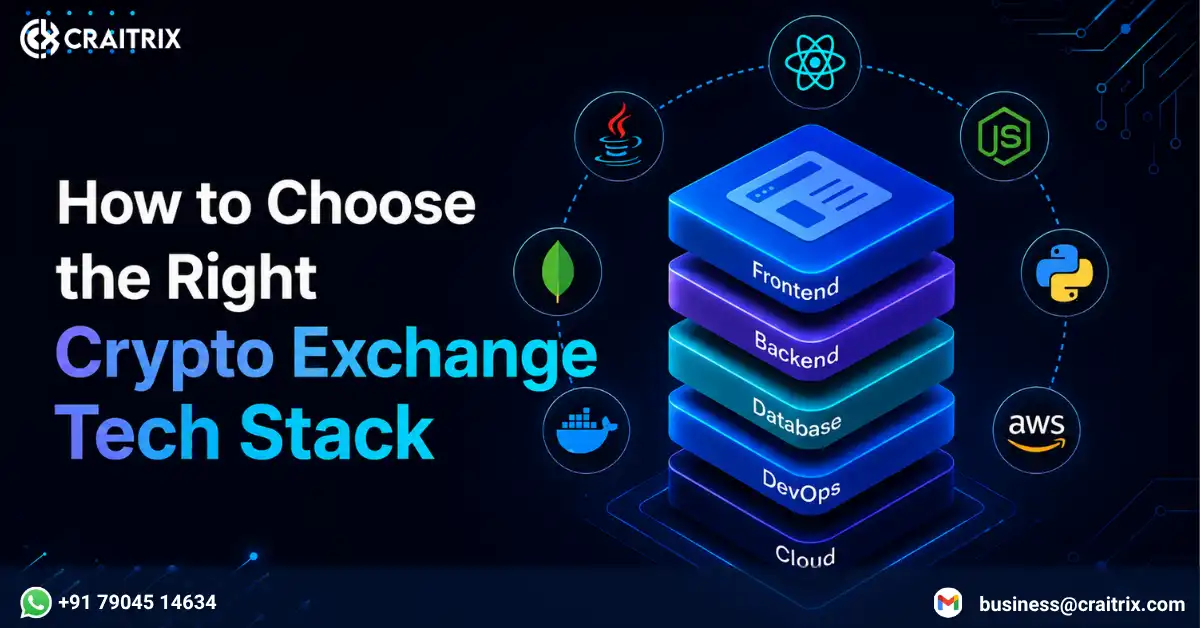
Building a scalable crypto exchange starts with choosing the right crypto exchange tech stack. The technologies powering the frontend, backend, matching engine, databases, blockchain infrastructure, wallets, APIs, security systems, and cloud environment directly affect trading performance, platform security, scalability, and long-term maintenance.
A well-planned crypto exchange technology stack helps exchanges handle high trading volumes, real-time market data, secure transactions, and growing user demand without creating unnecessary infrastructure bottlenecks. Whether you are developing a centralized exchange, decentralized platform, P2P marketplace, or hybrid trading platform, the technology architecture should align with your business model and future growth plans.
This guide explores the key technologies used to build a modern, scalable crypto trading platform in 2026.
What Is a Crypto Exchange Tech Stack?
A crypto exchange tech stack is the combination of programming languages, frameworks, databases, APIs, blockchain infrastructure, security tools, and cloud technologies used to build and operate a cryptocurrency trading platform. Each layer has a specific role, but they work together to process trades, manage user accounts, handle digital assets, and deliver real-time market information.
Core Layers of a Cryptocurrency Exchange Technology Stack
A typical cryptocurrency exchange technology stack includes:
- Frontend: Provides the trading interface, charts, order forms, dashboards, and account screens users interact with.
- Backend: Handles business logic, user management, trading operations, transactions, and API requests.
- Matching Engine: Matches buy and sell orders according to the exchange’s trading rules and execution logic.
- Database: Stores user information, balances, orders, transactions, and other operational data.
- APIs: Connect the frontend with backend services and enable integrations with wallets, liquidity providers, blockchain
networks, and external systems. - Blockchain: Supports deposits, withdrawals, transaction verification, and on-chain settlement.
- Wallet Infrastructure: Manages digital assets and protects private keys through technologies such as hot wallets, cold storage, MPC, or HSM-based security.
- Security: Includes authentication, encryption, access controls, monitoring, transaction controls, and infrastructure protection.
- Cloud and DevOps: Provides scalable infrastructure, deployment automation, monitoring, high availability, and disaster recovery.
Together, these components form the crypto exchange architecture that determines how efficiently and securely a trading platform can operate.
How Does a Crypto Exchange Technology Stack Work?
A crypto exchange technology stack connects multiple technical layers to process trades, manage digital assets, and deliver real-time market information. Each component performs a specific function while communicating with other services through APIs and internal systems.
From Trading Interface to Order Matching
The typical trading flow is:
User → Frontend → API → Trading Services → Matching Engine → Order Book → Database
A trader submits an order through the frontend. The API sends the request to backend trading services, where the matching engine evaluates it against available orders in the order book. Once matched, the trade is executed and the relevant balances and records are updated.
From Wallet Transactions to Blockchain Settlement
Blockchain transactions follow a separate flow:
Wallet → Transaction Validation → Blockchain Node → Confirmation → Exchange Ledger
When users deposit or withdraw crypto, wallet infrastructure processes the transaction through the relevant blockchain network. After validation and required confirmations, the exchange updates its internal ledger.
This architecture enables real-time trading, efficient order matching, blockchain settlement, and synchronized account records across the platform.
For businesses evaluating the complete process of how to build a crypto exchange, understanding how these technical layers work together provides an important foundation.
Core Technologies Used in Crypto Exchange Development
The core technologies used in crypto exchange development determine how efficiently a platform handles trading, user requests, market data, and large transaction volumes. A modern exchange typically combines frontend frameworks, backend languages, a high-performance matching engine, databases, caching systems, and event-streaming technologies.
Frontend Technologies for Crypto Trading Platforms
The frontend is responsible for delivering a responsive crypto trading interface where users can view charts, prices, order books, balances, and trading tools.
Common technologies include:
- React for dynamic trading interfaces
- Next.js for high-performance web applications
- TypeScript for maintainable application development
- Vue as an alternative frontend framework
Real-time market data can be delivered to the interface through WebSockets, allowing traders to receive price and order-book updates without repeatedly refreshing the page.
Backend Technologies and Programming Languages
The backend manages business logic, user accounts, trading operations, APIs, transactions, and integrations.
Popular crypto exchange programming languages include:
- Node.js – useful for API-driven and real-time applications
- Go – suitable for high-concurrency backend services
- Rust – valuable for performance-critical components
- Python – commonly used for supporting services and data processing
- Java – suitable for large-scale enterprise systems
- C++ – often considered for performance-sensitive trading infrastructure
The right choice depends on performance requirements, development speed, concurrency, and long-term maintainability.
Matching Engine and Order Book Technology
The crypto exchange matching engine is the core trading component responsible for matching buy and sell orders. It must support high concurrency, low latency, accurate order execution, and fault tolerance.
Its architecture typically includes:
- Order matching
- Order books
- Matching algorithms
- Order execution
- Low-latency processing
- Fault-tolerant services
Database, Cache and Event Streaming
Different workloads often require different data technologies.
PostgreSQL can manage transactional exchange data, while TimescaleDB can support time-series market information. MongoDB may be used for flexible data structures, and Redis provides fast caching and temporary data access. Kafka supports event-driven architecture and high-volume event streaming.
Separating transactional data, market data, caching, and event processing helps create a more scalable crypto exchange database architecture.
Blockchain, Wallet and Multi-Chain Technology
Blockchain and wallet infrastructure form a critical part of a crypto exchange technology stack, supporting deposits, withdrawals, transaction verification, and digital asset management. The technology choices depend on the assets and networks the exchange intends to support.
Blockchain Networks and Node Infrastructure
A multi-chain exchange may integrate networks such as:
- Bitcoin
- Ethereum
- BNB Chain
- Solana
- Polygon
- EVM-compatible networks
The platform can connect with blockchain nodes to monitor transactions, validate deposits, process withdrawals, and retrieve on-chain data. For exchanges supporting multiple networks, blockchain infrastructure helps manage different blockchain protocols and asset standards through a unified architecture.
Wallet and Key Management Technology
Wallet infrastructure protects user assets and supports secure deposit and withdrawal operations. Common approaches include:
- Hot wallets for operational transactions
- Cold wallets for offline asset storage
- MPC for distributed key management
- HSM for hardware-backed key protection
- Multisignature wallets for additional authorization controls
- Withdrawal controls to manage transaction risks
A well-designed crypto wallet technology layer should separate operational funds from protected reserves while applying appropriate key-management and transaction-security controls.
APIs, Real-Time Communication and Liquidity Technology
APIs and real-time communication technologies connect a crypto exchange with its frontend, trading services, blockchain infrastructure, liquidity providers, and external platforms. The right communication architecture helps deliver market data quickly while supporting reliable order execution and integrations.
REST, WebSocket and gRPC for Crypto Exchanges
Different communication methods serve different exchange requirements:
- REST API is commonly used for account operations, order management, and standard service requests.
- WebSocket enables continuous real-time delivery of prices, trades, order-book updates, and market data.
- gRPC can support fast communication between internal exchange services where performance and efficient service-to-service communication are important.
Together, these technologies form an effective crypto exchange API architecture for trading and platform operations.
Liquidity Aggregation and External Integrations
Exchanges can connect with liquidity providers, market makers, and external trading platforms through APIs. Liquidity aggregation can combine available liquidity from multiple sources to improve market depth and execution opportunities.
For institutional connectivity, exchanges may also integrate specialized trading APIs and FIX connectivity, depending on their infrastructure and market-participant requirements.
Security and Compliance Technology for Crypto Exchanges
Security should be built into the architecture of a crypto exchange from the beginning. A strong security layer protects user accounts, APIs, wallets, transactions, and infrastructure while reducing operational and financial risks.
Authentication, API and Infrastructure Security
Core security technologies and controls include:
- Two-factor authentication (2FA) for account protection
- Encryption for sensitive data
- API security to protect application endpoints
- Web Application Firewall (WAF) for application-layer protection
- DDoS protection against availability attacks
- Access controls for managing permissions
These controls create multiple security layers across the exchange and help strengthen overall crypto exchange cybersecurity.
Wallet, Transaction and Key Security
Digital asset security requires dedicated controls for keys and transactions. Exchanges can use MPC, HSM, and other key-management technologies to protect sensitive credentials. Transaction monitoring, withdrawal controls, and risk rules can help identify and restrict suspicious activity before funds are moved.
KYC, AML and Compliance Integrations
A compliant exchange may integrate:
- KYC verification
- AML monitoring
- Sanctions screening
- Blockchain analytics
- Transaction monitoring
These systems help exchanges evaluate users and transactions against applicable compliance requirements.
Regulatory requirements differ by jurisdiction, so legal and compliance requirements should always be verified against the latest applicable rules before implementation.
Cloud, DevOps and Scalability Stack
A reliable crypto exchange cloud infrastructure must support high availability, traffic growth, rapid deployments, and continuous monitoring. Cloud and DevOps technologies help exchanges scale resources while maintaining consistent platform performance.
Cloud Infrastructure for Crypto Exchanges
Common cloud platforms include:
- AWS
- Azure
- Google Cloud
Exchange infrastructure can use load balancing, distributed services, and high-availability configurations to handle growing traffic and reduce the impact of infrastructure failures.
Docker, Kubernetes and Microservices
Docker packages exchange services into consistent deployment environments, while Kubernetes can orchestrate containers across infrastructure.
A crypto exchange microservices architecture can separate services such as user management, trading, wallet operations, notifications, and market data. Auto-scaling allows resources to increase or decrease according to workload and traffic requirements.
Monitoring and Observability
Continuous monitoring is essential for identifying performance and infrastructure problems. An exchange should track:
- Metrics
- Logs
- Distributed tracing
- Alerts
- Performance indicators
- Disaster recovery status
Effective observability helps development and operations teams identify issues faster and understand how individual services affect the overall platform.
Together, cloud infrastructure, containerization, microservices, monitoring, and disaster recovery create a more resilient and scalable crypto exchange architecture.
CEX vs DEX vs P2P: How Does the Tech Stack Change?
The technology requirements of a crypto exchange vary significantly depending on its operating model. A CEX, DEX, P2P, or hybrid exchange requires a different combination of trading, blockchain, custody, and transaction technologies.
| Exchange Model | Primary Technology Focus |
| CEX | Matching engine, custody, APIs, centralized infrastructure |
| DEX | Smart contracts, blockchain, wallets, on-chain liquidity |
| P2P | Escrow, payment integrations, risk and dispute systems |
| Hybrid | Combination of centralized and blockchain infrastructure |
Centralized Exchange Technology Stack
A CEX tech stack typically prioritizes a high-performance matching engine, centralized databases, wallet infrastructure, APIs, security systems, and scalable cloud infrastructure. This architecture is central to centralized exchange development, where performance, custody, and centralized trading infrastructure are key considerations.
Decentralized Exchange Technology Stack
A DEX tech stack relies heavily on smart contracts, blockchain networks, non-custodial wallets, and on-chain liquidity. Trading logic and settlement can be executed through blockchain-based infrastructure, as required in decentralized exchange development.
P2P and Hybrid Exchange Technology
P2P exchange technology focuses on escrow mechanisms, payment integrations, user verification, dispute management, and risk controls. These requirements form the core of P2P crypto exchange development. A hybrid model combines centralized trading or services with blockchain-based components to provide greater architectural flexibility.
How to Choose the Right Crypto Exchange Tech Stack
Choosing the best crypto exchange tech stack should start with your business model, expected trading activity, security requirements, and growth plans—not simply the popularity of a programming language. The right architecture should support today’s requirements while leaving enough flexibility for future expansion.
Match Technology to Your Exchange’s Scale and Trading Requirements
Start by defining:
- Trading volume: Higher volumes require optimized matching and data-processing systems.
- Concurrent users: Growing user activity demands scalable backend and cloud infrastructure.
- Performance: Low-latency trading requires performance-focused services and real-time communication.
- Asset coverage: Multi-chain exchanges need flexible blockchain and wallet infrastructure.
- Security: Custody, authentication, transaction monitoring, and key management should be designed into the architecture.
Custom vs White-Label: Which Approach Fits?
Choose custom crypto exchange development when you need unique trading features, complete control, custom integrations, long-term scalability, or differentiated user experiences. A white-label solution can be more suitable when speed to market and initial cost efficiency are the priorities.
If your goal is to build a scalable platform around your specific business model, selecting the right development architecture is as important as selecting individual technologies.
Recommended Crypto Exchange Tech Stack for 2026
There is no single best crypto exchange tech stack for every business. However, the following reference architecture provides a practical starting point for a scalable trading platform:
| Layer | Example Stack |
| Frontend | React / Next.js + TypeScript |
| Backend | Go / Node.js |
| Matching Engine | Rust / C++ |
| Database | PostgreSQL + TimescaleDB |
| Cache | Redis |
| Messaging | Kafka |
| APIs | REST + WebSocket + gRPC |
| Blockchain | Multi-chain nodes + SDKs |
| Cloud | AWS / Azure / GCP |
| Infrastructure | Docker + Kubernetes |
| Security | MPC/HSM + encryption + WAF |
| Monitoring | Metrics + logs + tracing |
The final architecture should be adapted to the exchange model, trading volume, supported assets, security requirements, budget, and scalability goals rather than copied as a fixed stack.
Common Crypto Exchange Technology Stack Mistakes
Choosing technologies individually can create architectural problems when they are not planned around the exchange’s actual trading workload, security model, and growth targets.
Designing Only for the Initial Launch
A stack that works for an MVP may struggle when trading volume, concurrent users, assets, and market-data requests increase. Plan infrastructure around the platform’s expected growth rather than today’s traffic.
Adding Security After Development
Treating security as a final development phase can expose wallets, APIs, accounts, and transactions to unnecessary risk. Authentication, key management, transaction controls, encryption, and infrastructure protection should be built into the architecture from the start.
Using One Technology for Every Workload
Trading transactions, market data, caching, analytics, and event processing have different performance requirements. Separating these workloads helps prevent bottlenecks and improves scalability.
Choosing a Stack That Doesn’t Fit the Business Model
A CEX, DEX, P2P, and hybrid exchange require different infrastructure priorities. The technology stack should therefore be selected around the exchange model, trading requirements, security needs, and long-term growth strategy.
Future Trends Shaping Crypto Exchange Technology in 2026 and Beyond
Crypto exchange architecture is evolving beyond basic trading infrastructure as exchanges adopt more intelligent risk systems, multi-chain capabilities, institutional connectivity, and new digital asset infrastructure.
AI-Powered Risk Detection and Trading Infrastructure
AI can support fraud detection, anomaly monitoring, risk analysis, and trading infrastructure, helping exchanges identify unusual activity and respond faster to potential threats.
MPC Custody and Multi-Chain Infrastructure
MPC custody and multi-chain infrastructure are becoming increasingly important for exchanges managing assets across multiple networks. Cross-chain capabilities can also support broader asset coverage and interoperability.
Institutional APIs, Real-Time Analytics and Cloud-Native Systems
Institutional-grade APIs, real-time analytics, advanced observability, and cloud-native architecture can help exchanges deliver more reliable and responsive trading infrastructure.
Tokenized Assets and Next-Generation Exchange Infrastructure
The growth of tokenized real-world assets (RWA) introduces new requirements for custody, settlement, compliance, and multi-asset support. Exchanges planning for these markets may need more flexible digital asset infrastructure.
The key shift: Future-ready exchanges will need architectures that can adapt as trading models, asset classes, security requirements, and user expectations evolve.
For exchange founders: Choosing an adaptable technology foundation today can reduce costly architectural changes as the platform expands into new markets and capabilities.
Conclusion
A crypto exchange is only as strong as the architecture connecting its critical systems. The right technology decisions should translate into faster order execution, dependable wallet operations, reliable liquidity connectivity, stronger security, and infrastructure that can handle growth without constant redesign.
If you are planning cryptocurrency exchange development, Craitrix can help turn your technical requirements into a functional trading platform. From exchange architecture and trading infrastructure to wallet integration, blockchain connectivity, liquidity, security, and scalability, the platform can be structured around your business model and prepared for future expansion.
Frequently Asked Questions
Q1. What is a crypto exchange tech stack?
Ans: A crypto exchange tech stack is the combination of technologies used to build, operate, secure, and scale a cryptocurrency exchange.
Q2. What technology is used to build a crypto exchange?
Ans: A crypto exchange typically uses React or Next.js, Go or Node.js, PostgreSQL, Redis, Kafka, REST/WebSocket APIs, blockchain nodes, wallets, and cloud infrastructure.
Q3. Which programming language is best for a crypto exchange?
Ans: There is no single best programming language; Go, Rust, C++, Node.js, Python, and Java can be selected based on performance, scalability, and maintainability requirements.
Q4. What database is best for a cryptocurrency exchange?
Ans: PostgreSQL is a strong choice for transactional data, while Redis, TimescaleDB, MongoDB, and Kafka can support caching, market data, flexible data, and event-streaming workloads.
Q5. What technology is used for a crypto exchange matching engine?
Ans: A crypto exchange matching engine commonly uses performance-focused technologies such as Rust or C++ to support low-latency order processing and high throughput.
Q6. What is the difference between a CEX and DEX tech stack?
Ans: A CEX uses centralized infrastructure, matching engines, databases, APIs, and custody systems, while a DEX relies primarily on smart contracts, blockchain networks, wallets, and on-chain liquidity.
Q7. How much does the tech stack affect crypto exchange development cost?
Ans: The tech stack can significantly affect development cost because scalability, security, blockchain integrations, infrastructure, and system complexity determine the overall development scope.