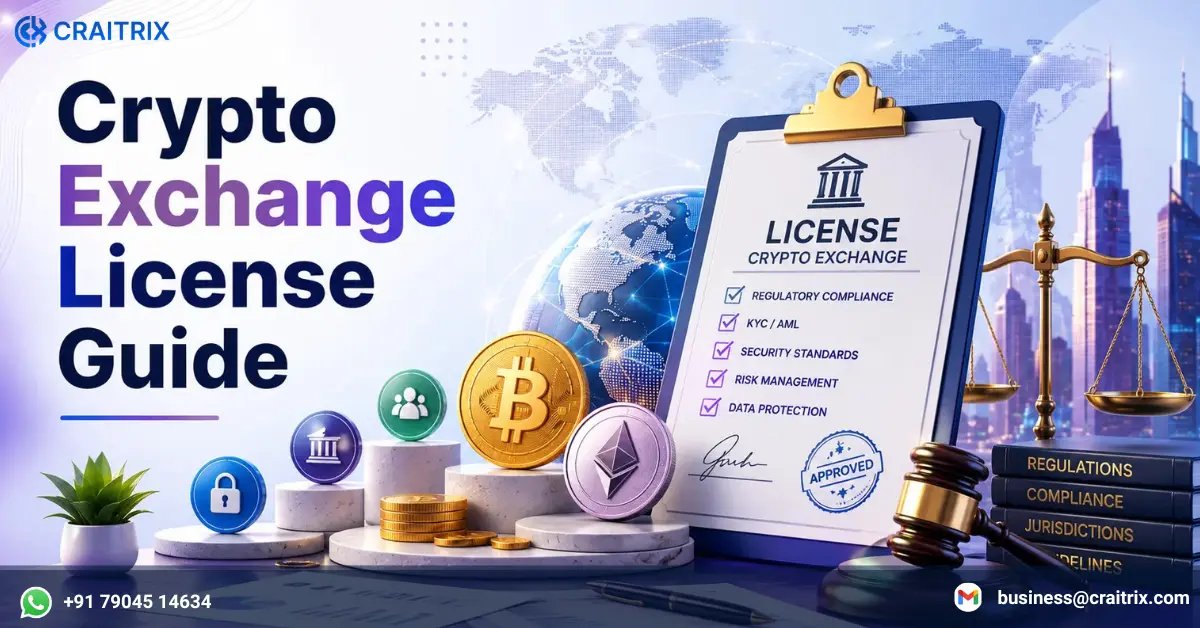
Running a crypto exchange without a license is no longer an option. Regulators across the USA, UAE, UK, Europe, and Singapore now require formal licensing before you launch. The global cryptocurrency market capitalization reached approximately $3.4 trillion in 2025, underscoring the accelerating adoption of crypto assets worldwide. An uptrend like that has led to governments following stringent rules of crypto regulatory compliance and keeping you in tune with them.
The licensing jurisdiction you choose defines your whole business from the start. Your jurisdiction defines which banks you can work with, how much your users will trust you, how wide you can operate, and how your business will grow in the future.
This complete blog is all you need to know about a crypto exchange license. It is here. You will know about license types, country comparisons, costs, VASP license criteria, AML requirements, KYC rules, and the licensing process.
What is a Crypto Exchange License?
A crypto exchange license is a form of state regulatory approval. It permits a company to run a cryptocurrency trading platform legally. It is granted by authorities to maintain AML compliance, financial security, and safeguards for users.
Not all crypto activities of the same type will require the same license. But many activities that generate revenue, engage users, or carry out their activities with the public will require regulation.
| Activity | License Required |
| Spot trading platform | Crypto exchange license or VASP license |
| Crypto brokerage services | Broker-dealer or VASP registration |
| Custodial wallet services | Custody license or VASP approval |
| Fiat on/off ramp | Money transmission or MSB license |
| OTC trading desk | VASP or financial intermediary license |
| Crypto payment processing | Payment institution or MSB license |
| Staking-as-a-service | Varies by jurisdiction; often VASP-covered |
| Derivatives and futures trading | Securities or derivatives trading license |
Thus, any platform handling user funds needs formal licensing; skipping this step leads to serious legal and financial consequences.
Crypto Exchange License vs. VASP Registration vs. Money Service Business (MSB)
While they might look similar, these 3 structures are actually very different in what they do. You will have to see which applies according to your business class and target market.
| Type | What It Covers | Who Needs It | Key Regulator |
| Crypto Exchange License | Full exchange operations, trading, custody | Exchange platforms | FCA, MAS, VARA, ADGM |
| VASP Registration | Broad virtual asset services under FATF rules | Any crypto service business | National financial regulators |
| MSB (Money Service Business) | Fiat conversion, payment processing | Fiat gateway and payment businesses | FinCEN (USA), FINTRAC (Canada) |
A VASP license covers the broadest range of crypto services globally. An MSB registration focuses mainly on fiat money movement. A full crypto exchange license gives you the most operational scope but requires the most compliance effort.
Understanding which framework applies saves time, money, and legal risk early on.
Types of Crypto Exchange Licenses
Crypto exchange licenses are not all created equal. Your intended license will be a direct result of the services you plan to offer. Selecting the appropriate license type will keep your crypto business legally protected from day
Spot Crypto Exchange License
This Spot Trading Crypto Exchange license authorizes the platforms to offer direct buying and selling of crypto. It needs a full KYC, AML realization, and authorization.
Custodial Wallet License
The license is for platforms that hold or control cryptocurrencies on your behalf. Regulators feel there are stringent requirements for custody, risk management, and capital reserve requirements.
Crypto Brokerage License
Applies to businesses that execute crypto transactions for clients, whether retail or institutional, including OTC trading, protection of client funds, and compliance officer rules.
Crypto Payment Service License
Permits businesses to process crypto payments and conduct business with a fiat gateway legally. The same applies to the FATF Travel Rule and money transmission rules.
Crypto Derivatives Exchange License
For platforms regulated to provide legal futures, options, and leverage crypto trading products, this license applies. Securities regulators such as the SEC or FCA impose capital requirements here.
Multi-Service Virtual Asset Service Provider (VASP) License
One VASP license key lets multiple virtual asset services operate with a single regulatory approval. It should meet FATF requirements for trading custody, staking, and fiat gateway services.
Selecting the right license type as early as possible will save considerable time, expense, and legal risk later on.
Why Crypto Exchange Licensing Matters for Your Business
Rather, a crypto exchange license is a strategic investment in your business. It determines whether you can access banking, persuade investors, and win user trust. Licensed crypto exchanges grow faster and scale globally with hardly any friction.
Business Benefits of Becoming a Licensed Crypto Exchange
Licensing will build customer confidence, provide banking access, bring institutional investors, and create opportunities to develop worldwide partnerships for your exchange.
Risks of Operating Without a Crypto Exchange License
Unlicensed exchanges are subject to fines or forced shutdowns, refusal of banking services, and long-term damage to their reputation by financial services regulators across the globe.
Having the right licenses in place protects your business and lays the groundwork for sustainable global expansion.
Country-by-Country Crypto Exchange Licensing Guide
Different countries have varying laws and costs, and, in some cases, how long their regulators take to give you the green light.
Key Crypto Regulatory Authorities Around the World
Various countries have adopted different authorities to regulate crypto assets, almost like securities, so that safe market operations can be ensured. Examples of such authorities are VARA, MAS, and SEC.
European Union (MiCA Framework)
The MiCA regulation offers a single VASP license, which allows businesses to readily operate, and cross-border passporting rights are preserved in all 27 EU member states.
Dubai (VARA)
Dubai’s crypto regulatory body, VARA, has rolled out a complete legal structure, making it one of the best choices to set up a crypto business globally in a modern environment.
Abu Dhabi (ADGM)
The ADGM is a financial center that extends world-class facilities and outstanding legal setups for digital asset exchange businesses geared towards institutional clients.
Singapore (MAS)
Being a license holder of MAS is a hallmark of global credibility; your company is subjected to strict but reasonable fiat-to-crypto compliance standards.
Hong Kong (SFC)
SFC’s role is to put in place protection measures for investors that are of international standards. This has attracted a wide base of institutional market players in the Asian region.
Lithuania
Lithuania is a great, cost-efficient point of entry for crypto startups that want to adapt and comply fully with EU-wide rules and regulations.
Estonia
Estonia, because of its high standards and quality requirements, poses a challenge to getting a license, as it demands quite a lot of capital and also the assessment of risks locally.
Australia (ASIC)
The ASIC structure is aimed at the requirement of crypto registration with a significant emphasis on consumer protection, as well as making the local market transparent.
Canada (FINTRAC)
Register with FINTRAC for mandatory transaction tracking to ensure rigorous compliance with Canadian AML compliance laws.
United States (FinCEN, SEC & State Regulators)
In order to operate here, you need money transmission licenses as well as strict Federal registration with FinCEN and the SEC.
The choice of your preferred jurisdiction will determine how much your initial investment, your interaction with the banking system will occur, and how successful you will be globally from a regulatory perspective over the long term.
| Jurisdiction | Primary Regulator | Estimated Timeline | Relative Cost | Banking Support | Best For |
|---|---|---|---|---|---|
| European Union (MiCA) | National Competent Authorities (MiCA Framework) | Moderate | Medium | Excellent | EU-Wide Expansion & Cross-Border Operations |
| Lithuania | Financial Crime Investigation Service (FCIS) | Fast | Low | Good | Startups & SMEs |
| Estonia | Financial Intelligence Unit (FIU) | Moderate | Medium | Good | Compliance-Focused Crypto Businesses |
| Dubai | Virtual Assets Regulatory Authority (VARA) | Moderate | Medium | Excellent | International Exchanges |
| Abu Dhabi | Abu Dhabi Global Market (ADGM) – FSRA | Moderate | Medium-High | Excellent | Institutional Platforms |
| Singapore | Monetary Authority of Singapore (MAS) | Longer | High | Excellent | Enterprise Businesses |
| Hong Kong | Securities and Futures Commission (SFC) | Moderate | High | Excellent | Asian Market Expansion |
| Switzerland | Swiss Financial Market Supervisory Authority (FINMA) | Moderate | High | Excellent | Institutional Investors & Digital Asset Firms |
| Canada | Financial Transactions and Reports Analysis Centre of Canada (FINTRAC) | Moderate | Medium | Good | North American Expansion |
| Australia | Australian Securities and Investments Commission (ASIC) | Moderate | Medium | Good | Regional Businesses |
| United States | FinCEN + State Regulators | Long | High | Strong | US Market Entry |
How to Choose the Right Crypto Exchange Licensing Jurisdiction
Selecting the best crypto exchange licensing jurisdiction will increase compliance, cut costs, help you obtain banking, and reaffirm your global long-term business.
| Criteria | Best Choice | Why It Matters |
| Cost | Lithuania | Lower licensing and operational costs make it ideal for startups with limited budgets. |
| Licensing Timeline | Lithuania | Faster approvals help businesses launch sooner and enter the market quickly. |
| Capital Requirement | Lithuania | Lower capital requirements reduce financial barriers for new crypto exchanges. |
| Tax Benefits | UAE (VARA/ADGM) | Business-friendly tax policies help maximize profits and support long-term growth. |
| Banking Support | Singapore, Switzerland, UAE | Strong banking relationships simplify fiat gateways, payments, and business operations. |
| Compliance Complexity | Lithuania, Canada | Moderate compliance requirements make regulatory management easier for growing exchanges. |
| Global Reputation | Singapore, Switzerland, UAE | Well-known regulatory frameworks increase investor confidence and international business credibility. |
| Best for Startup Crypto Exchanges | Lithuania, Estonia, Canada | Affordable licensing, faster approvals, and simpler compliance support startup growth. |
| Best for Enterprise & Institutional Exchanges | Singapore, Switzerland, UAE | Advanced regulations attract institutional investors and support large-scale exchange operations. |
| Best for Global Expansion | UAE, Singapore, Switzerland | International recognition makes cross-border licensing and business expansion more efficient. |
| Best for DeFi & Hybrid Exchanges | Switzerland, UAE | Progressive regulations better support innovative blockchain, DeFi, and hybrid exchange business models. |
Eventually, the right licensing jurisdiction combines entering compliance, cost scale, banking connectivity, and worldwide chances well together to lay the great groundwork for a consistent crypto exchange success.
Step-by-Step Process to Get a Crypto Exchange License
Obtaining a license for a cryptocurrency exchange involves various requirements, documentation, and meticulous regulatory steps. Check out the following licensing process that covers how to get the approval your crypto exchange needs.
Choose the Right Licensing Jurisdiction
Analyze the costs of crypto licenses, different legal frameworks, and access to target markets before choosing a suitable jurisdiction where you will receive your license.
Register Your Legal Business Entity
For the purposes of cryptocurrency licensing in any of your selected countries, you must establish the legal existence of your crypto entity before the licensing procedure starts.
Prepare AML, KYC, Compliance, and Risk Management Policies
Establishing sound anti-money laundering and know your customer policies, in addition to creating internal policies about risk assessment and establishing a role for the compliance officer before submitting a license application, is imperative.
Develop Your Business Plan and Financial Documentation
For your crypto exchange to be considered for approval by a relevant regulatory body, you should also have a detailed business plan with financial forecasts, proof of reserves, and other operational documents in order.
Submit the License Application
After you have gathered all the necessary documentation, submit a completed application for a crypto exchange license to the relevant authority in your jurisdiction.
Regulatory Review, Due Diligence, and Approval
A comprehensive background check, due diligence, and thorough analysis of your compliance measures will be performed by regulators, and eventually, a positive outcome will be delivered.
Launch and Maintain Your Licensed Crypto Exchange
Once the application has been processed and approved, you should make sure that the operational business operations comply with AML, KYC, and reporting requirements on a permanent basis.
By adhering to this licensing strategy, the path to compliant and legal operation of a crypto exchange is straightforward.
Documents Required for Crypto Exchange Licensing
Having fully prepared licensing documents not only makes it easier to get a green light from the regulator but also shows your operations are ready, builds compliance, and earns the trust of the financial authorities across the globe.
Company Incorporation Documents
Company incorporation documents are essential to obtain crypto exchange licensing. These papers show the legal business registration, company structure, proof of the company’s existence, and eligibility for licensing approval.
Shareholder, Director, and Ultimate Beneficial Owner (UBO) Information
It is a transparency measure from the regulators to check shareholders, directors, and UBOs. This verification also helps in controlling ownership that is hidden and crimes related to finances.
AML and KYC Policies
Explicit AML compliance and KYC verification policies show that your company effectively screens customers, controls transactions, and complies with regulatory demands.
Business Plan and Revenue Model
Through a comprehensive business plan, you can describe the functioning of your cryptocurrency exchange, the markets you will address, the means of revenue, strategies for growth, and how you intend to keep the business going.
Financial Projections and Capital Adequacy
By looking at financial forecasts, one can get an idea of the business’s strength, the availability of funds, operational sustainability, and having enough capital to meet regulatory compliance requirements.
Information Security and Risk Management Framework
Your security and risk management setup means you have security measures in place to protect customer’s assets. Besides reducing cyber threats, it ensures compliance and operational resilience.
Cryptocurrency licensing-related documentation that is well-prepared will be a big plus when it comes to obtaining approvals, reducing complexity during compliance reviews, minimizing regulatory waiting times, and supporting the successful introduction and growth of your cryptocurrency exchange.
What Factors Affect Crypto Exchange License Approval?
As one starts to operate their cryptocurrency exchange legally, regulators review tons of business-related, financial, and compliance factors when a crypto exchange license is being considered.
Shareholder and Management Background Checks
One of the things that regulators do is to check the background of shareholders and management. They look at their personal qualities, like their trustworthiness and honesty, as well as their experience and if they have been involved in any legal issues.
Source of Funds Verification
It is a must for applicants to show evidence that the money used for investment is from legitimate, transparent, and legally verifiable sources of finance.
Compliance Team Expertise
Experienced compliance developers help to build trust among regulators through the deployment of effective AML compliance, KYC verification, and risk management procedures.
Cybersecurity and Technology Infrastructure
Having top-notch cybersecurity facilities is a must, mainly when it comes to guarding customer resources, securing transactions, and preventing breaches. And the infrastructure must meet the regulatory requirements for security.
Financial Stability and Capital Requirements
Having ample capital and financial capability is one of the main ways to show that the company is sustainable in the near future, that it is resilient, and the customers’ funds will be safe.
Following the regulations helps exchange license approval, reduces delays, establishes compliance, and creates long-term trust for crypto businesses.
Crypto Exchange Licensing Costs and Timelines
Understanding crypto exchange licensing costs and timelines allows companies to appropriately set their budgets, be sure of their compliance, and launch crypto exchanges with no unnecessary delays.
Government Licensing Fees
License fees charged by different governments vary according to the jurisdiction, the scope of crypto exchange licensing, the regulatory authority, and the business model of the company.
Legal, Consulting, and Advisory Costs
Lawyers and compliance advisors help with crypto regulatory compliance, getting the required documents ready for approval, and the licensing process.
Technology, Infrastructure, and Compliance Costs
Technological expenses involve trading systems, cybersecurity, AML compliance, KYC verification, and other digital asset infrastructure requirements.
Estimated Licensing Timelines by Country
The length of the license process depends on the country, the financial regulator, the quality of the application, the readiness for compliance, and the complexity of the regulatory review.
Proper budgeting and setting achievable timescales for licensing will help to eliminate surprises, lower expenses, and speed up compliant crypto exchange introduction to the market.
| Expense Category | Description |
|---|---|
| Government Licensing Fees | Regulatory application and approval charges |
| Company Incorporation | Business registration and legal entity formation |
| Legal & Compliance Consulting | Licensing preparation and legal advisory |
| AML Software | Transaction monitoring and sanctions screening |
| KYC Verification | Identity verification providers |
| Cybersecurity Infrastructure | Security controls, penetration testing, infrastructure |
| Technology Development | Trading engine, wallet integration, APIs |
| Insurance | Professional liability and cyber insurance (where applicable) |
| Annual Renewal Fees | Ongoing regulatory maintenance |
Ongoing Compliance Requirements After Licensing
Being licensed is just the start of your journey to staying compliant with crypto regulation.
To keep your crypto exchange licensed, you need to be constantly monitoring, reporting, and staying compliant with crypto regulations every day.
AML Monitoring and Suspicious Activity Reporting
Licensed exchanges are required to closely scrutinize each transaction and alert appropriate financial authorities if they come across any suspicious activity.
Continuous KYC Verification
Crypto exchanges will need to self-verify their user’s identity regularly to adhere to ever-changing KYC verification regulation standards.
FATF Travel Rule Compliance
It is required that all authorized exchanges submit sender and recipient details for each eligible virtual asset transaction
Transaction Monitoring Systems
Monitor for transactions inconsistent with the normal course of customer activity, suspicious activity, or potentially related to money laundering; they must be detected immediately.
Regulatory Reporting and Record Keeping
Registered crypto exchanges are required to submit periodic compliance reports and retain comprehensive records of their transactions.
Independent Compliance Audits
Periodic third-party audits assure that your exchange is fully AML compliant, KYC compliant, and license authority compliant.
Ongoing compliance helps to preserve your license, your user’s funds, and your long-term crypto business reputation throughout the world.
| Frequency | Compliance Activity |
|---|---|
| Daily | Transaction monitoring and sanctions screening |
| Weekly | Internal compliance reviews |
| Monthly | Risk assessment and reporting |
| Quarterly | Policy updates and employee training |
| Annually | Independent compliance audit and regulatory review |
Common Mistakes Made When Applying for a Crypto Exchange License
To help you stay one step ahead of global financial regulators and ensure you don’t face unnecessary delays or rejections, here is a list of typical errors that applicants make, and you should avoid them.
Choosing the Wrong Licensing Jurisdiction
Just going for a licensing region without figuring out where your target customers are would not only lead you to spend a lot of money but also end up with regulatory requirements that don’t align with your business model.
Ignoring Banking and Payment Infrastructure Requirements
Being a licensed VASP will not help much if the local banks reject your essential plan of integrating a fiat gateway.
Weak AML, KYC, and Compliance Documentation
Providing the authorities with shallow policies will result in an automatic rejection of the VASP license application during its stringent review process.
Underestimating Long-Term Compliance Costs
Apart from the salaries of a qualified compliance officer and internal audit teams, there are other indirect costs connected to compliance that startups often overlook.
Correcting these errors from the very beginning to have a smooth time with crypto regulatory compliance and ensure your business is not at risk.
Launch Your Licensed Crypto Exchange with Expert Guidance
Launching a licensed crypto exchange is not just a matter of submission of regulatory documents. It is about having the right blend of knowledge, development, and licensing support through each stage. Our team guides you in making a decision on the licensing jurisdiction, AML and KYC compliance document preparation, and understanding and handling complicated crypto exchange regulations. We develop crypto exchange platforms that fit your specific target market. We are knowledgeable in every step of the way, from VASP license application to obtaining a regulatory approval, and will handle yours efficiently. Post-launch, we are also offering technical support and transaction monitoring systems, as well as continuous crypto regulatory compliance management. Work with us to reduce your time to market and have a legally protected, investor-ready crypto exchange launched in 2026
Frequently Asked Questions
Q1. Which country is the easiest to obtain a crypto exchange license?
Ans: Lithuania is frequently recognized as the easiest country for the crypto licensing process since it has comparatively lower licensing fees, approval timelines are shorter, and the licensing conditions for a crypto exchange are simple.
Q2. How much does a crypto exchange license cost?
Ans: The price depends on the country and usually covers thousands to hundreds of thousands of dollars. It depends on the license legal compliance, and infrastructural needs.
Q3. How long does it take to get a crypto exchange license?
Ans: On average, getting an agreement can take 1 to 12 months. It depends on the country, the quality of the submitted documents, the regulatory review process, and readiness for compliance.
Q4. Can one crypto exchange license be used globally?
Ans: No. Most crypto exchange licenses are only valid within the geographic area of the issuing authority, so additional permissions must be obtained for running the operations outside of the country.
Q5. What is the difference between a crypto exchange license and VASP registration?
Ans: A crypto exchange license permits the handling of exchange activities, while a VASP registration covers a wider range of virtual asset-service providers as per local laws.
Q6. Is MiCA mandatory for crypto exchanges operating in Europe?
Ans: Definitely. MiCA is the crypto regulation that harmonizes the rules for crypto-businesses within the area of the European Union member states balanced by eligibility.
Q7. Do decentralized (DeFi) crypto exchanges require a license?
Ans: That really depends on the legal structure of the locality, the design of the platform, custody model, and whether regulated financial services are provided to users.
Q8. Can startups obtain a crypto exchange license with limited capital?
Ans: Definitely. Certain countries have implemented startup-friendly licensing programs with fewer capital criteria and reduction of compliance obligations for qualifying businesses.
Q9. What happens if a crypto exchange operates without a license?
Ans: The consequences of non-licensed operation include fines prosecution business limitations, banking difficulties, and loss of customer confidence.
Q10. Which crypto licensing jurisdiction is best for international expansion?
Ans: UAE, Singapore, and Switzerland are famous for their top-notch regulatory structures, excellent access to banking, and are great supporters of international crypto business.
Q11. Which crypto exchange license offers the fastest approval process?
Ans: Lithuania is the one that normally grants the fastest approvals process if all regulated requirements are met successfully with proper documents.
Q12. What is the minimum capital required to obtain a crypto exchange license?
Ans: In different countries where the licensing is issued, the requirements differ greatly in regard to capital; the type of business and the services that the exchange brings also play roles.
Q13. Can one company hold multiple crypto exchange licenses?
Ans: That is very possible. It is a practice of many worldwide exchanges to procure many licenses to operate in different countries and regulatory jurisdictions with ease.
Q14. How often must licensed crypto exchanges undergo compliance audits?
Ans: Annual compliance audits are a standard requirement for most regulators; yet, based on regulatory risk assessment, some jurisdictions might require more frequent reviews.