Ever wondered how digital marketplaces process billions of global transactions with millisecond accuracy? Learning how to start a crypto exchange is the key to entering this high-stakes financial frontier. With digital assets becoming one of the foundations of the economy, these exchanges act as crucial intermediaries that connect investors worldwide to a market expected to hit $85 billion by 2026.
Starting a trading platform benefits from that unprecedented flow of transactions and the clarity of regulations emerging across the globe on the other hand. If you stick to a certain development roadmap, you’ll be able to come up with a safe, efficient platform that offers a variety of trading pairs and sufficient liquidity.
Our comprehensive guide is designed to help you at every step of the way. It not only covers everything that one should know when starting a crypto exchange but also shares tips on how to make the most of this highly profitable opportunity.
Why is Crypto Exchange Development Essential in 2026?
Crypto exchange development is the process of building a digital platform for users to buy, sell & trade. It includes everything from matching engine and wallet systems to KYC compliance tools. The total market value of cryptocurrencies worldwide is $3.4 trillion. Trading volumes on a daily basis are over $150 billion.
Regulations such as the EU’s MiCA framework, Dubai’s VARA, and Singapore’s MAS licensing are finally offering business people a clear, well-organised way to operate legally. So for any fintech entrepreneurs who are looking at how to start the crypto exchange development process in 2026, now is the best time.
Legal Requirements for Starting a Cryptocurrency Exchange
Getting the legal foundation right isn’t optional, is it necessary to build a crypto exchange. Here’s everything your crypto exchange needs to stay compliant, trusted, and operational globally.
Global Licensing: US MSB, EU MiCA & VASP
To operate in a legal manner, you need a licence. To create a crypto exchange in the US, you need Money Services Business (MSB) registration. The EU expects the compliance of groups falling under the scope of Markets in Crypto-Assets (MiCA). Most of the world sees VASP (Virtual Asset Service Providers) as the benchmark for crypto business regulations.
KYC and AML Compliance
It’s a must for an exchange to identify its users and track their transactions. KYC and AML are two compliance frameworks that handle the identity of customer profiling. And tracking their financial transactions with the purpose of preventing their use for money laundering and terrorist financing.
Data Protection: GDPR, Privacy Policies and User Data
It’s a legal requisite to use personal data in a responsible way. Through strict enforcement of the General Data Protection Regulation (GDPR), the European Union (EU) governs the processing of their personal data. Apart from that, your exchange will always need a privacy policy.
Choosing the Right Jurisdiction for Your Exchange
Three jurisdictions that offer crypto-friendly licensing are Dubai’s VARA, Singapore’s MAS, and Estonia’s FIU. Your decision will have a huge impact on taxes, compliance costs as well as market access. So make a strategic choice right from the first day. Not doing the legal work is the most sure and quickest way to kill your project.
| Rank | Jurisdiction | Regulator | License Time | Approx. Cost | Key Strength |
| 1 | Georgia | NBG | Fast | Low | 0% retained earnings tax |
| 2 | Seychelles | FSA | 3-6 months | Low | Offshore flexibility |
| 3 | Canada | FINTRAC | 4-6 months | Medium | Institutional trust |
| 4 | St. Vincent | FSA | Fast | Low | No local presence |
| 5 | Poland | KNF/MiCA | Varies | Medium | EU passporting |
| 6 | Dubai (UAE) | VARA | 2-12 months | AED 85k+ | Global credibility |
| 7 | Mauritius | FSC | 3-6 months | Low | Tax exemptions |
| 8 | Cayman Islands | CIMA | Fast | Low | No min capital |
| 9 | El Salvador | CNAD | 3-6 months | $2k capital | Bitcoin hub |
| 10 | Estonia | FIU/MiCA | Varies | €12k+ | EU-wide access |
Therefore, get a licence, be compliant with the law, and build the trust of users. These are the elements that an exchange is solely dependent on for its success in the long run.

How to Start a Crypto Exchange in 2026- 7 Proven Steps
To successfully launch a crypto exchange, you need to plan, strategise, think about the legal issues, and build your platform from scratch. This is a step-by-step guide to building your own cryptocurrency exchange in 2026.
1. Plan Your Business Model & Market
Every successful crypto exchange begins with a plan, not code. You have to figure out what kind of platform you are making and who it is for. Centralized exchanges let you manage the order book, and decentralized ones run on smart contracts. Hybrids mix both. Each path brings different legal, technical, and financial demands. Pick your market too – retail users, institutions, or a certain region. The sharper the focus, the simpler your product choices, marketing strategy, and legal paperwork become.
- But you can’t skip defining your exchange type, CEX, DEX, or hybrid, it depends on your tech skills and user base.
- Your niche matters maybe it is a specific country, a type of asset like spot trading or NFTs, or a particular group of users.
- Revenue comes from trading fees, listing charges, withdrawal costs, or premium memberships. Look at Binance and coinbase closely – also regional players – to see where gaps exist.
- Set a budget that fits reality and a time to build a crypto exchange that doesn’t stretch beyond 18 months to launch.
Most exchanges take six to eighteen months from start to production-ready launch. That’s when you stop testing and begin scaling.
2. Review Regulations and Get Licensed
In 2026, regulators worldwide tightened their control over crypto platforms. The EU’s MiCA regulation has been implemented in all member states. VASP (Virtual Asset Service Provider) registration is a requirement in most countries if you want to legally onboard users and handle fiat currencies. Getting your license early is not only about avoiding penalties; it is what gives you the opportunity to collaborate with banks, payment processors and gain genuine user trust. A licensed exchange is a trustworthy exchange. Failure to obtain a license doesn’t save time. It only postpones a much bigger and more costly problem.
- VASP registration a must in the EU, UK, UAE, Singapore, and most major markets
- MiCA compliance compulsory if you intend to cater to any European users after 2024
- KYC and AML systems automated identity verification is nowadays a standard requirement.
- Data privacy laws GDPR in Europe, state laws in the US, and local equivalents worldwide
- Crypto-friendly jurisdictions Dubai (VARA), Lithuania, and Seychelles offer faster, cleaner licensing paths
3. Determine Your Exchange Features
Build only what your users really want at launch, then grow from there. One of the most costly mistakes when building a crypto exchange is to go all-in from the beginning. On your first day, you do not require every feature. What you need are the right features that your specific audience really expects, ones that make trading feel quick and secure, and ones that encourage users to return.
You should start with a robust core: spot trading, wallet management, order types, and KYC flows. Afterwards, you can introduce features such as staking, margin trading, and API access once you have concrete user data to help you decide. A feature is supposed to be a solution to a user problem rather than a way to showcase your company to potential investors via a pitch deck.
- Spot trading
- Order types
- Wallet system
- KYC/AML
- Fiat-on ramp
- Mobile app
- Staking
- Admin dashboard
- API access
- 2FA security
- Referral system
4. Develop Platform Architecture
Crypto exchange architecture is where you build the trading platform. And where the majority of teams either set up themselves for long-term success or unknowingly plant the seeds of their future failure. You have two primary choices, custom development, where your team builds everything from scratch, or a white-label exchange solution, where you begin with a proven base and customize it. Custom gives you complete flexibility and a unique product but takes more time and money. White-label allows you to get to market faster with smaller initial risk.
- Custom development full control, unique architecture, higher cost great for well-funded teams with a technical edge.
- White-label solution quicker to market, cheaper initially, dominated by provider’s underlying framework
- Matching engine the heart of your exchange; it needs to be capable of processing thousands of orders per second without any delayCold wallet storage user funds must be held mostly (90%+) in cold storage, not in hot wallets
- Multi-sig wallets require multiple authorisations for large withdrawals to reduce single-point-of-failure risk
- Scalable cloud infrastructure uses AWS or GCP with auto-scaling so traffic spikes do not take you down
- A third-party security audit is mandatory before launch, and again at least once per year
5. Tech Stack
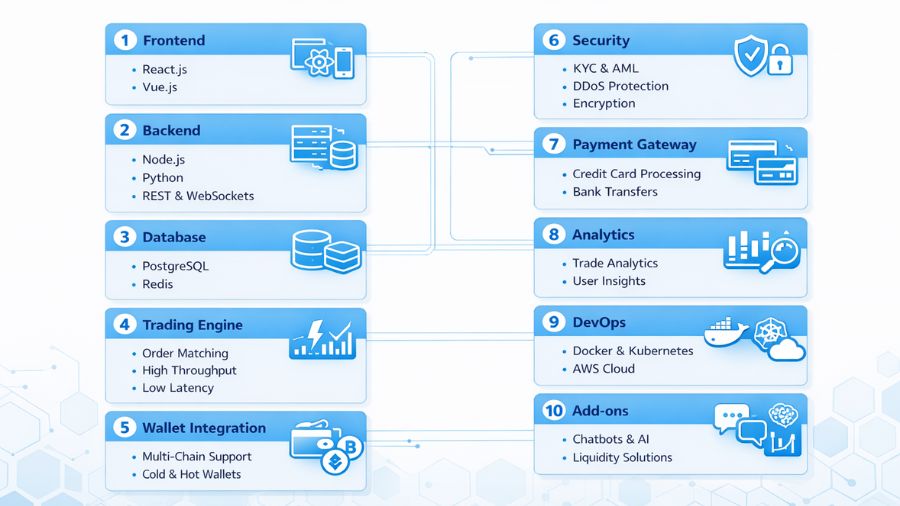
Choosing the right tech stack is a critical decision development teams make. Incorrect decisions not only result in degraded performance but also expose one to security risks and later require costly rewrites. The top crypto exchanges that are operating at a production level are relying on proven technologies known for speed, security, and developer experience. Your tech stack must include the front end that users interact with, the back end that handles trading operations, the blockchain component that facilitates on-chain activities, and the database and infrastructure layers that support scaling. Here is the main technology set of the industry’s leading platforms that we are reviewing at the moment.
- Front end includes React.js or Next.js for fast, component-based, and SEO-friendly for public pages
- Back end includes Node.js (high concurrency) or Go (ultra-low latency for trading engines)
- Trading engine
- C++ or Rust for the matching engine, performance at this layer is non-negotiable
- Database; PostgreSQL for transactional data, Redis for real-time order books and caching
- Blockchain layer includes Web3.js or Ethers.js for EVM chains; custom SDKs for BTC, Solana, and others
- Cloud infra includes AWS or GCP with Kubernetes for container orchestration and auto-scaling
- Message queue includes Apache Kafka for high-throughput event streaming between services
- Security layer areHSM (Hardware Security Modules) for key management and cold wallet signing
6. Implement Liquidity and Integrations
Regardless of how well your platform is engineered, users will abandon it as soon as they encounter wide spreads, slow order filling, or a lack of trading pairs. Liquidity management in crypto exchanges is the most important part. It is what traders need. Usually, new exchanges require external liquidity sources at their launch since they don’t yet have enough organic trading volume. Besides liquidity, you must have uninterrupted payment correlation so that users can deposit and withdraw with their preferred currencies and payment methods. Each additional step that a user has to go through to get their money is one more reason why they might decide to leave. Here are some of the most popular choices among institutional liquidity providers:
- Liquidity aggregators are instruments such as Verto or Yellow Network that automatically combine several sources to get the best conversion rate.
- Fiat payment gateways, Add Stripe, Checkout.com, or Banxa for card and bank transfer support. Crypto payment APIs, Enable cross-chain multi-deposits and withdrawals from major networks. Public trading API, Good documentation of REST and WebSocket APIs brings algorithmic traders, who increase the volume.
- Third-party integrations, It links to CoinGecko or CoinMarketCap for price data and market visibility.
7. Test & Launch Along With Monitoring
A rushed launch can shatter user trust in crypto fast. One bug, one security breach, or a downtime lasting hours can ruin your exchange’s reputation for years. That’s why pre-launch testing isn’t optional, it’s the price of credibility. But testing stops short if you don’t watch what happens after go-live. Real-time monitoring, quick incident response, and constant updates are needed to stay secure, stable, and competitive. The exchanges that survive long-term treat operations like a product, not something you just fix when things break.
Pre-Launch testing checklists:
- Stress test the matching engine – simulate 10,000+ orders to spot failures before anyone uses it. Third-party security audits by a specialized crypto firm are non-negotiable.
- Every deposit, withdrawal, and currency swap must work perfectly under real conditions.
- Run a beta with real users so your internal team sees problems they’d miss.
- Start with a soft launch – open slowly, watch closely, fix breaks, then grow.
Post-launch monitoring essentials:
- 24/7 system monitoring, Grafana, Datadog, or PagerDuty for real-time alerts on anomalies and downtime
- Incident response plan, Document exactly what happens when something goes wrong — before it goes wrong
- Regular software updates, Patch vulnerabilities and ship improvements on a consistent release schedule
- Dedicated customer support in crypto, slow support, churned users, every single time
- Quarterly security reviews the threat landscape evolves constantly, your defences need to keep up
The path to developing a successful trading platform starts with mastering these seven steps. Your business will be successful globally through this digital asset development.
Types of Crypto Exchange
Not all crypto exchanges are built the same way. However, every type is connected to a particular user, case, and security level. Your choice of a model will determine the entire roadmap of your future development.
| Type | How it works | Key benefit | Best For | Example |
| CEX | Company manages all trades | Fast & liquid | Beginners | Binance, Coinbase |
| DEX | Smart contract run trades | Trustless & transparent | DeFi traders | Uniswap, dUdX |
| Hybrid | CEX speed & DEX security | Flexible & secure | Power traders | Qurrex, Legolax |
| P2P | Direct buyer-seller trading | No middlemen | Restricted regions | Paxful, Hodl Hodl |
| OTC | Private large-volume trades | Zero slippage | Institutions | Cumberland, Genesis |
Besides that, each type of exchange addresses the trading issue from their perspective. Startups & business owners have a great influence on deciding the most suitable exchange. As a matter of fact, developing DEX is still the most rapidly expanding segment.
How Much Does It Cost to Start a Crypto Exchange?
In fact, understanding the cost to develop a crypto exchange is the first thing every smart founder must do. So if you are thinking about building your own crypto exchange, this is a breakdown.
White-Label vs Custom Crypto Exchange Development Cost
White-label crypto exchange development costs range from $50K to $150K, with launch in 60 – 90 days. A hybrid model costs $150K to $500K. Building a custom crypto exchange from scratch begins at $500K and often exceeds $1M, taking up to 18 months. Your budget and how fast you want to go should shape the choice. The thing is, going all-in on custom isn’t always necessary. You can get a working platform faster and cheaper with white-label.
Ongoing Operational Costs
Infrastructure, compliance and team launching are just step one. Staying operational is where real costs stack up. Cloud hosting, security systems, KYC/AML tools, legal fees, and support teams add up to $100K – $200K yearly. These aren’t optional for any serious trading platform. Without them, you risk compliance issues or getting shut down.
Funding Options
Not every startup has access to big capital. Bootstrapping works well for simple white-label setups. Attempt funds are better suited for full custom projects needing over a million dollars in funding. Token sales through IEOs or IDOs are growing, they raise money and build early users and liquidity naturally.
Think about the money first, then about the tools. So strategy-wise, the crypto exchange development model is designed to help founders who keep their expenses minimal. Also invest wisely, and increase the size of their platform selectively as a result of a genuine market turn that will justify each dollar spent.
Team Structure – Who You Need to Build and Run an Exchange
You can’t build a crypto exchange by yourself. You need to hire the right crypto exchange development company for the right jobs. Here’s who to hire, what they do, and when to hire them.
Core Technical Team: Blockchain Developers, Security and DevOps
Your tech team is crucial for the operation of your platform. You require proficient blockchain developers, security engineers capable of identifying threats, and DevOps experts who are able to deal with issues related to cloud infrastructure. The absence of these three working in harmony will make it impossible for your platform to be launched, safe, and scalable under the stress of real trading.
Business and Compliance Roles: Legal, Compliance and AML
This team prevents your company from facing any problems. A crypto compliance officer is your point person for all regulatory obligations, your legal team is responsible for licensing and contracts, and your AML analyst is the one who checks for unusual transactions every day. Regulators have no tolerance for “we didn’t know” – this team will make sure that you always know.
Customer Support and Community Management at Scale
Happy users stick around, but frustrated ones can quickly damage your brand. To prevent this, you should build a responsive 24/7 support team to handle tickets, disputes, and onboarding. In addition, have a community manager that manages Telegram, Discord, and other social channels so that they can help keep the users’ trust and the platform’s reputation on a consistent basis.
House vs Outsourcing: When to Hire a Crypto Exchange Development Company
Actually, the honest truth is that building everything in-house costs a lot and takes time. For most founders it is better to outsource to a centralized crypto exchange development company in order to get their work done faster, have the advantage of using their expertise that has already been proven, and get the work done at a very low cost. Keep the main business functions internal. Give the complex technology development work to specialists who have been there and done that.
Hence, get your team structure right from day one. The best crypto exchange development service providers know the rules. They can help scale your platform from day one and set you apart from the ones that struggle.
How to Launch Your Crypto Exchange the Right Way?
Most founders don’t get told what really breaks new crypto exchanges. We do. Here are five of the most expensive errors and how to stop them before they happen.
Skipping Compliance and Legal Structuring Early
Founders often build the crypto exchange first, then worry about compliance. That’s the wrong order. Legal missteps can shut down an exchange, freeze user funds, and ruin reputation long before growth kicks in.
Underestimating Liquidity Needs at Launch
Liquidity issues at launch hurt trust fast. Users leave when spreads are too wide. Without solid tier-1 partnerships in place, your cryptocurrency trading platform will lose traders permanently.
Security Shortcuts That Expose Your Exchange to Hacks
Security gaps are dangerous; Mt. Gox lost $450 million. FTX’s collapse was tied to custody flaws. Skipping tests, using weak wallet design, or ignoring crypto-specific threats means total loss, with no recovery possible.
Neglecting UX and Mobile-First Design
Traders are quick to close plain, slow platforms. Poor implementation of exchange UX best practices results in high bounce rates. Along with low retention and no word-of-mouth growth. Mobile-first design is not just an option; it’s your first impression.
Over-Relying on a Single Revenue Stream
You can’t rely only on trading fees to cover your business during bear markets. Successful exchanges diversify their revenue sources. These include staking, listing fees, margin products, and API access. So when you want to start your own crypto exchange, it becomes profitable irrespective of market conditions.
Each mistake above is completely preventable with the right partner, right planning, and right priorities. Build wisely from the first day your future users and investors are relying on you for exactly that.
Why Craitrix is Your Fastest Path to Launching a Crypto Exchange?
Starting a profitable crypto exchange in 2026 requires more than just an idea, it demands strategic execution and the right development partner. Craitrix is a great choice because we not only have a verified portfolio of live exchanges but also a strong security record that will help you build your platform on trust. We have tight-knit relations with the regulators and understand thoroughly the requirements of MiCA, VASP, and other global licensing. We take the initiative in handling the complexities of regulations while you focus on other aspects of your business. Do you want to get a ready market entry with a turnkey exchange solution? Or are you aiming at custom development to keep scaling continuously? Either way, we will work together based on your exchange development RFP to accomplish specific targets.