Custom ERP Software
Development Company
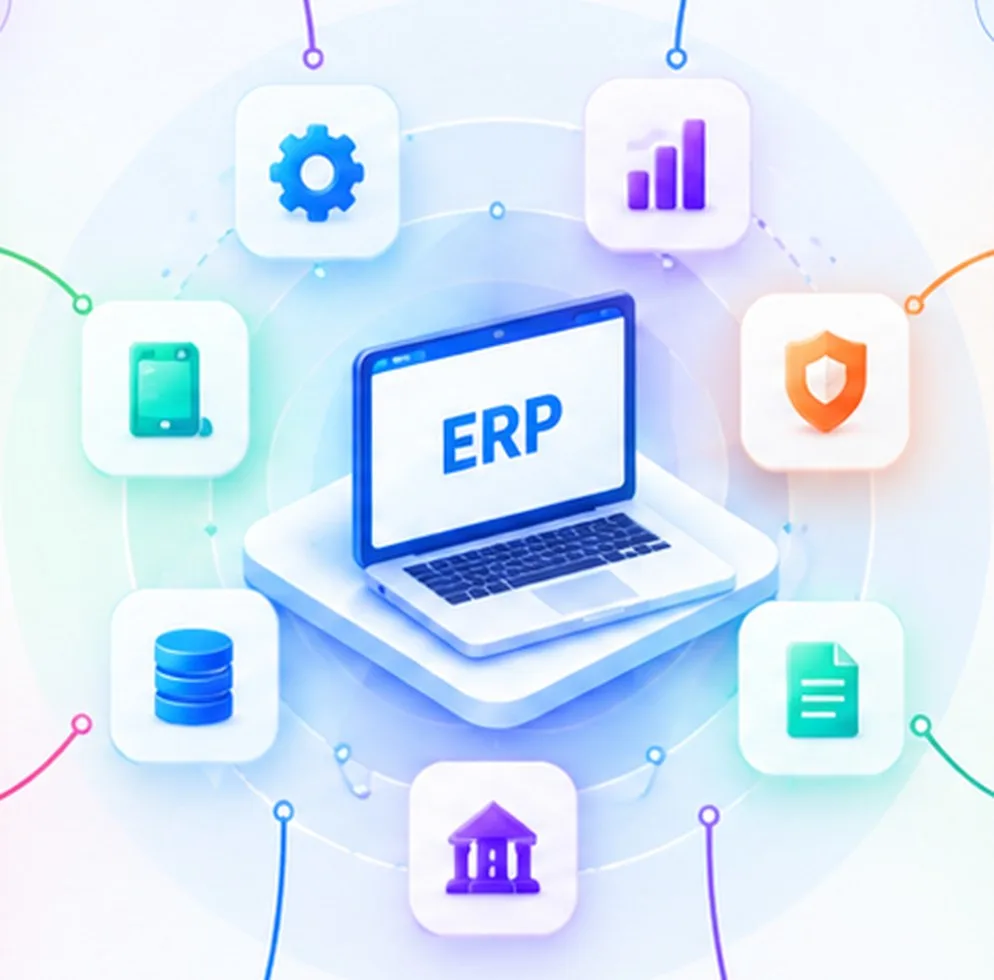
Hold finance, HR, inventory, sales, and operations in one platform with our powerful custom ERP software development services. We develop smart ERP solutions to improve productivity, automate workflows, and provide real-time insights for business growth.

What is ERP Software Development?
Creating an ERP system from scratch to meet a company's unique requirements and demands is known as Custom ERP development. An ERP system connects different departments of an organization—like finance, HR, inventory management, procurement, sales, CRM, and supply chain management- to enhance efficiency and transparency. Custom ERP software development allows businesses to design applications that cater to their unique processes and needs. ERP systems offer businesses real-time data, streamlined workflows, and improved cross-departmental integration, all of which contribute to efficient operations, minimized manual work, and informed decision-making – key factors for sustainable business growth.
What Does an ERP Software Development Company Do?
An ERP software development company designs, develops, integrates, implements, and maintains enterprise resource planning systems based on a business's specific operational requirements. Instead of relying only on predefined workflows, businesses can work with an ERP development company to create a centralized platform that connects functions such as finance, HR, inventory, procurement, sales, manufacturing, and operations.
An ERP development company typically handles the complete development lifecycle, from understanding business processes and defining requirements to designing the architecture, developing ERP modules, integrating third-party systems, migrating existing data, testing the platform, and providing post-launch support.
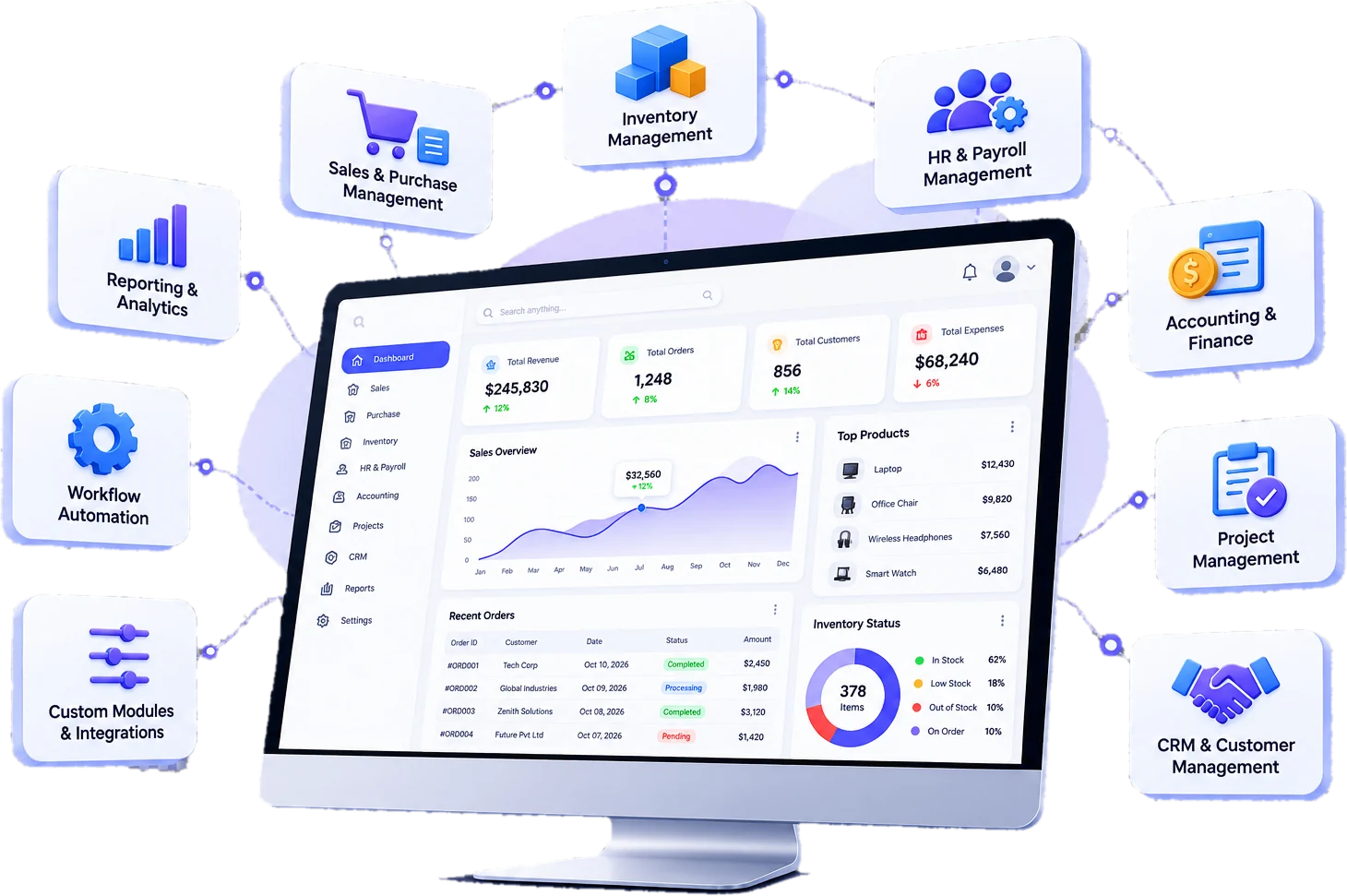

Not Sure Which ERP Modules Your Business Needs?
Share your current processes and systems with our team and we will recommend the right ERP scope, modules, and integrations for your business.
Our ERP Software Development Services
We offer end-to-end ERP software development services for businesses to streamline operations, automate workflows, and improve business efficiency. From building custom ERP solutions to modernizing legacy systems, our services are customized to meet the business requirements.
Custom ERP Development
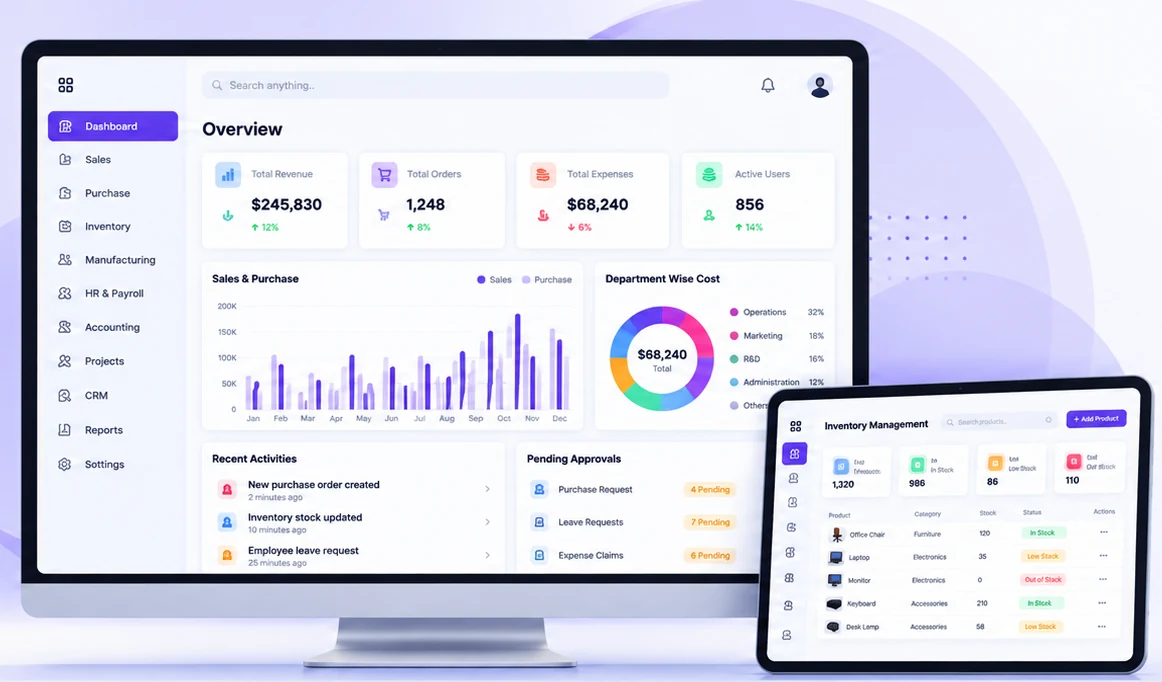
We create a fully customized ERP system for the business processes and operational needs. Our systems unify departments such as HR, finance, inventory, and sales into a centralized platform. All modules are structured to help meet business objectives and ensure efficient workflow. The architecture is expandable, secure, and adaptable for future requirements. This helps companies to become more efficient, more productive, and more decisive.
Cloud ERP Development
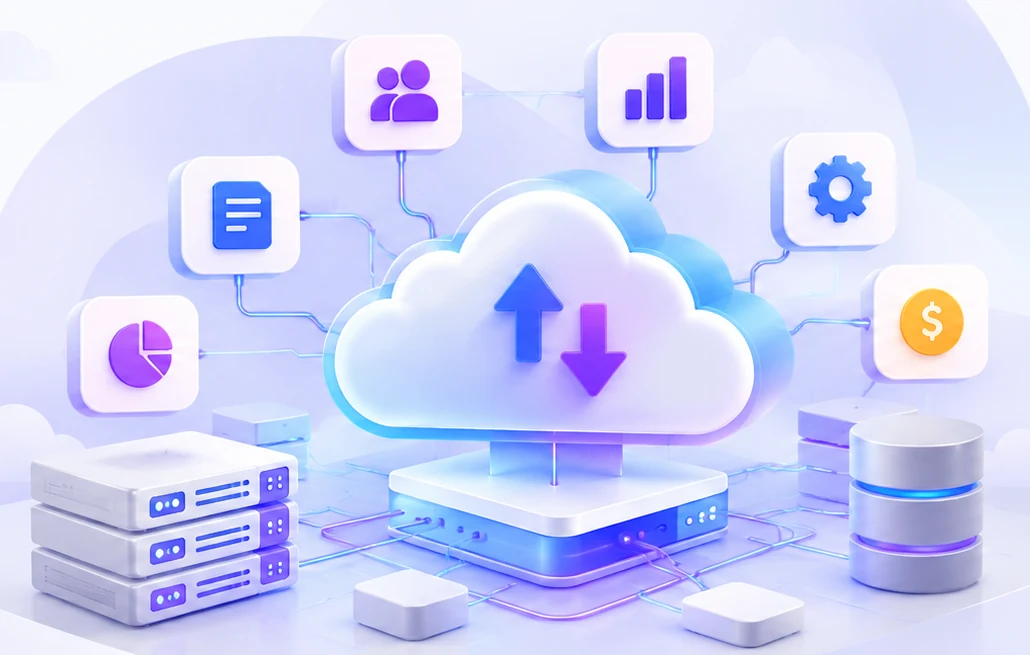
We create cloud native ERP systems to offer safe access from everywhere and at any time. Cloud deployment eliminates the need for costly infrastructure and makes system management easy. Our solutions are scalable and meet the increasing needs of businesses. Businesses enjoy greater flexibility, lower costs, and reliability.
ERP Modernization Services
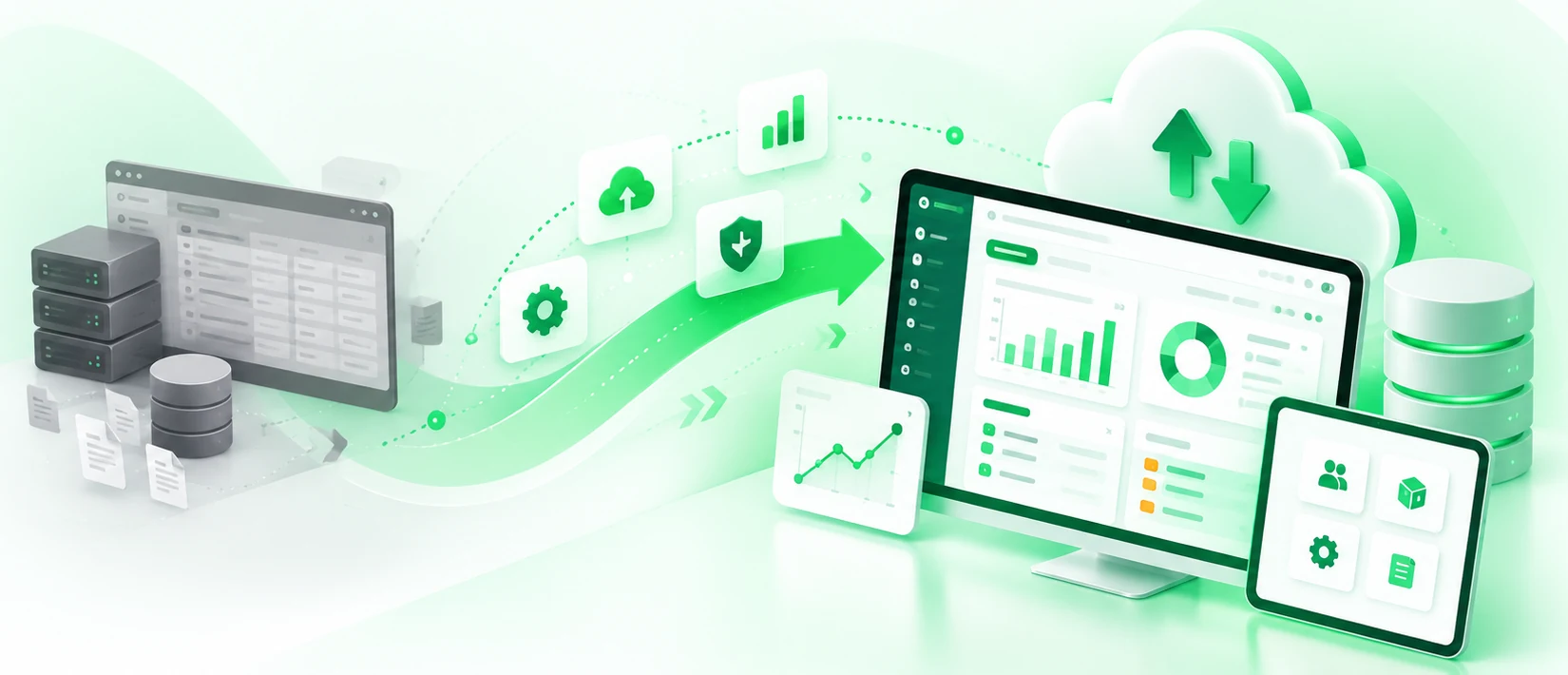
We update traditional ERP systems to incorporate the latest technology, user-friendly interfaces, and enhanced capabilities. Our team makes the legacy applications better, providing improved performance and user experience. Modernization can lower maintenance expenses and boost productivity in an organization.
Business System Integration Services
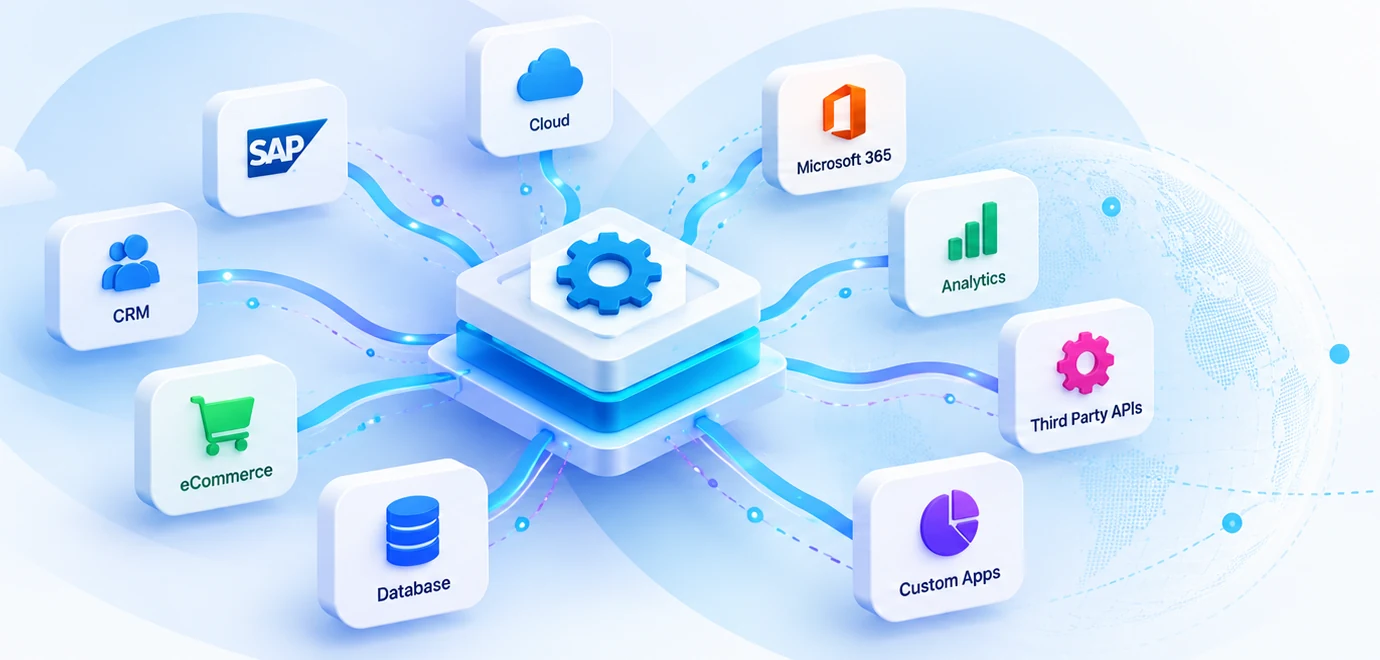
We connect ERP software with HRMS, CRM, accounting software, eCommerce, and third-party applications. These connections allow information to flow easily between various business areas and eliminate the need to manage information silos. Our integration services help businesses automate workflows and reduce manual processes.
ERP Migration Services
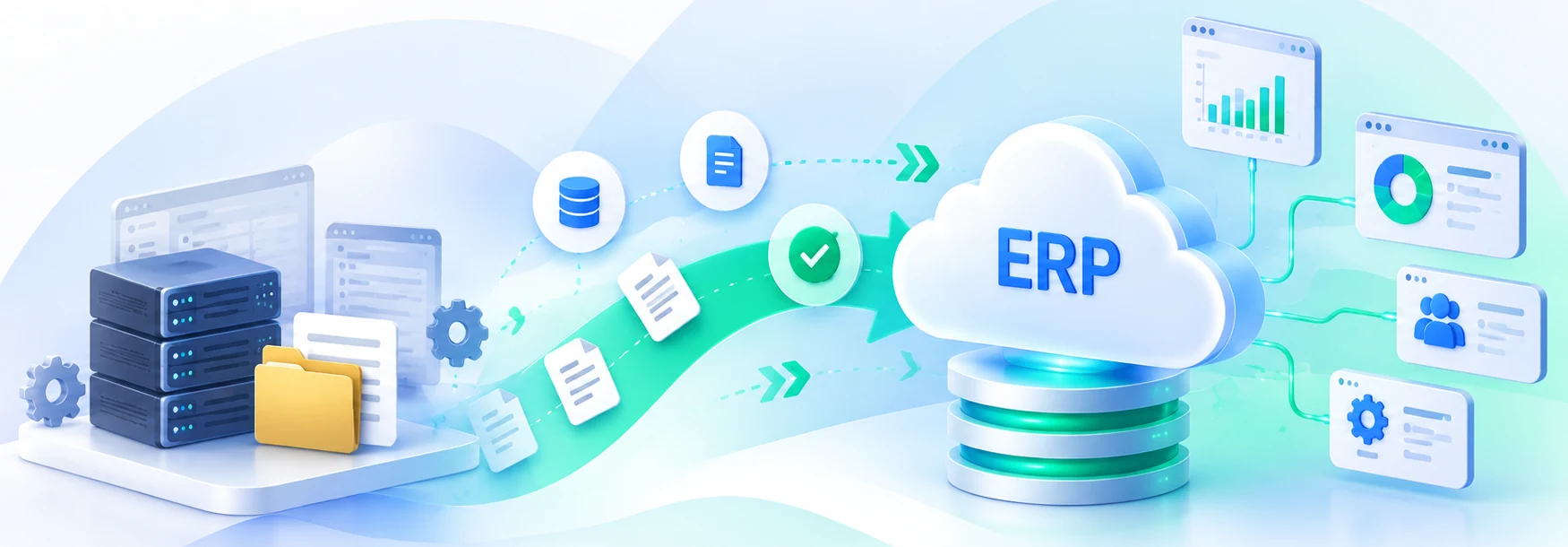
We offer migration services to help businesses move from spreadsheets, legacy systems or older software without hassle. Our services help companies move their data safely without compromising data integrity or system functionality. Migration is well planned to minimize downtime and operational risks.
ERP Support & Maintenance
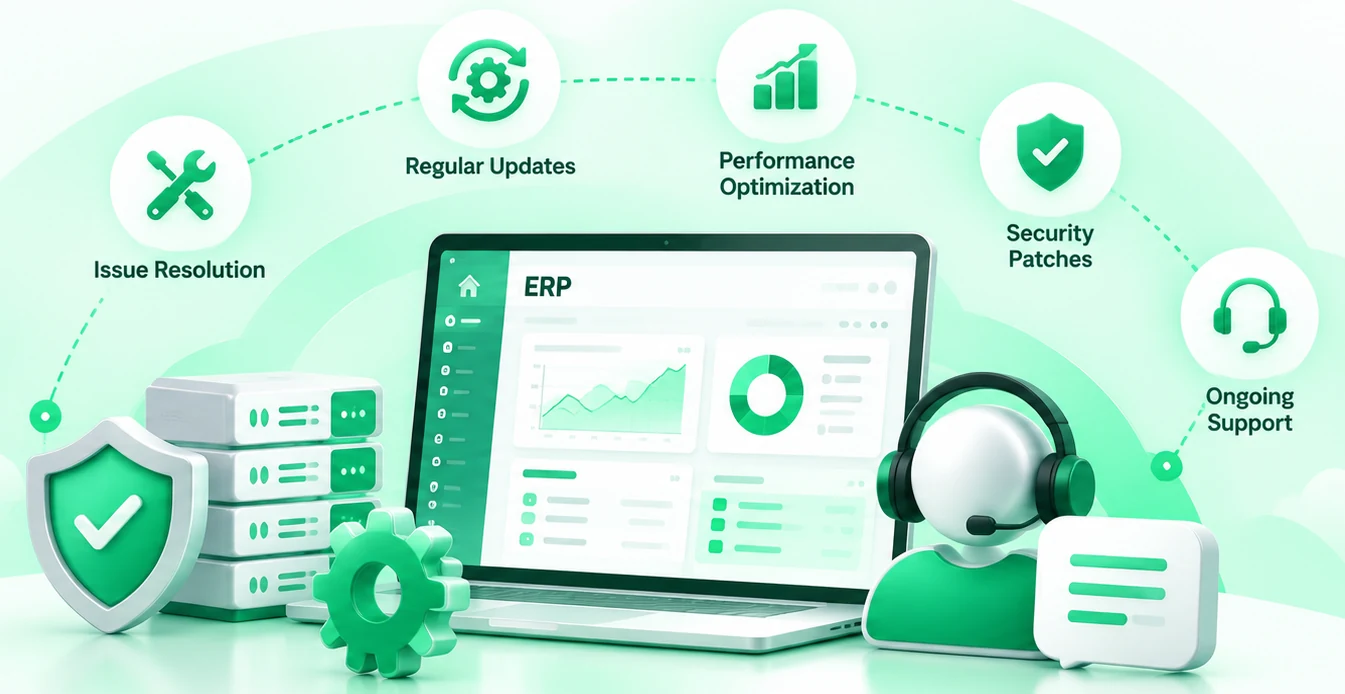
We ensure our ERP support and maintenance services keep the system performing optimally. Our team handles software updates, bug fixes, and performance enhancements. Regular monitoring helps to identify and solve issues before they impact operations.
Business Challenges Our ERP Solutions Solve
Businesses often struggle with disconnected systems, inefficient workflows, and limited visibility into operations. Our custom ERP solutions address these challenges by binding the critical functions together in a single platform. Here is how we address challenges with our ERP solutions.
Disconnected Business Systems
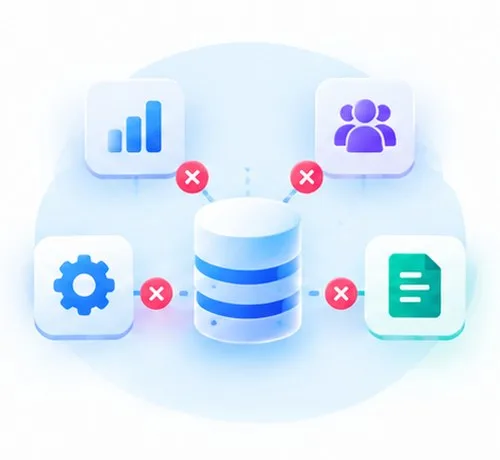
Businesses opt to work independently and rely on multiple software applications, which leads to fragmented processes and inconsistent data. Our ERP solutions centralize these business operations in a single platform for seamless information flow. By using a single platform for their operations, businesses gain better control and efficiency.
Manual Processes & Workflow Inefficiencies
Many processes in an organization are repetitive and manual, leading to delays, errors, and low productivity. To tackle this, our ERP system automates certain workflows such as approvals, reporting, and tracking, resulting in an efficient and high-performing business.
Lack of Real-Time Visibility
The lack of access to business information may delay decision-making and impact overall performance. Our ERP solutions feature real-time reporting, analytics, and centralized dashboards. This enables them to react fast to market fluctuations.
Data Silos Across Departments
Communication gaps often arise when departments operate independently. Our ERP system creates a unified environment where the information is shared across HR, sales, inventory, finance, and other teams. Organizations benefit from improved productivity and coordination.
Scalability & Growth Challenges
Legacy systems are typically unable to handle the growing demands and loads as businesses grow. We have designed the ERP solutions with scalable architectures that scale along with your business growth. This allows organizations to grow at ease and maintain sustainable growth over the long run.
Compliance, Security & Data Management
In manual systems, managing sensitive data is challenging while meeting the regulatory standards. Our ERP solutions strengthen data security via encryption, role-based access control, and regular monitoring. This module reduces risks and produces business information.
Have an ERP Requirement in Mind? Let’s Build It.
From finance and HR to inventory, procurement, and supply chain, Craitrix builds custom ERP software around your business workflows.

ERP Modules We Develop
Our ERP modules help businesses to streamline their business operations and improve overall efficiency. We customize modules for specific workflows and integrate them into centralized systems for seamless data sharing. From HR to finance, we help businesses to enhance visibility and make data-driven decisions for sustainable growth.
Finance & Accounting Management
We build an ERP solution to manage finance and accounting, handling accounts payable, receivable, invoicing, and reporting. This module provides a real-time view of financial performance and cash flow. By automating accounting tasks, businesses can reduce the risk related to human error and ensure financial planning.
Human Resource Management
Our HRM module will be all in one place, which will centralize all your employee information, recruitment, attendance, leave management, etc. It streamlines the workforce management process and enhances employee engagement. This module supports organizations in making better use of their resources and talent management.
Payroll Management
Establish salary calculation, tax deduction, reimbursement, and employee benefit administration through our payroll module. The module minimizes the chances of mistakes and ensures the timely processing of salaries. With our payroll management module, employees can gain accurate payslips and payroll records.
Inventory & Warehouse Management
The inventory and warehouse module helps track inventory levels and warehouse movement and orders in real-time. This module minimises stock shortages and excess stock. Automated stock management makes inventory management more efficient and accurate. It provides enhanced visibility and optimized inventory costs for businesses.
Procurement & Purchase Management
This module automates purchasing activities, purchasing orders, and supplier management. It assists organisations in streamlining procurement processes and maintaining good vendor relations. Real-time information helps with cost management and stock on hand. This leads to a more streamlined and transparent procurement process.
Supply Chain Management
Our SCM module offers complete visibility of the sourcing, logistics, inventory and distribution processes. It allows enterprises to optimize the activities in their supply chains. The module enhances collaboration with suppliers and partners. Organizations benefit from improved efficiency and customer satisfaction.
Manufacturing Management
The manufacturing module enables businesses to control their production processes, resources, quality, and shop floor operations. It helps to streamline processes and cut down on manufacturing expenses. Efficient use of materials and resources with real-time monitoring.
Customer Relationship Management
With our CRM module, businesses can handle customer interactions, sales pipelines, leads, and support activities from a single location. It helps salespeople to build connections and enhance customer engagement. Automated workflows boost sales productivity and service quality.
Project & Resource Management
The project and resource management module enables organizations to manage projects, resources, tasks, and budgets. It offers transparency over project timelines and team performance. Workflows can be streamlined and inter-departmental collaboration enhanced.
Business Intelligence & Reporting
Our business intelligence and reporting module transforms operational data into meaningful insights through dashboards and analytics. It provides real-time reports on financial performance, sales, inventory, and operational metrics. Businesses can identify trends, forecast outcomes, and make informed decisions.
ERP Use Cases
Custom ERP software can be designed to support different operational requirements across departments and industries. Instead of managing individual functions through disconnected applications, businesses can use an ERP platform to connect workflows and centralize operational data.
Common ERP use cases include:
Financial Management
ERP systems can centralize accounting, accounts payable and receivable, invoicing, budgeting, expense management, financial reporting, and transaction tracking.
Human Resource Management
Businesses can manage employee records, attendance, leave, payroll, recruitment, performance, and employee-related workflows through an integrated HR module.
Inventory & Warehouse Management
ERP software can help businesses track inventory levels, stock movements, warehouses, purchase orders, product availability, and replenishment requirements.
Procurement Management
Organizations can manage suppliers, purchase requests, purchase orders, approvals, procurement workflows, and supplier-related information from a centralized platform.
Manufacturing Management
Manufacturers can use ERP systems to manage production planning, bills of materials, work orders, raw materials, production schedules, quality processes, and resource utilization.
Sales & CRM
ERP platforms can connect customer information with sales activities, quotations, orders, invoices, customer service, and related operational data.
Supply Chain Management
Businesses can coordinate procurement, inventory, suppliers, logistics, order processing, and distribution workflows across the supply chain.
Project & Resource Management
Service-based organizations can manage projects, tasks, employees, resources, budgets, timesheets, and project-related financial information through an integrated ERP system.
Multi-Location Business Management
Businesses operating across multiple branches, warehouses, or offices can centralize data while maintaining location-specific workflows, permissions, inventory, and reporting.
Business Intelligence & Reporting
ERP systems can consolidate operational data into dashboards and reports, allowing management teams to monitor financial, sales, inventory, workforce, and operational performance.
Industry-Specific Operations
ERP software can also be customized for industries such as manufacturing, retail, healthcare, logistics, construction, education, real estate, financial services, eCommerce, and food and beverage, with workflows and modules aligned with industry-specific requirements.
Advanced ERP Software Features We Develop
We develop ERP systems that have the advanced features to enable businesses to automate processes and gain visibility. These features will help organizations meet the growing demands on business while supporting their complex workflows.
Workflow Automation
Our workflow automation solutions automate repetitive tasks and streamline business processes. Automated approvals and task assignment enhance operational efficiency. Companies can accelerate the process and reduce human mistakes, thus speeding up daily activities.
Role-Based Access Control
We integrate role-based access control to ensure there is secure and authorized access to critical information. Different permissions are granted to different users according to their responsibilities and roles to ensure that data will not be exposed and to enhance internal security.
Enterprise Data Security
We protect sensitive business information by implementing advanced security measures. Secure architecture safeguards enterprise data from unauthorized access and can maintain customer trust and operational integrity to ensure long-term system reliability.
Audit Trails & Compliance Management
Audit trails & compliance management are used to track user activities and system changes. We implement this feature to enhance accountability and transparency across business operations. Automated tracking reduces risks associated with manual record-keeping, strengthens governance, and simplifies audits.
Multi-Branch & Multi-Location Management
Our ERP software can be implemented across various branches, business locations, and warehouses. With our platform, businesses can track their operations, inventory, and finances in real-time across various locations.
Document Management System
We build in document management capabilities that enable businesses to store, organize, and retrieve digital documents. Automated document workflows minimize paper usage and increase access, creating greater operational efficiency and less administration.
Real-Time Reporting Dashboards
We create and customize interactive dashboards that deliver real-time data on important business metrics and performance indicators. These dashboards are mainly used to track sales, finance, and operations. Visual analytics makes complex information easier to understand, increases transparency, and enhances control over operations.
Mobile ERP Applications
Our mobile ERP applications enable users to access critical business information anytime and anywhere. Mobile accessibility helps businesses to improve their responsiveness and workforce productivity. Real-time synchronization ensures data consistency across devices.
AI-Powered ERP Software Development Services We Offer
We use AI in our ERP software solutions to improve operational efficiency and provide actionable insights. These smart solutions enable organizations to respond faster to changing business conditions and gain a competitive advantage.
Predictive Business Analytics
We offer AI-powered analytics solutions to analyze real-time data to predict growth opportunities. Predictive analytics enhances planning and risk management. Businesses can use data-driven forecasts to optimize operations.
Intelligent Demand Forecasting
Our intelligent demand forecasting capability helps businesses forecast customer demand with more accuracy. Machine learning algorithms analyze sales trends, seasonality, and market patterns. Accurate or precise forecasting would reduce inventory shortages and excesses and improve operational efficiencies.
AI-Powered Inventory Optimization
AI is applied to automate and optimize inventory replenishment. Intelligent algorithms are used to monitor stock movements and predict inventory requirements, leading to better inventory management and improved profitability.

Smart Financial Analysis
Our AI-based financial analysis tools allow for a more detailed breakdown of cash flow, expenses, and profitability. Automated analysis improves financial decisions by identifying financial risks and opportunities. This results in better financial performance and operational stability.
AI-Based Workflow Automation
We automate workflows with AI to enhance repetitive and complex business processes. Intelligent systems can prioritize tasks, identify anomalies, and automate approvals to reduce manual intervention and improve process efficiency. AI-powered automation typically results in increased productivity and accuracy.

Conversational ERP Dashboards
Our conversational ERP dashboards empower users to query business data with natural language. AI assistants give you instant answers, reports, and insights without needing technical expertise. This improves the user experience and makes the data analysis easier.
We offer AI-powered analytics solutions to analyze real-time data to predict growth opportunities. Predictive analytics enhances planning and risk management. Businesses can use data-driven forecasts to optimize operations.
Our intelligent demand forecasting capability helps businesses forecast customer demand with more accuracy. Machine learning algorithms analyze sales trends, seasonality, and market patterns. Accurate or precise forecasting would reduce inventory shortages and excesses and improve operational efficiencies.
AI is applied to automate and optimize inventory replenishment. Intelligent algorithms are used to monitor stock movements and predict inventory requirements, leading to better inventory management and improved profitability.
Our AI-based financial analysis tools allow for a more detailed breakdown of cash flow, expenses, and profitability. Automated analysis improves financial decisions by identifying financial risks and opportunities. This results in better financial performance and operational stability.
We automate workflows with AI to enhance repetitive and complex business processes. Intelligent systems can prioritize tasks, identify anomalies, and automate approvals to reduce manual intervention and improve process efficiency. AI-powered automation typically results in increased productivity and accuracy.
Our conversational ERP dashboards empower users to query business data with natural language. AI assistants give you instant answers, reports, and insights without needing technical expertise. This improves the user experience and makes the data analysis easier.
Ready to Add AI to Your ERP?
Talk to our team about predictive analytics, demand forecasting, and AI-based automation for your ERP platform.
Our Expertise in Industry-Specific ERP Development
We develop industry-specific ERP solutions customized to meet the business requirements and workflows. From manufacturing and healthcare to retail and logistics, our ERP solutions help businesses achieve greater productivity and sustainable growth.
Manufacturing ERP
We optimize production planning, inventory control, procurement, and quality management with our manufacturing ERP solutions. Real-time monitoring and workflow automation improve efficiency and reduce operational costs for a seamless production process in the manufacturing sector.

Retail ERP
Our retail ERP systems centralize inventory, sales, procurement, and customer management. Real-time stock visibility and automated workflows help retailers to improve customer experiences, manage multiple channels efficiently, and maximize profitability.

Healthcare ERP
We develop healthcare ERP solutions to streamline finance, procurement, HR, and administrative processes. Centralized data management and automation improve operational efficiency while ensuring regulatory compliance and secure information handling.
Logistics & Supply Chain ERP
We help businesses to manage warehousing, transportation, inventory, and distribution operations via a unified ERP platform. Real-time tracking and analytics improve supply chain visibility, reduce delays, and optimize logistics performance.
Construction ERP
Our construction ERP solutions simplify project planning, budgeting, procurement, workforce management, and resource allocation. Businesses gain complete visibility into project progress and improve cost control and operational efficiency.

Education ERP
We build education ERP systems for managing admissions, finance, administration, student records, and attendance. Automated workflows and centralized information improve collaboration and streamline institutional operations.
Real Estate ERP
Our real estate solutions help to manage properties, leases, customer relationships, and financial operations from a centralized platform. Businesses can improve asset management and enhance customer service via streamlined processes.
Financial Services ERP
We create an ERP system for financial institutions to manage accounting, compliance, reporting, and customer operations. Real-time insights and automated workflows improve governance, accuracy, and decision-making capabilities.

eCommerce ERP
In an ERP system for eCommerce, we integrate inventory, orders, payments, logistics, and customer management across multiple channels. Businesses benefit from improved accuracy, governance, and decision-making capabilities.

Food & Beverage ERP
We develop ERP platforms for food and beverage businesses to manage procurement, inventory, production, quality control, and distribution. Real-time tracking and automation help to reduce wastage, maintain compliance, and improve operational efficiency.
Our ERP Integration Services for Connected Business Ecosystems
We enable seamless data exchange and process synchronization to help businesses improve efficiency and reduce data silos, and enhance collaboration across departments.
CRM Integration
We integrate ERP with CRM systems for seamless customer data and service operations & sales processes. Real-time syncing supports accurate data across departments, enhancing customer engagement and sales processes. Centralized customer insights help make better decisions and improve productivity and customer satisfaction.
Accounting Software Integration
Our ERP accounting software integration services integrate ERP systems with the financial application to streamline transactions. Automated synchronization minimizes duplicate data entry and provides businesses with real-time data visibility into financial records and reporting, ensuring accurate financial operations.
HRMS Integration
We seamlessly connect our ERP solutions to HRMS platforms for efficient employee data management, payroll, attendance tracking, and workflows. Centralized information enhances HR efficiency and minimizes administrative workloads. This integration boosts workforce productivity as well as operational visibility.
Payment Gateway Integration
Payment Gateway integration offers secure and seamless transactions with ERP platforms. Businesses can automate their invoicing systems, payment tracking, and financial reconciliation. This enhances customer experiences and simplifies financial operations.
eCommerce Platform Integration
ERP is integrated with eCommerce platforms for inventory, order, customer, and shipping sync. Real-time updates ensure order accuracy and increase efficiency in order fulfillment, making it easy to manage multiple sales channels from one central location.
Business Intelligence Tools Integration
Our ERP solutions integrate with business intelligence tools to provide advanced analytics and data visualization capabilities. Real-time dashboards can help organizations track performance, uncover trends and use them for strategic planning and decision-making. This empowers organizations with data-driven growth opportunities.
Third-Party API Integration
We provide third-party API integration services to connect ERP systems with external applications and custom platforms. Seamless data exchange improves process automation and operational efficiency. Businesses can extend ERP capabilities according to their unique requirements.
Supply Chain & Logistics Integration
Our supply chain and logistics integration services connect ERP systems with warehouse, transportation, and distribution platforms. Real-time synchronization improves inventory visibility and delivery tracking. Businesses can optimize logistics workflows and reduce operational delays.
Enterprise ERP Architecture We Build
Our team designs enterprise-grade ERP software architecture to deliver scalability, high performance, and long-term reliability. Our solutions are built to accommodate growing business requirements and ensure seamless operations and future readiness. We help organizations create robust ERP ecosystems that support digital transformation and sustainable growth.
Modular ERP Architecture
We develop modular ERP architectures for businesses to implement functionalities based on their requirements. Each module can be added or customized without impacting the entire system. This approach provides flexibility and simplifies maintenance to ensure long-term adaptability and cost efficiency.
Cloud Native ERP Systems
Our cloud-based ERP solutions are optimized for easy access and speed. They offer secure access to business data, no matter the location or device. Cloud infrastructure eliminates the need for hardware and cuts costs. Automatic updates and resource optimization guarantee continuous performance.
Microservices-Based ERP Platforms
We develop microservice-based ERP solutions that divide the services into distinct microservices to achieve flexibility and performance. This architecture enables faster development and easier maintenance.
Multi-Tenant ERP Solutions
We also have multi-tenant ERP solutions, which allow multiple business units or customers to run securely on a shared infrastructure. This architecture maximizes the use of resources and minimizes deployment expenses. Multi-tenant systems give you scalability and optimal resource usage.
High Availability ERP Infrastructure
We build high-availability ERP infrastructures to guarantee business continuity. Redundant systems, failover systems, and backup systems can reduce risks associated with downtime. Continuous monitoring helps to ensure optimal system performance and reliability. This design guarantees consistent availability and operational continuity.
API First ERP Architecture
Our API-first ERP architecture enables seamless communication between ERP systems and external applications. Standardized APIs facilitate seamless integration with CRM, HRMS systems, eCommerce solutions, and third-party services. It establishes an environment that is future-proof and can adjust to new technologies.
Tech Stack for ERP Software Development
The database and technology stack for an ERP system should be selected according to factors such as transaction volume, scalability, security, integration requirements, deployment environment, and the complexity of business workflows.
A typical custom ERP technology stack may include:
 Frontend
 Backend
 Database
 Mobile
 APIs & IntegrationCloud Infrastructure
 Architecture
 Security
 DevOps
Our ERP Software Development Process
We follow a structured ERP development process to deliver solutions that align with your business goals and operational requirements. From initial discovery to post-deployment support, every phase is focused on scalability and performance. Our agile approach ensures faster delivery and successful ERP implementation services.
Business Discovery & Requirement Analysis
This is the initial stage where we understand the client’s business process, challenges and define project requirements. Detailed analysis helps us to identify critical workflows and functional needs. This phase establishes a clear roadmap for development.
Stakeholder Workshops
Sessions with key teams to map goals, pain points, and priorities.
Process Mapping
Document current workflows, data flows, and approval chains.
Requirement Specification
Define functional, technical, and reporting requirements.
Scope & Roadmap
Prioritize modules and phases for a clear delivery plan.
Outcome of this stage
- Documented business processes and pain points
- Approved functional and technical requirements
- Clear project scope and development roadmap
ERP Strategy & Solution Design
Our experts create a strategic ERP blueprint customized to your operational requirements and future growth plans. We carefully define the modules and integration capabilities to deliver maximum business value.
Module Planning
Select and define the ERP modules your operations need.
Architecture Blueprint
Plan a scalable, secure system architecture.
Integration Planning
Identify the systems and data flows to connect.
Technology Selection
Choose the right stack for performance and growth.
Outcome of this stage
- Approved ERP solution blueprint
- Defined modules, integrations, and architecture
- Technology stack aligned with growth plans
UI/UX Design & Prototyping
We design intuitive user interfaces and interactive prototypes to enhance the user experience. Prototypes and wireframes help visualize workflows before development begins. Effective UI/UX contributes to higher user adoption rates.
User-Centered Design
Designs tailored to your business users and workflows.
Interactive Prototypes
Clickable prototypes to visualize the user journey.
Responsive Interfaces
Consistent experience across web and mobile devices.
Feedback & Iteration
Refine designs based on stakeholder feedback.
Outcome of this stage
- Validated user flows and wireframes
- Interactive prototype for early feedback
- UI/UX ready for development with clear design guidelines
ERP Developemnt & Customization
Our team of developers builds custom ERP modules based on the client’s requirements. We implement scalable architecture and modern technologies to ensure high performance. Custom features are integrated to automate the workflows and improve efficiency.
Custom Modules
Build modules around your exact business processes.
Scalable Architecture
Modular code that grows with your organization.
Workflow Automation
Automate approvals, tasks, and notifications.
Secure Coding
Role-based access, encryption, and secure APIs.
Outcome of this stage
- Fully functional ERP modules
- Automated workflows configured to your processes
- Scalable, secure, and maintainable codebase
System Integration & Data Migration
We integrate ERP automation software with the existing application and migrate data from the legacy systems securely. Careful planning ensures minimal disruption to business operations. Data validation and cleansing maintain accuracy and consistency for a smooth transition.
System Integration
Connect CRM, HRMS, accounting, and third-party apps.
Data Mapping
Map legacy data to the new ERP structure.
Data Cleansing
Remove duplicates and fix inconsistencies before migration.
Validation & Reconciliation
Verify migrated records for accuracy and completeness.
Outcome of this stage
- Connected business systems with real-time data flow
- Clean, validated data in the new ERP
- Minimal disruption during the transition
Testing and Quality Assurance
Our quality assurance team conducts comprehensive testing to verify the performance, security, and functionality. We identify and resolve issues before deployment to ensure a seamless user experience and that the platform meets high-quality standards.
Functional Testing
Verify every module and workflow works as intended.
Performance Testing
Ensure speed and stability under real workloads.
Security Testing
Identify and fix vulnerabilities before launch.
User Acceptance Testing
Validate the system with your end users.
Outcome of this stage
- Stable, thoroughly tested ERP release
- Verified performance and security
- User sign-off before deployment
Deployment & User Training
We deploy ERP solutions using best practices to ensure smooth implementation and minimal downtime. User training sessions help employees understand system functionalities and workflows.
Go-Live Planning
Plan the cut-over to minimize downtime.
Production Deployment
Deploy on cloud or on-premise infrastructure.
Role-Based Training
Hands-on training for each user group.
Documentation
User guides and admin manuals for your team.
Outcome of this stage
- ERP live in production with minimal downtime
- Trained users ready to adopt the system
- Complete documentation for ongoing use
Post Implementation Support & Optimization
Our support services ensure the ERP system continues to perform efficiently after deployment. We provide updates, monitoring, performance optimization, and technical assistance. Continuous improvements help adapt the system to changing business requirements, ensuring long-term value and sustained business growth.
Monitoring
Track system health and performance continuously.
Updates & Fixes
Regular updates, patches, and bug fixes.
Performance Optimization
Tune the system as data and users grow.
Enhancements
Add features and modules as needs evolve.
Outcome of this stage
- Reliable, high-performing ERP system
- Continuous improvements aligned with business growth
- Long-term value from your ERP investment
Ready to Plan Your ERP Implementation?
Our team can help you scope modules, integrations, data migration, and rollout phases before development begins.
ERP Implementation Services
ERP implementation involves configuring, deploying, and preparing the ERP system for actual business operations. It goes beyond software development by ensuring that the solution is properly aligned with business workflows, existing systems, users, and operational requirements.
A structured implementation approach helps businesses transition to the new ERP system while reducing operational disruption and ensuring that the platform is ready for day-to-day use.
Our ERP implementation services cover:
Implementation Planning
Define project scope, implementation phases, responsibilities, milestones, and deployment requirements.
ERP Configuration
Configure modules, workflows, user roles, permissions, notifications, reports, and business rules according to operational requirements.
System Integration
Connect the ERP platform with existing CRM, accounting, HR, eCommerce, payment, logistics, and other business applications.
Data Migration
Prepare, transfer, validate, and organize data from legacy systems, spreadsheets, or other business applications.
User Training
Provide training and documentation to help employees understand the ERP interface, workflows, and role-specific functionality.
Testing & Validation
Validate business processes, integrations, permissions, reports, and system performance before production deployment.
Go-Live Support
Assist with production deployment, issue resolution, user onboarding, and operational transition.
Post-Implementation Support
Monitor system performance, resolve issues, apply updates, and optimize workflows after launch.
ERP Data Migration Strategy
ERP data migration involves transferring business information from legacy ERP systems, spreadsheets, databases, or other applications into the new ERP platform. A structured migration strategy helps maintain data accuracy and reduces the risk of operational disruption during implementation.
Depending on the project, businesses can use a full migration, phased migration, or parallel migration approach. The appropriate strategy depends on data volume, system dependencies, business continuity requirements, and the complexity of the existing environment.
Our ERP data migration approach typically includes:
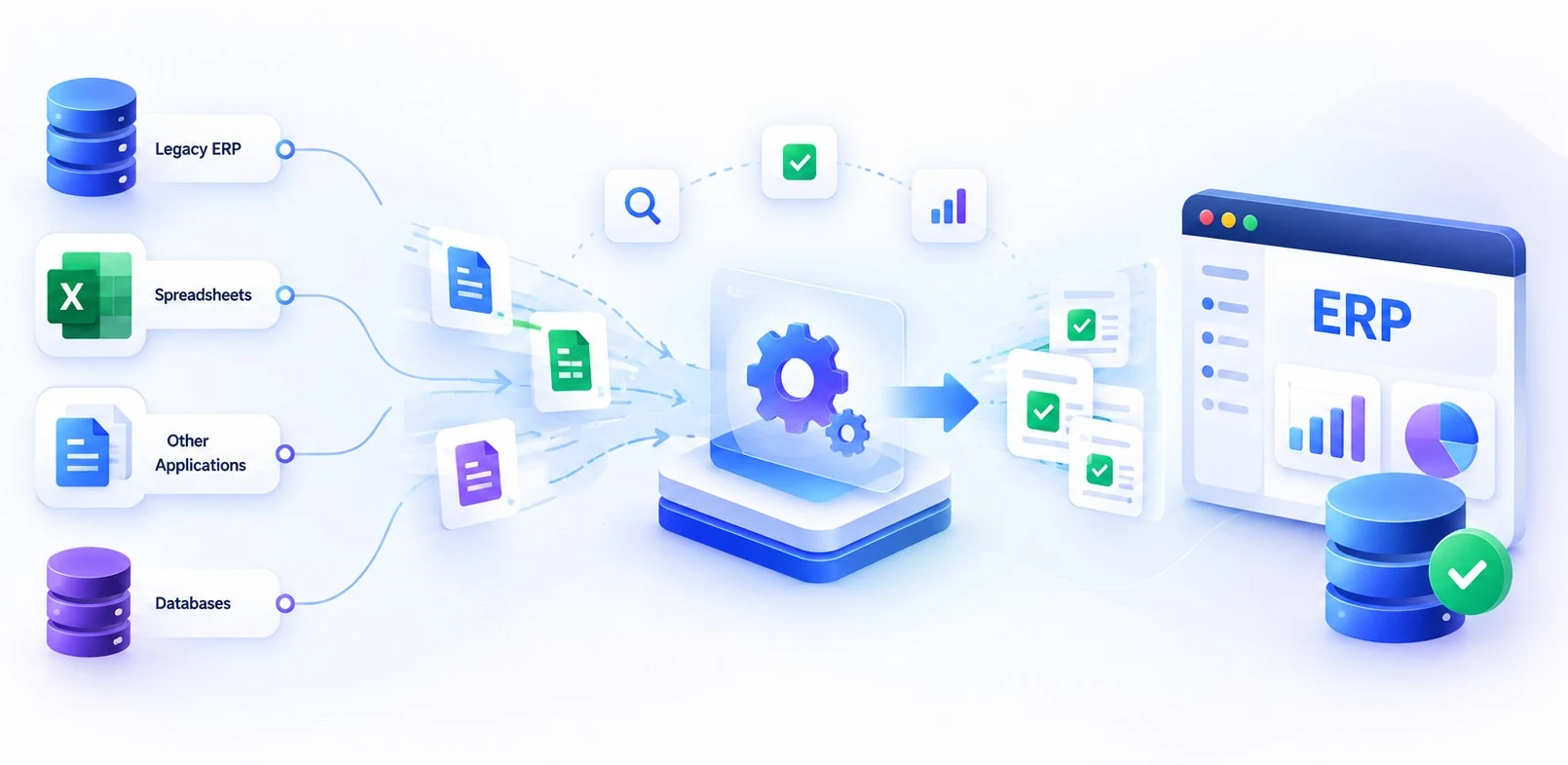
Data Assessment
Identify the existing data sources, data formats, database structures, dependencies, and data quality issues.
Data Mapping
Map fields from the existing systems to the corresponding fields and modules in the new ERP platform.
Data Cleansing
Remove duplicate, outdated, incomplete, or inconsistent records before transferring the data.
Data Transformation
Convert data into formats and structures compatible with the new ERP database and business workflows.
Migration & Validation
Transfer the prepared data into the new system and validate records, relationships, calculations, and business-critical information.
Testing & Reconciliation
Compare migrated data against the source systems to identify missing, duplicated, or inaccurate records.
Production Migration
Perform the final migration during the planned deployment window and verify the system before business operations resume.
ERP Development Timeline
The ERP development timeline depends on the number of modules, customization requirements, integrations, data migration complexity, deployment model, and testing requirements. A basic ERP can take a few months, while a complex enterprise platform may require significantly longer development and implementation.
A typical ERP project progresses through requirement analysis, solution architecture, UI/UX design, development, integration, data migration, testing, deployment, and post-launch support. The timeline can change as requirements evolve, particularly when businesses require extensive customization or integration with multiple legacy systems.
For organizations that need to launch sooner, ERP development can also be divided into phases. Core modules can be released first, followed by additional modules, integrations, automation, and advanced capabilities.
Requirement Analysis
Understand business goals, current processes and project requirements.
1 – 2 WeeksSolution Design
Plan the ERP architecture, modules, and technology stack.
2 – 3 WeeksUI/UX Design & Prototyping
Create user-friendly designs and interactive prototypes.
2 – 3 WeeksDevelopment & Customization
Build and customize modules with scalable and secure architecture.
8 – 16 WeeksSystem Integration & Data Migration
Integrate with existing systems and migrate data securely.
3 – 6 WeeksTesting & Quality Assurance
Perform functional, security, and performance testing.
2 – 4 WeeksDeployment & User Training
Deploy the solution and provide hands-on training for your team.
1 – 2 WeeksPost Implementation Support
Offer continuous support, monitoring, and improvements.
OngoingERP Software Development Cost
The cost of ERP software development depends on the scope, number of modules, level of customization, integrations, deployment model, user roles, and data migration requirements. A small ERP system with a limited number of modules will require a different investment than a large enterprise platform supporting multiple departments, locations, and complex workflows.
As a general estimate, custom ERP development can range from $5,000 to $50,000+, depending on the complexity of the solution.
The final cost is influenced by factors such as the number of ERP modules, UI/UX requirements, third-party integrations, cloud or on-premise deployment, mobile access, data migration, security requirements, user volume, and ongoing support. A detailed requirement analysis is therefore recommended before establishing the final project estimate.
| ERP Development Level | Estimated Cost | Typical Scope |
|---|---|---|
| Basic ERP | $5,000–$15,000 | Core modules, limited users, basic workflows and reporting |
| Mid-Level ERP | $15,000–$30,000 | Multiple departments, integrations, automation, dashboards and role-based access |
| Advanced ERP | $30,000–$50,000+ | Complex workflows, multiple locations, extensive integrations, advanced security and enterprise-level requirements |
Build, Launch & Scale Your ERP Platform With Craitrix
Tell us about your departments, workflows, and existing systems. Our team will help you plan, build, integrate, and launch an ERP aligned with your business goals.

Why Choose Craitrix for ERP Software Development Services?
Craitrix is the best custom ERP solution provider, helping businesses streamline operations, automate workflows, and achieve sustainable growth. Our experienced team specializes in building scalable, secure, and industry-specific ERP platforms tailored to unique business requirements. We leverage modern technologies, cloud architecture, and seamless integrations to ensure high performance and flexibility. From consulting and development to migration, implementation, and ongoing support, we provide end-to-end ERP services with a strong focus on quality and innovation. With agile development practices and customer-centric approaches, Craitrix ensures reliable ERP solutions that drive operational efficiency and long-term business success.
Success Stories & Case Studies
Explore how we have assisted businesses in modernizing operations and achieving measurable growth via custom ERP solutions. Our ERP implementations are designed to automate workflows, improve visibility, and support long-term scalability. Our solutions have enabled organizations to operate more efficiently and make data-driven decisions.
Manufacturing ERP Transformation
We developed a custom ERP solution for a manufacturing company to streamline production planning, inventory management, and quality control processes. The platform integrated procurement and warehouse operations into a unified system. The company achieved faster production cycles and increased overall efficiency.
Retail Operations Automation
Our team built an ERP platform for a retail business to automate inventory management, order processing, and customer relationship workflows. The solution synchronized multiple sales channels and centralized reporting. The retailer experienced enhanced customer satisfaction and optimized day-to-day operations.
Logistics Process Optimization
We delivered a custom ERP system for a logistics company to manage fleet operations, warehouse activities, and shipment tracking. The platform provided real-time visibility into supply chain processes and automated key workflows. The business achieved higher efficiency and better resource management.
Enterprise Digital Transformation
We implemented a scalable ERP solution for a growing enterprise to unify finance, HR, procurement, and project management functions. The platform replaced fragmented legacy systems with a centralized ecosystem. The organization successfully accelerated its digital transformation journey and supported future growth.
FAQs
ERP software development is the process of creating a single platform where businesses can manage their core functions such as finance, HR, procurement, sales, and operations. ERP for businesses helps to enhance productivity and make informed business decisions.
With custom ERP software, you can select the features and modules that suit your business, while an off-the-shelf solution offers only basic features. Businesses can also add modules as they require, exclude the ones they don't need, and design workflows according to their business needs and objectives.
The timeline for ERP software development depends on the project complexity, module integration, and customization. The time period required for basic ERP systems might be several months, and the enterprise level may take more time.
ERP software development costs vary based on the features, modules, integrations, and user registration. The investments in custom solutions will vary depending on the complexity and needed scalability.
Yes, you can integrate ERP software with existing systems such as CRM platforms, HRMS, accounting software, eCommerce applications, and third-party tools. These integrations enable seamless data exchange and eliminate information silos.
ERP solutions are applicable in various industries such as manufacturing, retail, healthcare, and construction, and many more. A custom ERP platform can benefit any organization looking to automate operations, enhance collaboration, and gain real-time visibility.
Yes, custom ERP solutions are designed and developed with scalability and flexibility. New modules, users, workflows, and integrations can be added as business requirements evolve. This adaptability ensures that the ERP system continues to support operational changes and future growth.
Custom ERP solutions are developed with advanced security measures and use data encryption, role-based access controls, and audit trails to protect sensitive information and ensure compliance. Strong security practices minimize risks and maintain the integrity of business data.
Yes, we provide post-launch support and maintenance services to ensure optimal ERP performance. Continuous support helps businesses to maintain reliability, improve efficiency and adapt their ERP systems to changing requirements.
Starting an ERP software development project begins with understanding your business processes, goals, and operational challenges. Our experts conduct requirement analysis, define a strategy, and recommend suitable modules and technologies. From planning to deployment and support, we guide businesses through every stage of ERP implementation.