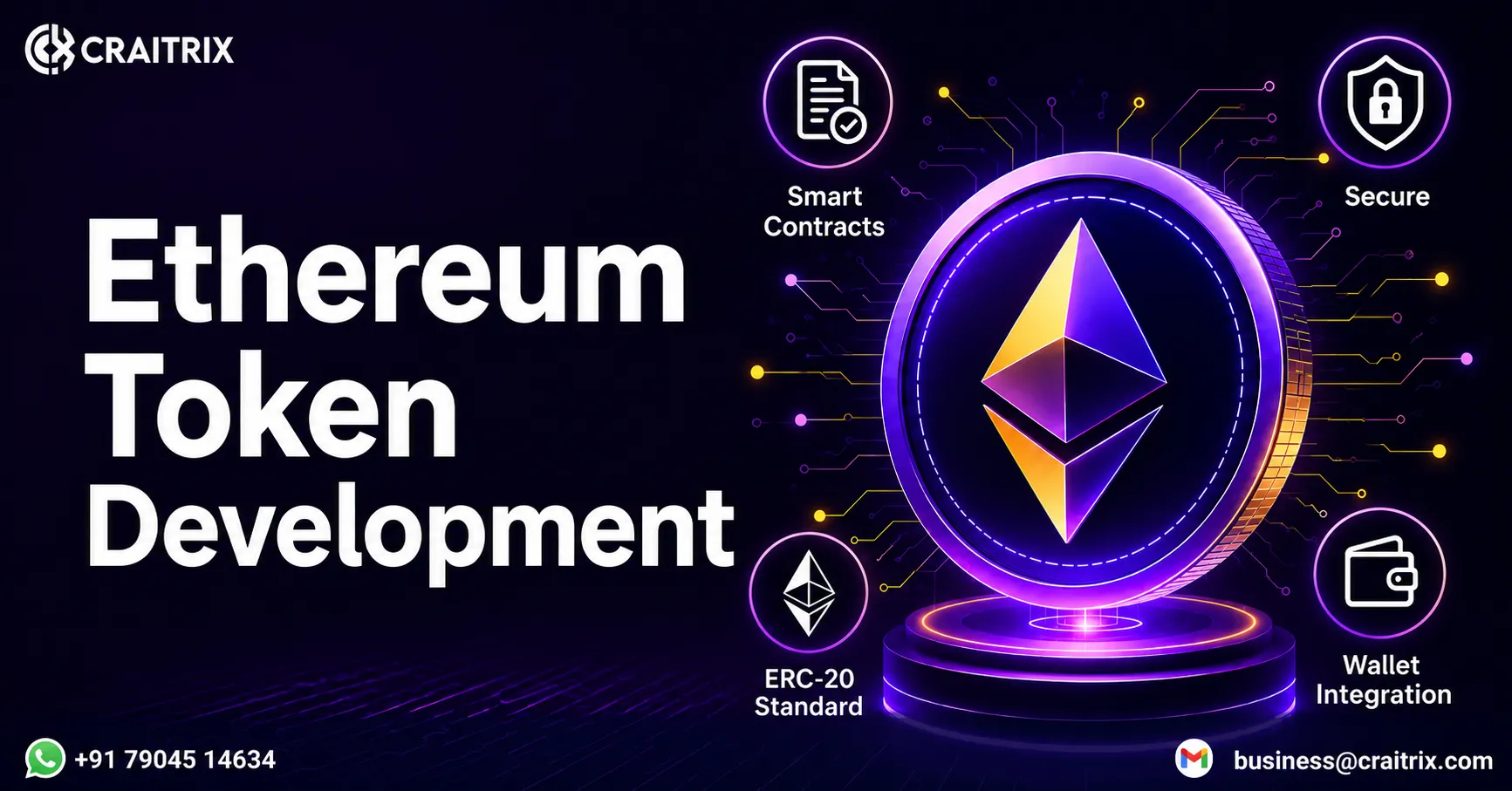
Ethereum token development helps businesses adopt Web3 technologies to improve transparency, automate operations, and unlock new revenue streams. From startups to large enterprises, organizations across industries are using tokenization to build decentralized applications, improve customer engagement, and create new digital economies.
Ethereum has emerged as one of the leading blockchains for token development because of its secure smart contract infrastructure, mature ecosystem, and wide range of ERC token standards. Its Layer-2 scaling options, interoperability, and strong developer community make it a preferred choice for creating utility tokens, NFTs, security tokens, governance tokens, stablecoins, and other blockchain-powered digital assets.
This guide covers how Ethereum token development works, including our token development services, ERC standards, key features, development process, use cases, business benefits, costs, and how to choose the right development partner for your project.
What is Ethereum Token Development?
Ethereum token development is the process of creating digital assets on the Ethereum blockchain. These tokens are built using smart contracts, which are self-executing code that automates rules and transactions. Many companies use Ethereum-based tokens to run DeFi services, NFT marketplaces, and Web3 applications. Ethereum offers strong security, decentralization, and a large developer community.
Token standards such as ERC-20, ERC-721, and ERC-1155 define how a token behaves on-chain, and each suits different real-world scenarios. For instance, ERC-20 represents fungible assets such as currencies, while ERC-721 represents unique items such as collectibles. Many companies choose Ethereum for its mature tooling and wide wallet and exchange support.
Our Ethereum Token Development Services
Craitrix offers end-to-end Ethereum token development services, from token design and smart contract development to testing, deployment, and long-term maintenance.
ERC-20 Token Development
We develop standard-compliant ERC-20 tokens for payment systems, DeFi, and blockchain business ecosystems.
ERC-721 NFT Token Development
We build ERC-721 tokens for unique, verifiable digital assets used in NFT marketplaces, gaming, and collectibles.
ERC-1155 Multi-Token Development
We build ERC-1155 tokens that support both fungible and non-fungible assets in a single smart contract.
ERC-1400 Security Token Development
We build ERC-1400 security tokens with transfer restrictions and compliance controls to support regulated security token offerings. Legal requirements vary by jurisdiction.
ERC-4626 Vault Token Development
We design ERC-4626 vault tokens that standardize yield-bearing DeFi strategies and make them easier to integrate with other platforms.
Custom Ethereum Token Development
We design custom Ethereum tokens with the supply rules, permissions, and utility your business model requires.
Smart Contract Development
We develop gas-efficient smart contracts that automate business logic in decentralized applications.
Smart Contract Audit and Testing
We test and review your smart contract code to find vulnerabilities before deployment, reducing the risk of errors and exploits. For high-value projects, we also recommend an independent third-party audit.
Token Migration Services
We migrate existing tokens to newer standards or other blockchains with balance verification and minimal downtime for holders.
Token Upgrade and Maintenance
We provide ongoing monitoring, upgrades, and maintenance so your token stays compatible with wallets, exchanges, and network changes.
We support your project from the initial idea through token launch and post-launch maintenance.
Ethereum Token Standards We Develop
We develop tokens across all major Ethereum token standards, from simple ERC-20 tokens to regulated security tokens.
ERC-20
ERC-20 is the most widely used fungible token standard on Ethereum. It is used for cryptocurrencies, stablecoins, DeFi protocols, and blockchain-based payment systems.
ERC-721
ERC-721 is the non-fungible token standard for unique, verifiable digital assets. It is used for NFTs, collectibles, gaming assets, and proof of ownership for real-world items.
ERC-777
ERC-777 is a fungible token standard that adds transaction hooks and operator controls on top of ERC-20 functionality. It is rarely used in new projects because of reentrancy risks and limited adoption, so ERC-20 is usually the safer choice.
ERC-1155
ERC-1155 lets a single contract handle both fungible and non-fungible tokens. This avoids deploying separate contracts, which reduces gas costs and deployment time.
ERC-1400
ERC-1400 is a standard for security tokens, with features such as partitions, transfer restrictions, and document management. It is used to tokenize real-world assets such as real estate, equity, debt instruments, and funds, subject to local securities regulations.
ERC-4626
ERC-4626 is a tokenized vault standard for yield-bearing DeFi strategies. It standardizes how vaults accept deposits and issue shares, which makes integration with other DeFi applications easier.
The table below compares the main Ethereum token standards, so you can match the right standard to your project.
| Standard | Token Type | Best For | Example Use |
|---|---|---|---|
| ERC-20 | Fungible | Payments, utility, governance, and DeFi tokens | Stablecoins, utility tokens |
| ERC-721 | Non-fungible | Unique digital assets and proof of ownership | NFTs, collectibles, gaming items |
| ERC-777 | Fungible | ERC-20-compatible tokens with hooks (rarely used in new projects) | Existing token systems |
| ERC-1155 | Fungible and non-fungible | Multiple asset types in one contract | Gaming assets, NFT marketplaces |
| ERC-1400 | Security token | Regulated tokenized assets | Real estate, equity, debt tokens |
| ERC-4626 | Vault token | Yield-bearing DeFi vaults | Yield vaults, asset management |
Not sure which standard fits? Our team can recommend one based on your use case, compliance needs, and budget.
Why Ethereum is the Preferred Blockchain for Token Development
Ethereum is one of the most widely used blockchains for token development, with a mature security record, Layer-2 scaling options, and a large ecosystem.
Proven Security
Ethereum runs on a proof-of-stake network with a long security record, which makes it a reliable place to deploy smart contracts and tokens.
Decentralization
Ethereum’s decentralized architecture provides transparency, censorship resistance, and high network reliability for token-based operations.
Smart Contracts
Smart contracts automate token creation, transfers, governance, and business rules without a third party.
Scalability
Ethereum scales through Layer-2 networks and ongoing protocol upgrades, which lowers transaction costs for token projects.
Ecosystem
Ethereum has wide wallet, exchange, DeFi, and NFT marketplace support, along with mature developer tools.
These strengths make Ethereum a practical base for most token projects.
Key Features of Our Ethereum Token Development Solutions
Our Ethereum token solutions include features that make your token secure, flexible, and ready to grow.
Customization
We customize token supply, permissions, governance, and utility to match your business needs.
Minting
Controlled minting lets you release tokens in stages that match your economic model.
Burning
Burn functions let you reduce token supply according to your tokenomics.
Upgradeability
We can build upgradeable contracts using proxy patterns, so new functionality can be added without redeploying the token. Upgrade rights are protected with multi-signature or governance controls and a security review.
Interoperability
Tokens we develop work with Ethereum wallets, dApps, and exchanges.
We design these features for security and growth from the first version.
Our Ethereum Token Development Process
Our development process takes your token from the initial idea to a tested, deployed smart contract, with clear communication at every stage.
Consultation
We start by understanding your business goals, target users, token type, and technical requirements. Our team then helps you define the right token strategy for your project.
Planning
Our team defines the token supply, token type, and functionality, and selects the blockchain or Layer-2 network. We also decide which token standard and smart contract design fit your project.
Development
We write secure smart contracts based on established standards and well-reviewed libraries, and customize them to your token’s rules and features.
Testing
We run functional, security, and performance tests, along with bug fixes, to confirm that the token behaves as intended before launch.
Deployment
We deploy the tested smart contract to the Ethereum network or your chosen Layer-2, complete the required integrations, and provide technical support at launch.
Our support continues after launch with monitoring, upgrades, and ongoing technical assistance.
Ethereum Token Use Cases
Ethereum tokens support a wide range of business models, from decentralized finance and asset tokenization to governance and loyalty programs.
Utility Tokens
Utility tokens give holders access to a product, service, or platform feature. They are commonly built as ERC-20 tokens and used for in-app payments, rewards, and platform access.
Security Tokens
Security tokens represent ownership in real-world assets such as equity, real estate, or debt. They are built with compliance controls such as transfer restrictions, and legal requirements vary by jurisdiction.
Stablecoins
Stablecoins are tokens designed to hold a steady value, usually pegged to a currency such as the US dollar. They are used for payments, remittances, and trading, and they require reserve management and regulatory review.
Governance Tokens
Governance tokens give holders voting rights over protocol changes, treasury decisions, or community proposals, which supports decentralized decision-making.
Non-Fungible Tokens (NFTs)
NFTs represent unique digital or physical assets such as art, game items, tickets, and membership passes, with verifiable ownership recorded on-chain.
Not sure which token type fits your business? Our team can help you choose based on your goals and compliance needs.
Business Benefits of Ethereum Token Development
Ethereum tokens help businesses improve efficiency, transparency, and reach, and open up new ways to raise capital and engage customers.
Tokenization
Tokenization turns physical and digital assets into blockchain-based tokens. This can open new investment and monetization options, subject to local securities regulations.
Transparency
Blockchain transactions are recorded on a public ledger that cannot be altered, which supports trust and accountability with users, partners, and stakeholders.
Automation
Smart contracts automate transactions and enforce business rules without manual steps, which lowers operational costs and reduces human error.
Liquidity
Tokenized assets can be traded more easily, and fractional ownership lets more people participate. Actual liquidity depends on the token’s market, exchange listings, and demand.
Accessibility
Ethereum is open to users worldwide, which supports borderless transactions and makes it easier to grow your token community. Local regulations still apply in each market.
Used well, Ethereum tokens can improve efficiency and create new revenue and engagement opportunities for your business.
Industries We Serve with Ethereum Token Development
Ethereum tokens are used across industries that benefit from transparency, automation, and digital ownership.
FinTech
Payment tokens, stablecoin integrations, and lending or staking platforms.
Real Estate
Tokenized property ownership and fractional investment, subject to local securities regulations.
Healthcare
Access-control and data-sharing models, and reward programs for patient engagement. Health data should stay off-chain to meet privacy rules.
Gaming
In-game currencies, NFT assets, and player rewards that users can own and trade.
Supply Chain
Tokens that track goods and verify provenance across suppliers and distributors.
DeFi
Governance tokens, liquidity tokens, and vault tokens for decentralized lending and yield platforms.
Ethereum Token Development Cost
The cost of Ethereum token development depends on the scope of your project. The table below shows how relative cost changes by token type. For price ranges across token types and blockchains, see our crypto token development cost guide.
| Token type | Relative cost | Why |
|---|---|---|
| Basic ERC-20 | Lowest | Standard contract, minimal custom logic |
| ERC-20 with vesting, staking, or upgradeability | Low to medium | Extra logic and more testing |
| ERC-721 / ERC-1155 | Medium | Metadata, minting rules, marketplace integration |
| ERC-4626 vault | Medium to high | Yield logic that is security-critical |
| ERC-1400 security token | High | Compliance controls and legal preparation |
| Independent security audit | Additional cost | Priced separately from development |
Other factors that affect cost include the network you deploy on (Layer-2 is cheaper than Ethereum mainnet for transactions), wallet and exchange integrations, UI/UX, and post-launch monitoring and maintenance.
Why Choose Craitrix as Your Ethereum Token Development Company?
Choosing the right crypto token development company helps you launch Ethereum tokens that are secure and ready to scale. At Craitrix, our blockchain developers work with ERC standards and follow a structured process that covers testing and security review before deployment. We communicate clearly throughout the project, deliver in agile sprints, and support you after launch. From designing your tokenomics model and integrating wallets to ongoing upgrades, we tailor each project to your business requirements.
- Experienced Developers: Our blockchain developers work with ERC standards and Solidity across utility, NFT, and security token projects.
- Secure Development: Contracts are built on well-reviewed libraries and tested before deployment, with an independent audit recommended for high-value tokens.
- Agile Methodology: We deliver in short sprints, so you see working progress at regular intervals.
- Transparent Communication: You get clear updates, defined milestones, and direct access to the team.
- Dedicated Support: We stay involved after launch with monitoring, upgrades, and technical help.
Frequently Asked Questions
Q1. What is Ethereum token development?
Ans: Ethereum token development is the process of creating blockchain-based tokens on Ethereum using ERC standards. These tokens can represent payments, assets, governance rights, or utility within an application, and they run on smart contracts.
Q2. Which Ethereum token standard is best for my project?
Ans: It depends on your use case. ERC-20 suits fungible tokens such as payments, utility, and governance. ERC-721 suits unique assets such as NFTs. ERC-1155 handles both fungible and non-fungible tokens in one contract. ERC-1400 suits regulated security tokens, and ERC-4626 suits yield-bearing vaults. Our team can recommend the right standard for your project.
Q3. Why should I choose Ethereum for token development?
Ans: Ethereum offers strong security, mature smart contract tooling, wide wallet and exchange support, and a large developer ecosystem. Scalability and lower transaction costs are available through Layer-2 networks such as Arbitrum, Base, and Optimism.
Q4. How much does Ethereum token development cost?
Ans: Ethereum token development cost depends on the token standard, smart contract complexity, security audit, integrations, and post-launch support. A basic ERC-20 token costs far less than a regulated security token. See our crypto token development cost guide for ranges.
Q5. How long does Ethereum token development take?
Ans: A basic ERC-20 token can take a few weeks. Complex tokens such as security tokens or vaults take longer because of added logic, testing, and compliance work.
Q6. Can I customize my Ethereum token?
Ans: Yes. You can customize supply rules, governance, minting and burning logic, access controls, and staking or vesting features, depending on the token standard and your business requirements.
Q7. Do you provide smart contract auditing?
Ans: Yes. We test and review smart contracts for vulnerabilities before deployment. For high-value projects, we also recommend an independent third-party audit.
Q8. Can Ethereum tokens be listed on cryptocurrency exchanges?
Ans: Yes. Ethereum tokens can be listed on exchanges that support them, but each exchange has its own listing requirements, and compliance rules vary by jurisdiction.
Q9. Do you provide post-launch support?
Ans: Yes. Post-launch support includes monitoring, maintenance, upgrades, and technical assistance to keep your token stable and compatible with wallets, exchanges, and network changes.
Q10. How do I get started with Ethereum token development?
Ans: Start by defining your business goals, token type, and required features. Then contact our team for a consultation, and we will help you plan the token design, scope, and development process.