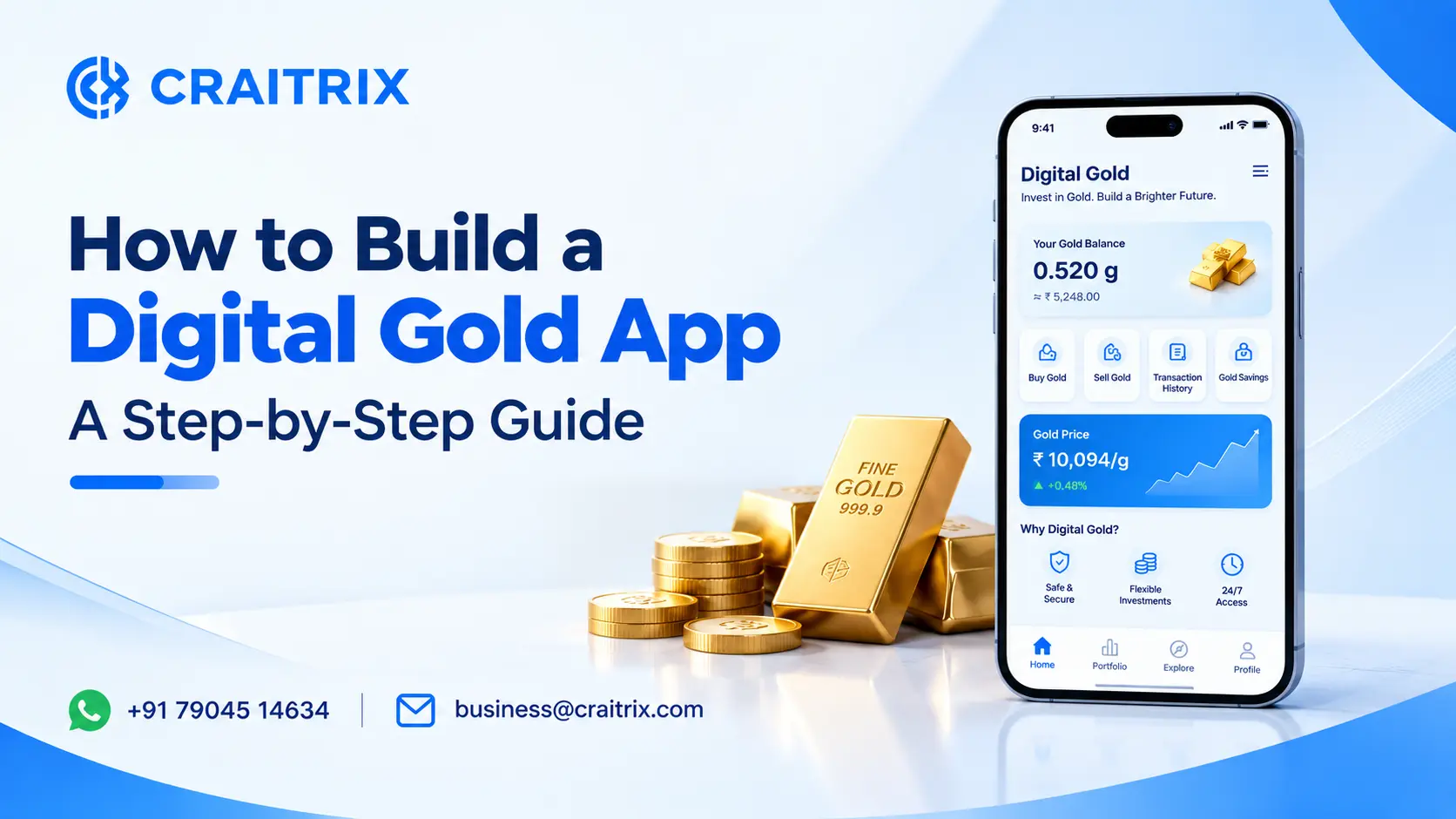
Why Businesses Are Exploring Digital Gold App Development
Gold has been a savings habit in a lot of households for generations. What’s changing is how people buy it. More customers now skip the jewellery shop for small purchases and just open an app to check the rate, buy a few grams, and see what they own.
If you’re a business wondering how to build a digital gold app, understand this early: the app screen is the easy bit. A price ticker and a buy button won’t carry you. What matters is the business model behind it, the gold-provider integrations, secure payments, clean transaction records, and straight answers to two questions. Where is the gold held? And how does a customer get it back?
Jewellers, fintech startups, and solo entrepreneurs can all sell digital gold under their own brand. How much work that takes depends on how you structure the product and what your external providers handle for you. Two apps that look identical can carry very different workloads.
This guide covers the entire digital gold app development process: choosing a business model, building and testing the platform, and launching a platform that can handle real customers paying real money.
How Does a Digital Gold App Work?
At its simplest, a digital gold app (often called a digi gold app) is a customer-facing front end connected to a few systems behind it. One supplies gold prices. One executes transactions. One takes payments. And one keeps track of what each customer owns.
A customer signs up, completes whatever verification is required, checks the price, and chooses how much to buy. The app then works with the gold provider to line up the payment and the gold transaction. Once both are confirmed, the purchase shows up in the customer’s holdings and history.
A single purchase usually goes like this:
- Customer registration: the user creates an account and completes any identity checks that apply.
- Gold price display: the app fetches the current buy or sell quote from the provider.
- Payment processing: the payment gateway handles the money and reports back a status.
- Gold purchase confirmation: the app checks what the provider actually sent back.
- Holdings update: the platform updates the customer’s records and reconciles the transaction.
Teams often get caught on this: a successful payment doesn’t mean the gold purchase went through. Your app has to check the provider’s confirmation and know what to do with transactions that are pending or have failed.
So give the backend, the ledger, and reconciliation as much attention as the screens. Customers only see the screens, but the other three decide whether the numbers are right.
Essential Features to Include in a Digital Gold App
What goes into your digital gold investment app depends on your audience, your gold provider, and how the product runs. For a first release, put your effort into reliable transactions and clear information. The fancy extras can come later.
1. User Registration and Identity Verification
People need an easy way to open an account, manage their profile, and complete whatever verification your model and the rules require.
Spell out what you’re asking for and why, get proper consent, and look after personal data. If verification fails or needs a manual review, say so in plain words so users aren’t left wondering.
2. Live Gold Prices and Buy/Sell Functionality
Show the live price, explain any charges and taxes, and let customers see exactly how much gold they’ll receive before they confirm.
Prices move. If a quote expires or the rate changes during checkout, fetch a fresh one and, where it’s needed, ask the customer to confirm again. Selling works the same way: show the rate clearly and state the settlement conditions.
3. Digital Gold Wallet and Transaction History
The dashboard should show what the customer holds, list past transactions with their details, and make the next possible actions obvious.
Give every transaction a unique reference, a clear status, and a record you can trace to the provider’s confirmation. And never show a pending transaction as if it were a completed purchase.
4. Recurring Savings and Physical Redemption
Depending on what your provider supports and how the product is structured, you could add scheduled purchases, gifting, or the option to redeem digital holdings for physical gold.
Recurring purchases need a payment schedule, a plan for failed payments, a way to cancel, and good records. Physical redemption needs clear details on eligibility, minimum quantities, fees, delivery, and order status.
5. Admin Dashboard and Transaction Reconciliation
Your own team needs a dashboard too, so they can monitor transactions, dig into exceptions, help customers who run into trouble, and pull operational reports.
Build in role-based access, audit logs, and provider reports. Staff should also be able to reconcile payment records, provider confirmations, and customer holdings against one another.
How to Build a Digital Gold App Step by Step
Knowing how to build a digi gold app starts with planning the business. From there it moves through provider integration, engineering, and testing, and it keeps going once you’re live.
Step 1: Define Your Business Model and Target Audience
Start with who the app is for and what problem it solves. A jewellery retailer may want customers coming back between purchases. A fintech startup may want to add gold to a financial product it already has.
Next, pick the format: a standalone app, a branded digital gold service, or a feature inside an app you already run.
That one decision shapes a lot, from features and user experience to provider relationships, revenue, and budget. It also settles what you’ll handle yourself and what you’ll leave to partners.
Step 2: Choose a Gold Provider and Clarify Custody Arrangements
Sourcing, custody, transaction execution, and redemption sit at the core of how your product works. Look hard at providers before you commit to an architecture.
Read their documentation and test their API. Compare pricing, custody arrangements, insurance terms, reconciliation reports, settlement, redemption support, and what the contract says about who’s responsible for what.
Don’t assume a provider’s API covers every legal or operational requirement. Get clear, written answers on who owns each part of a customer transaction, and on what happens if the provider goes down or a dispute comes up.
Step 3: Plan the User Experience and Application Architecture
Map the customer journey from sign-up to buying, selling, and managing the account. Keep the key details, like the rate, the fees, and the confirmation status, easy to grasp.
On the technical side, keep the app interface apart from core transaction processing. A typical solution has:
- A customer-facing mobile app or website
- A backend for accounts, business rules, and transactions
- Integrations for gold pricing, payments, and provider operations
- A transaction ledger and a reconciliation service
- An admin dashboard with monitoring and reporting tools
Splitting things up this way makes the platform easier to maintain. It also lets your team track down problems without relying only on what the customer interface shows.
Step 4: Integrate Gold Pricing, Payments, and Provider APIs
This step connects your app to the outside systems that supply prices and process transactions.
Your developers will deal with authentication, request validation, quote expiry, provider timeouts, payment callbacks, duplicate requests, and transaction updates that arrive later than expected.
Picture a customer whose payment goes through while the provider’s confirmation lags. The app should mark the transaction as pending, keep checking its status, and update holdings only when the right confirmation arrives.
A few safeguards help: idempotency controls, unique transaction references, retry policies, and signed webhook verification. They stop duplicate processing and block unauthorized updates.
Step 5: Implement Security and Applicable Compliance Requirements
Make security part of the architecture from the start. Adding it just before launch rarely goes well.
Use encrypted communication, secure credential management, tightly restricted admin permissions, proper session controls, and monitoring for suspicious activity. Collect and keep sensitive personal information only if you really need it, and limit who can see it.
Get qualified advice on your legal obligations too: customer disclosures, identity verification, data protection, payment processing, and the structure of your gold product.
In India, digital gold products aren’t automatically the same as regulated gold ETFs or other securities-market products. Check current official guidance and get professional advice before you launch.
Step 6: Develop and Test Transaction Workflows
Before launch, test the full transaction lifecycle. Checking that screens load and buttons work isn’t enough.
Cover successful purchases, but also failed payments, expired quotes, delayed provider responses, duplicate callbacks, refunds, sales, and redemption requests wherever you support them.
Check that holdings stay accurate when several events happen close together, and make sure every transaction can be traced across payment records, provider responses, and your internal ledger.
The habits in our guide on How to Reduce eCommerce Order Processing Errors carry over nicely: validate every order, track its status, reconcile records, and have a clear way to resolve exceptions. A digital gold platform just adds a few more things to watch, such as gold quantities, price quotes, and provider confirmations.
Step 7: Launch, Monitor, and Improve the Platform
Launch in a controlled way, and only after the critical transaction and security checks pass. Once you’re live, watch purchase completion, payment failures, pending transactions, reconciliation differences, support requests, and uptime.
Ask customers and your operations staff what they think. Their feedback shows which screens confuse people, where avoidable errors slip in, and what the next round of development should tackle.
Launch isn’t the end. Provider APIs change, security problems appear, and customers want new things. Plan for monitoring, incident response, software updates, and regular reviews of how the platform operates.
What Technology Is Needed for Digital Gold Platform Development?
For digital gold platform development, pick a stack that fits the project’s complexity, its integrations, your security needs, and how you’ll maintain it. No one stack is right for every digital gold product.
A common setup uses Flutter or native mobile tech for the app, a backend framework like Node.js or Java, a relational database for transaction records, and cloud infrastructure for deployment and monitoring.
The backend is where transaction rules and permissions should be enforced. Keep payment and gold-provider integrations behind well-defined services, and make sure the ledger and reconciliation processes leave a record you can trace.
Also think about backup and recovery, logging, automated testing, performance monitoring, and how easily you could investigate a discrepancy in the transaction data.
For an MVP, a well-structured app with clearly separated modules can be enough. You can add more services as transaction volume, integrations, and operational needs grow.
How Much Does Digital Gold App Development Cost?
Digital gold app development cost depends on the number of features, the platforms you target, how many provider integrations you need, your security requirements, and how complex the operations are.
A basic MVP with account management, gold pricing, purchase flows, transaction history, and one provider integration needs far less work than a multi-platform product with recurring savings, advanced reconciliation, physical redemption, analytics, and several providers.
The main cost factors are:
- UI/UX design: customer journeys, accessibility, and interface design.
- Application development: mobile apps, web applications, and backend functionality.
- Third-party integrations: gold-provider APIs, payment gateways, and identity verification services.
- Security and testing: transaction testing, vulnerability assessments, and recovery planning.
- Operations and maintenance: hosting, monitoring, support, updates, and provider charges.
Wait until your business requirements and provider responsibilities are clear before putting a number on it. When you ask for a proposal for digital gold app development services, have development fees listed separately from third-party charges, ongoing maintenance, and any commercial commitments the provider requires.
A digital gold app development company needs to look at your features, target platforms, integration documentation, and launch requirements before it can give you a believable estimate. If someone quotes a firm figure or timeline before that, they’re guessing.
Common Challenges in Building a Digital Gold Platform
A digital gold app can look simple from the outside. Underneath, a few operational problems need real planning.
- Inconsistent transaction statuses: payment systems and gold providers don’t always update at the same moment, so the app needs a dependable way to settle transactions stuck in pending.
- Pricing changes: gold can move between a quote being generated and a purchase being confirmed. Handle expired quotes, and tell customers about the new price clearly.
- Reconciliation errors: your records won’t always match provider reports or payment settlements. Automated comparisons, alerts for exceptions, and documented fixes make gaps easier to catch.
- Provider dependency: outages, API changes, and slow responses can break key journeys. Monitoring, retry mechanisms you’ve actually tested, and clear fallback steps all matter.
- Customer trust: vague fees, redemption terms, custody arrangements, or transaction statuses lead to disputes. Build in transparent disclosures and support people can easily reach.
Deal with these during planning and testing. Learning about them from customers after launch costs a lot more.
How to Choose the Right Digital Gold App Development Company
Choosing a digital gold app development company takes more than comparing proposals side by side. Look for a team with real experience in transaction-heavy apps, external API integrations, data security, and operational monitoring.
Before you commit, ask how the team will:
- Design the application architecture and the transaction lifecycle
- Integrate your chosen gold provider and payment gateway
- Keep holdings and reconciliation records accurate
- Handle failed transactions, duplicate events, and provider outages
- Test security and protect customer information
- Support the platform after launch
A good partner will also be upfront about who is responsible for what: the software team, the gold provider, you as the business owner, and your legal or compliance advisers.
At Craitrix, businesses can explore our digital gold app development services to plan and build a platform that fits their business model, feature requirements, and integration needs.
Build a Digital Gold App That Is Ready for Real-World Use
Building a digital gold app takes product planning, secure engineering, reliable provider integrations, and well-run transaction operations, all working together. Start with a clearly defined business model and an MVP that gets the essential customer journeys right.
Once those core workflows are solid, you can grow into recurring purchases, gifting, redemption, and advanced reporting, guided by what your customers want and what your provider supports.
If your business is planning a digital gold platform, explore Craitrix Digi Gold App Development Company service to talk through the scope, integrations, and technical requirements of your project.