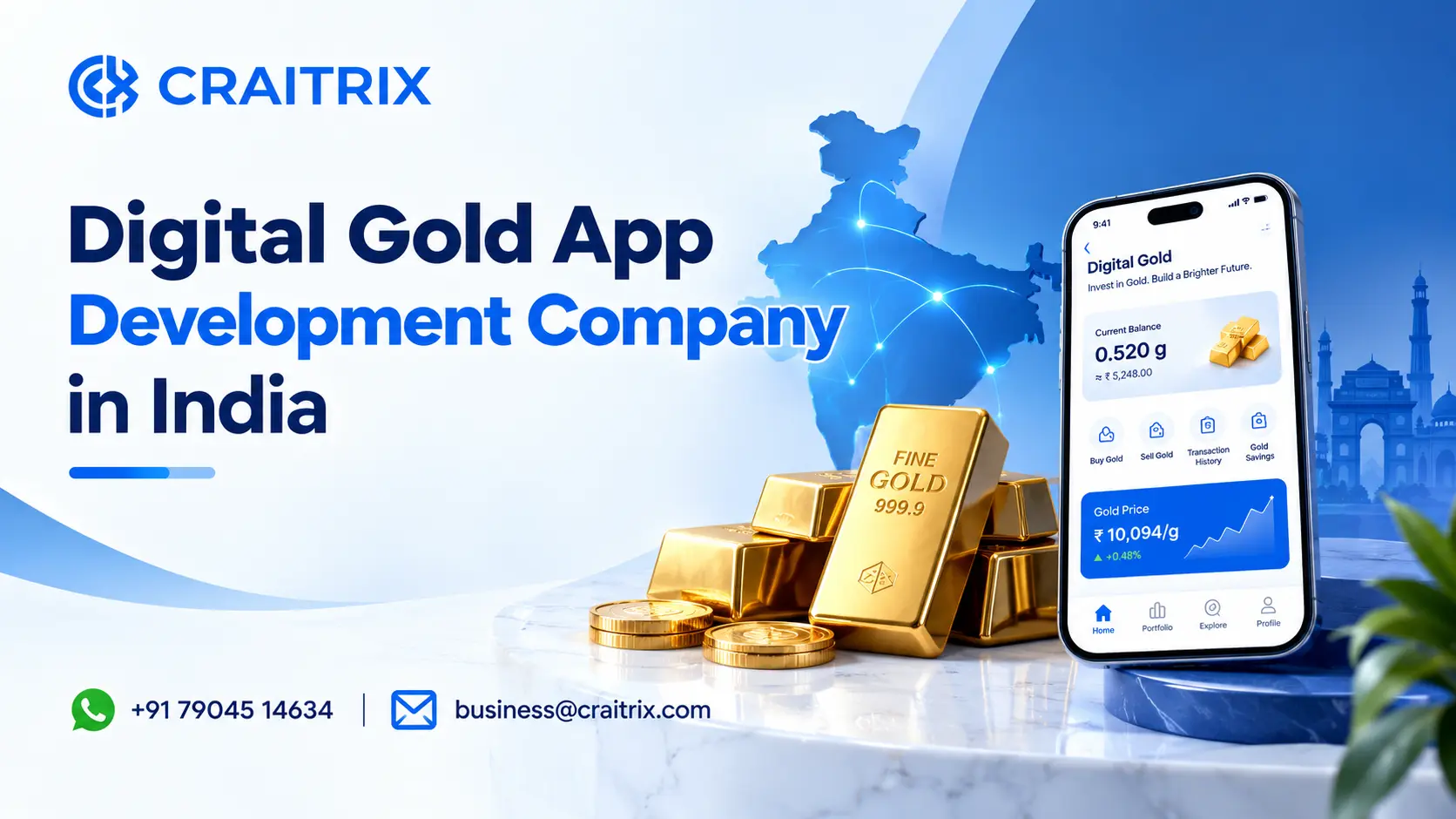
Gold has always held a special place in Indian households. People buy it for weddings, festivals, family savings, and long-term financial goals. But the way people purchase gold is changing. Today, customers can buy gold conveniently through their smartphones without visiting a jewellery store or worrying about storing physical gold at home.
This shift has created opportunities for jewellery businesses, fintech startups, and entrepreneurs interested in offering digital gold investment services. However, building a successful app involves more than adding a gold price display and a payment button. Businesses need a suitable operating model, a reliable gold provider, secure payment processing, transparent pricing, and a user experience that customers can trust.
If you are planning to enter this market, understanding how to build a digital gold app in India can help you plan the right features, estimate the investment, and prepare for the responsibilities involved in launching a gold-related digital platform.
What Is a Digital Gold App and How Does It Work?
A digital gold app is a platform that allows customers to buy, sell, and track gold through a mobile application or website. Instead of handling and storing the gold themselves, users interact with a digital service where their purchases and holdings are recorded according to the arrangement offered by the gold provider. Digital gold app development involves building the technology needed to support these transactions, manage customer accounts, integrate payment systems, and maintain accurate transaction records.
The gold allocation, custody, storage, selling, and redemption processes depend on the business model and the gold provider. These responsibilities should be clearly defined before development begins.
How Does a Digital Gold App Work?
The typical customer journey of a digital gold buyer is as follows: The customer can register with the necessary personal information.
Identity verification: The platform does the required verification process before procedures that are related to it are allowed.
Gold price checking: The customer can see the price at which the gold is being bought or sold, along with any fees or taxes.
Gold Purchase: The Customer chooses an amount or quantity of gold and proceeds to payment.
Payment processing: The payment gateway handles the payment, and the application is notified of the payment status.
Transaction confirmation: This can only be done after the platform confirms the transaction by checking the payment and getting the required feedback from the gold provider. As well as the transaction history, the customer’s account will show recorded gold.
Selling or redemption: The customer can sell the gold or ask for physical delivery depending on the services provided by the gold provider and the related terms.
The platform can utilize payment gateway integrations, notification services, a transaction ledger, a gold provider API, and an administrative dashboard behind this process.
The accuracy of the transactions is an important point to consider. For instance, a payment can be successful, and the gold provider may need more time to verify the transaction. The application should indicate whether the transaction is pending or not, rather than showing the transaction as completed or requiring the customer to pay again.
Why Are Digital Gold Apps Gaining Attention in India?
What’s making Digital Gold Apps Popular in India?
Although gold remains a significant part of the Indian household, there is a rising demand for hassle-free digital options. Digital gold platforms are an alternative approach for those who wish to purchase gold without having to venture out to a physical store for each purchase.
There are a number of reasons why this is a good business opportunity to investigate.
Convenience and flexible purchase options.
In traditional gold buying, the transaction might go through a store, where one would choose a gold item and think of storage or security after buying it. Digital gold platforms can streamline the process of buying gold by making it easier for customers to buy the quantity they can.
Depending on the provider, customers can start with smaller monetary amounts as opposed to buying a whole coin or jewellery piece. Each platform has its own minimum purchase amount, applicable fees, and options for transactions.
Opportunities for Jewellery Businesses
Jewellery stores can tap the digital space to supplement and enhance their customer relationships. Using a digital platform can allow customers to check gold prices, keep track of purchases, and avail of supported buying or redemption.
If you have existing customers, an app can offer an alternative method of customer engagement, in addition to the shop. But, it is left to the business model and agreement with the provider to specify how gold transactions will actually be implemented.
Potential for Fintech Startups
Fintech entrepreneurs may see digital gold as an opportunity to build a specialised financial services experience. Depending on the business arrangement, a platform might focus on customer onboarding, transaction management, digital interfaces, and integrations with an eligible gold provider.
The opportunity should be evaluated carefully. Customer demand alone does not guarantee profitability. Provider agreements, customer acquisition costs, transaction margins, operating expenses, applicable legal requirements, and customer trust all influence the viability of the business.
Better Visibility into Customer Transactions
A well-designed application can give users access to transaction histories, purchase confirmations, recorded holdings, and relevant account information. For businesses, administrative reporting can improve visibility into transaction statuses, customer activity, and reconciliation issues.
The key is to make the service understandable. Customers should know what they are buying, how their gold is recorded, what charges apply, and which conditions govern selling or redemption.
How to Build a Digital Gold App in India: Step-by-Step Process
Building a digital gold app requires coordinated business planning, provider selection, application development, integration, testing, and operational preparation. Following a structured process helps reduce avoidable rework and creates a clearer path from idea to launch.
Step 1: Define Your Business Model and Target Audience
Start by deciding who the application will serve and what role your business will play.
For example, you may be a jewellery retailer looking to extend your business online, a startup planning a gold-focused digital platform, or an established company adding digital gold services to an existing application.
Your business model should clarify:
- Who will provide the gold-related service?
- Who will be responsible for custody, allocation, and transaction fulfilment?
- How will the platform generate revenue?
- Which buying, selling, or redemption options will be available?
- What customer verification and support processes will be required?
- Which markets and customer segments will the application serve?
These decisions affect the required features, integrations, legal review, operating expenses, and development timeline.
Step 2: Choose a Reliable Gold Provider
The gold provider is one of the most important parts of a digital gold platform. Before choosing a partner, evaluate its operating model, commercial terms, technical capabilities, and transaction processes.
Ask potential providers about:
- Gold pricing and applicable fees.
- How purchases and holdings are recorded.
- Custody and storage arrangements.
- Selling, settlement, and redemption options.
- API documentation and integration support.
- Transaction confirmation and reconciliation processes.
- Service availability and downtime handling.
- Customer dispute resolution and responsibilities.
Do not choose a provider based only on the availability of an API. The platform also needs reliable transaction records, clear service responsibilities, and a practical process for handling failed or delayed transactions.
Step 3: Plan the Features and Customer Journey
Before development begins, map the complete customer journey from registration to purchase, account management, selling, and customer support.
Identify the features required for the first release and separate them from improvements that can be introduced later.
For example, the first version may focus on registration, required verification, gold prices, buying, payment processing, transaction history, and administrative reporting. Features such as recurring purchases, advanced analytics, or additional redemption options can be evaluated according to customer needs and provider capabilities.
Planning the customer journey also means considering situations where things do not go as expected. What happens if a payment fails? What if the provider takes several minutes to confirm a purchase? How will the user receive an update if a transaction is reversed?
Answering these questions early helps prevent confusing experiences after launch.
Step 4: Design a Simple and Trustworthy User Experience
Money-related transactions require clarity. Customers should be able to understand the buying process without navigating a complicated interface.
A well-designed digital gold app should display the current applicable gold price, purchase amount, estimated gold quantity, charges, taxes where applicable, and relevant terms before the customer confirms a transaction.
The interface should also make account balances and transaction statuses easy to understand. Clear labels such as Pending, Completed, Failed, and Refund Initiated can reduce confusion when supported by the actual transaction workflow.
During the design stage, consider accessibility, readable typography, straightforward navigation, and a consistent layout across supported devices. Avoid making claims about guaranteed returns or presenting gold purchases as risk-free investments.
Step 5: Develop the App and Integrate Essential APIs
Once the requirements and design are ready, development can begin.
The application may need integrations for live gold pricing, buying and selling, identity verification, payment processing, notifications, and physical redemption if the chosen provider supports it.
Each integration should have a clearly defined responsibility. The payment gateway handles payment processing, while the gold provider may handle price information, purchase confirmation, holdings records, or fulfilment. The exact division of responsibilities depends on the agreements and API capabilities.
The backend should validate important transaction details rather than relying on values supplied by the mobile application. It should also maintain consistent transaction records and handle duplicate requests, delayed responses, failed integrations, payment reversals, and reconciliation.
For example, if a user taps the purchase button twice, the backend should prevent unintended duplicate transactions. If a payment succeeds but the provider response is delayed, the system should preserve the transaction state and reconcile it before showing a final outcome.
Step 6: Implement Security and Review Compliance Requirements
Security and compliance planning should begin before the application is ready to launch.
Use appropriate authentication, access controls, encryption, secure API communication, monitoring, and audit logs. Sensitive information should be accessible only to authorised systems and personnel. Administrative access should follow the principle of least privilege, and security testing should be included in the release process.
The legal and compliance requirements depend on the entities involved, the product structure, the services offered, how payments and customer data are handled, and the business’s role in the transaction. A development team cannot establish regulatory compliance through software implementation alone.
Before launch, obtain appropriate legal and compliance advice on the proposed operating model, customer disclosures, identity verification, payment processing, data protection, advertising claims, and any applicable registration or authorisation requirements.
Step 7: Test the Application Before Launch
Testing should cover the complete transaction journey, not just whether each screen works.
Important scenarios include:
- Successful and failed payments.
- Duplicate purchase requests.
- Delayed gold provider responses.
- Changes in gold prices during checkout.
- Refunds and payment reversals.
- Incorrect or incomplete verification details.
- Network interruptions.
- Mismatched transaction records.
- Selling and redemption workflows, where supported.
- Unauthorised access and other security risks.
Test the app on supported devices and network conditions. Before a public launch, consider a controlled pilot with a limited audience so that usability problems, support requirements, and transaction issues can be identified early.
Step 8: Launch, Monitor, and Improve
Launching the application is the beginning of ongoing operations, not the end of development.
Monitor transaction success rates, payment failures, provider API response times, reconciliation exceptions, customer support requests, and points where users abandon the purchase process.
Use these insights to prioritise improvements. For instance, frequent support requests about transaction status may indicate that confirmation messages need to be clearer. Repeated reconciliation problems may require improvements to the backend workflow or provider integration.
As usage grows, review infrastructure capacity, support processes, monitoring, and operational controls before adding more features or expanding to new markets.
Essential Features of a Digital Gold Investment App
The right feature set depends on the business model and provider arrangement. However, most digital gold applications need several core capabilities to support a reliable customer experience.
1. Customer Registration and Verification
Allow users to create accounts through a simple onboarding process. Integrate identity verification where required to support secure account management.
2. Live Gold Prices and Transparent Pricing
Display current gold prices, purchase quantities, and applicable charges. Show price changes clearly before users confirm transactions.
3. Gold Buying and Selling
Enable users to buy or sell gold through a straightforward transaction flow. Display order details, confirmation messages, and transaction status based on provider capabilities.
4. Digital Wallet and Transaction History
Let users view their gold holdings, account details, and past transactions in one place. Use reliable backend records to keep displayed balances and transaction details accurate.
5. Secure Payment Gateway Integration
Integrate a suitable payment gateway to process transactions securely. Provide clear updates for successful payments, failures, reversals, and applicable refunds.
6. Recurring Purchases
Allow users to schedule regular gold purchases where the service supports this feature. Clearly explain payment authorisation, purchase schedules, and cancellation options.
7. Physical Gold Redemption
Allow users to exchange eligible digital gold holdings for physical gold where redemption is available. Display product options, delivery terms, applicable charges, and order tracking details.
8. Admin Dashboard and Reporting
Give administrators tools to manage customer accounts, monitor transactions, and review verification statuses. Include reconciliation reports, support management, and audit records to improve operational control.
Technology Required to Develop a Digital Gold App
The technology stack should be selected according to the expected workload, integration requirements, security needs, and future plans. There is no single stack that is suitable for every digital gold platform.
Mobile App Development
Cross-platform frameworks such as Flutter can support Android and iOS development through a shared codebase. Native development may be appropriate when a project requires platform-specific capabilities or particular performance characteristics.
The choice should consider the required features, available development expertise, maintenance needs, and budget.
Backend Development
The backend manages business logic, user accounts, transaction records, provider integrations, and administrative functions. A suitable server-side technology, such as Node.js or another framework aligned with the project requirements, can be used.
The architecture should support transaction validation, controlled access, error handling, and reliable processing of asynchronous events.
Database and Transaction Records
A suitable database stores application data and supports consistent transaction records. The design should consider auditability, backups, access restrictions, and reconciliation with external provider records.
For a gold-related application, transaction history and holdings records require particular care because discrepancies can affect customer trust and support operations.
API Integrations
Depending on the chosen provider and business model, integrations may include:
- Gold pricing and transaction APIs.
- Payment gateway APIs.
- Identity verification services.
- SMS, email, and push notification services.
- Physical redemption or delivery services, where supported.
- Analytics and customer support tools.
Every integration should have clear error handling, timeout management, and monitoring.
Cloud Infrastructure and Security
Cloud infrastructure can support application hosting, databases, backups, monitoring, and scaling. The final setup should be based on expected traffic, availability needs, data-handling requirements, and operating costs.
Security should be built into the architecture rather than treated as a final development task. This includes secure configuration, access management, dependency updates, logging, and ongoing vulnerability assessment.
Legal and Compliance Considerations for Digital Gold Apps in India
Before development, define your business model, provider responsibilities, and applicable legal requirements with qualified professionals.
- Provider Agreements: Clarify gold supply, custody, fulfilment, pricing, settlements, and customer complaint handling.
- Customer Verification and Data Protection: Identify required verification steps and protect customer information through appropriate privacy policies and security controls.
- Payments and Disclosures: Follow applicable payment requirements and clearly communicate fees, transaction terms, redemption limits, and refund policies.
- Legal Review: Verify applicable regulations, registrations, and authorisations. Partnering with a gold provider does not automatically remove all compliance obligations.
How Much Does It Cost to Build a Digital Gold App in India?
The digital gold app development cost in India depends on the app’s features, customization, integrations, security, and scalability. A basic app may include user registration, gold price display, buying and selling workflows, transaction history, and an admin panel to manage users and transactions.
Advanced applications can include live gold price API integration, payment gateways, automated transaction tracking, recurring purchases, physical gold redemption, advanced reporting, and enhanced security. The right scope depends on your business model, operational requirements, and future growth plans.
How Can You Control Development Costs?
Start with a clearly defined minimum viable product (MVP). Focus on the essential customer journey and the integrations needed to deliver it reliably.
Confirm provider capabilities before finalising the feature list. Build and test critical transaction workflows early, and avoid investing in optional features before validating customer needs and operational readiness.
A phased approach helps businesses make informed decisions about what to build first and what can be introduced after the initial release.
How to Choose the Right Digital Gold App Development Company in India
Choosing a development partner is about more than comparing quotations. The team should understand how mobile applications, payment workflows, external APIs, and transaction records work together.
Before selecting a company, evaluate the following areas.
Experience With API-Driven Applications
Ask whether the team has experience integrating third-party services, handling asynchronous responses, and maintaining consistent records across connected systems. Relevant experience can be more valuable than a long feature list.
Security and Transaction Reliability
Discuss authentication, access controls, data protection, audit logs, and transaction reconciliation. Ask how the team plans to handle failed payments, delayed provider confirmations, duplicate requests, and refunds.
Clear Scope and Cost Breakdown
A proposal should identify the features included, assumptions, integrations, testing activities, exclusions, estimated timeline, and payment milestones. This makes it easier to compare proposals fairly.
Documentation and Future Maintenance
Confirm who will own the source code and project assets, what documentation will be delivered, and how maintenance or future enhancements will be handled.
Transparent Communication
A dependable development partner should explain technical decisions in understandable language, raise risks early, and distinguish development responsibilities from provider, legal, and compliance responsibilities.
The right company will help you turn your business requirements into a realistic project plan rather than promising features or timelines without understanding the scope.
Build Your Digital Gold App With Craitrix
Craitrix helps businesses develop digital gold applications tailored to their needs, with features such as user registration, gold price integration, buying and selling workflows, payment gateways, transaction history, and admin dashboards.
From MVP planning to scalable architecture, we help you define your requirements, costs, and development roadmap.
Ready to get started? Explore our Digital Gold App Development Company services and discuss your project with Craitrix.
Frequently Asked Questions About Digital Gold App Development
Q1. How do I build a digital gold app in India?
To build a digital gold app in India, define your business model, choose a suitable gold provider, plan the essential features, design the customer journey, and develop the application with the required APIs and payment integrations. You should also review security, transaction reconciliation, legal requirements, testing, and ongoing support before launch.
Q2. How much does digital gold app development cost in India?
The digital gold app development cost in India depends on the app’s features, customization, integrations, and security requirements. Basic apps include essential user features and transaction workflows, while advanced solutions offer live gold pricing, automated transactions, recurring purchases, physical gold redemption, and detailed reporting. The final investment depends on your business needs.
Q3. Is a digital gold app profitable in India?
A digital gold app may create a business opportunity, but profitability is not guaranteed. It depends on the business model, provider terms, revenue sources, customer acquisition costs, transaction volume, support expenses, and applicable compliance obligations. Businesses should validate demand and operating costs before making a major investment.
Q4. What features should a digital gold investment app include?
Core features commonly include customer registration, required identity verification, gold price display, buying and selling workflows, payment integration, transaction history, account holdings, notifications, and an admin dashboard. Recurring purchases and physical redemption can be added if they are supported by the provider and permitted under the applicable arrangements.
Q5. How long does it take to develop a digital gold app?
A basic MVP may take approximately three to five months, while a more complex platform may take six months or longer. These are planning estimates, not guaranteed timelines. Provider integration, compliance review, feature scope, testing, and third-party dependencies can affect the delivery schedule.
Q6. Do I need a gold provider to launch a digital gold app?
If your application is intended to offer actual digital gold purchases, you generally need a suitable arrangement with an entity that can support the gold-related service. The exact arrangement depends on your business model and legal structure. Confirm the provider’s capabilities, contractual responsibilities, transaction processes, and applicable requirements before development.
Q7. How can I choose a digital gold app development company in India?
Evaluate the company’s experience with mobile applications, third-party API integrations, payment workflows, security, testing, and transaction handling. Request a clear scope, cost breakdown, project timeline, source-code ownership terms, documentation, and maintenance plan. Also ensure that legal and compliance responsibilities are addressed separately with qualified professionals.