If you have ever ordered dinner, booked a cab, or called a plumber from your phone, you have already lived inside the On-Demand Economy. It is not a trend anymore, it is how people expect services to work. And that is exactly why so many founders and business owners are now trying to figure out how to build an on-demand app that actually holds up once real users start relying on it.
The appeal is obvious. On-demand platforms connect a need with a solution in minutes, whether that need is a burger, a bag of groceries, a taxi, or a haircut. But building one is not just about slapping together a booking screen and a payment button. It takes the right business model, the right features, the right technology stack, and a development partner who understands how these apps behave under real-world pressure spikes in demand, live tracking, delayed drivers, refund disputes, and everything in between.
This guide walks through what an on-demand app actually is, how it works behind the scenes, the different types you can build, the features that matter most, the tech stack that powers them, the step-by-step process to build one, and what it typically costs. By the end, you will have a clear, practical picture of what it takes to go from idea to a working, scalable product.
What Is an On–Demand App?
An on-demand app is a mobile or web platform that connects users who need a service with providers who can deliver it, almost instantly. Think of it as a digital middleman that removes the waiting, the phone calls, and the guesswork out of getting something done.
Instead of driving to a restaurant, calling a cab company, or searching for a nearby electrician, users open an app, place a request, and get matched with someone nearby who can fulfill it often within minutes. The entire experience is built around speed, convenience, and trust.
How Does an On–Demand App Work?
At its core, an on-demand app runs on a three-sided structure: the customer, the service provider, and the admin panel that keeps everything organized in the background.
Here is the general flow:
A customer opens the app and places a request Like ordering food or booking a ride.
The system matches that request with an available provider based on location, availability, and sometimes ratings.
The provider accepts the request, and the customer can track progress in real time.
Once the service is completed, payment is processed automatically, and both sides can leave a rating.
Behind this simple-looking flow sits a fairly complex engine — GPS tracking, push notifications, payment gateways, and databases that update in real time so nobody is left staring at a spinning wheel wondering what is happening.
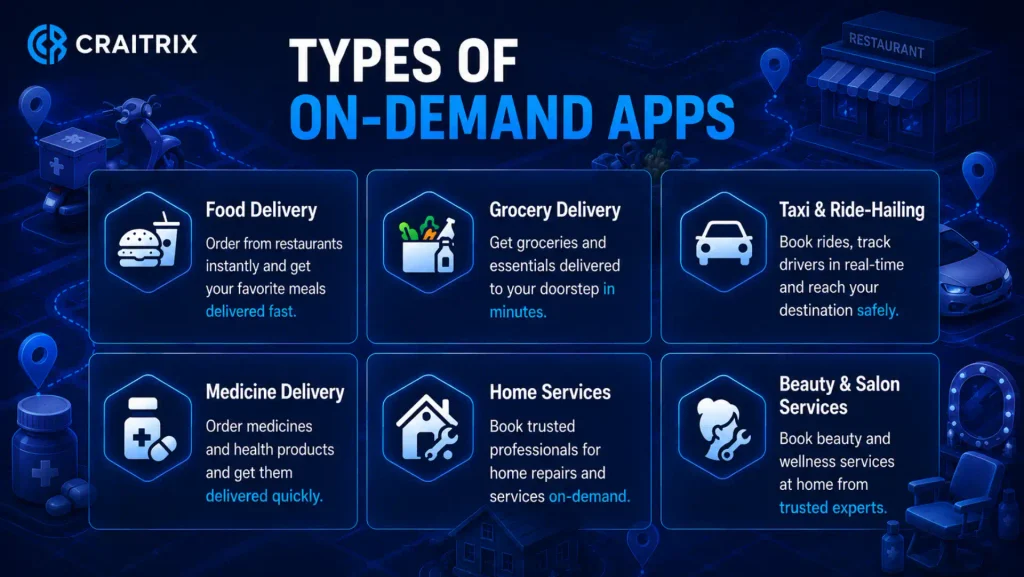
Types of On-Demand Applications
Not all on-demand apps solve the same problem, and the features you need will shift depending on which category you are building in. Here are the categories that dominate the market right now.
Food delivery
Food delivery apps sit at the center of daily convenience. Platforms like DoorDash and Zomato have permanently shifted how people eat — ordering has replaced the ten-minute call to the restaurant. A well-built on-demand food delivery app makes menu browsing effortless, keeps the order status visible from kitchen to doorstep, and remembers what a customer ordered last time so reordering takes seconds, not minutes.
Grocery delivery
Groceries are non-negotiable, which is exactly why this category exploded the way it did. Apps like Instacart and BigBasket showed how an on-demand grocery delivery app could take something as routine as a weekly shop and turn it into a five-minute task from a couch. Local grocers who couldn’t compete on footfall suddenly had a way to compete on convenience instead, and that shift is still playing out across smaller cities and towns.
Taxi & ride-hailing
Ride-hailing is where the on-demand model first proved itself at scale, and Uber remains the reference point most people measure against. Accurate GPS, fair pricing that updates in real time, and a driver-side experience that’s just as smooth as the rider’s get those three right and the rest of the app is comparatively easy.
Medicine delivery
Health emergencies don’t wait for pharmacy hours, and that urgency is what medicine delivery apps solve for. Bodies like the WHO have pushed for stronger telemedicine and digital health infrastructure, and apps like Doctor on Demand have ridden that shift — consultations and prescription deliveries that once took a full day now happen in under an hour. Building in this space means profit, yes, but it also means building something a community genuinely needs.
Home services
Letting a stranger into your home for a repair or a haircut used to require a recommendation from someone you trust. Platforms like Housecall Pro changed that equation by putting verification front and center — every electrician, cleaner, or stylist vetted before they ever show up at a customer’s door. That’s the real value proposition behind on demand home services app development: not just booking convenience, but the safety layer that makes booking a stranger feel reasonable in the first place.
Key Features of an On-Demand App
An on-demand platform typically consists of three connected components: a customer app, a service provider app, and an admin panel. Each plays a different role in managing bookings, services, payments, and overall platform operations.
Customer App
The customer app should make it easy for users to find services, place orders or bookings, make payments, and track their requests.
- Simple Sign-Up and Login: Allow users to register quickly using email, phone numbers, or social login.
- Search and Filters: Help users quickly find the right service, provider, product, or location.
- Real-Time Tracking: Let customers track orders, bookings, or service providers in real time.
- Multiple Payment Options: Support cards, digital wallets, UPI, and other relevant payment methods.
- In-App Chat or Calls: Enable customers to communicate directly with service providers when needed.
- Ratings and Reviews: Allow users to rate services and share their experiences.
- Order or Booking History: Give customers access to their previous and ongoing orders or bookings.
Service Provider App
The provider app helps service professionals manage requests, availability, navigation, earnings, and customer interactions.
- Availability Toggle: Providers can easily switch between available and unavailable status.
- Request Accept/Reject: Allow providers to review and respond to incoming service requests.
- Navigation and Route Optimization: Provide directions and optimized routes for location-based services.
- Earnings Dashboard: Let providers monitor completed jobs, earnings, commissions, and payouts.
- Instant or Scheduled Payouts: Provide convenient options for receiving their earnings.
Admin Panel
The admin panel acts as the control center of the platform. It allows businesses to manage users, providers, transactions, services, and overall operations from one place.
- User and Provider Management: Manage accounts, profiles, verification, and access permissions.
- Live Analytics and Reporting: Monitor bookings, revenue, users, providers, and other important metrics.
- Dispute Resolution: Handle complaints, cancellations, refunds, and conflicts between customers and providers.
- Commission and Pricing Controls: Configure commissions, service charges, pricing rules, and promotional offers.
- Push Notification Management: Send important updates, offers, reminders, and alerts to users and providers.
Why the Admin Panel Matters
A common mistake is to focus heavily on customer-facing features while treating the admin panel as an afterthought. A well-designed admin system is essential for scaling operations, resolving issues, monitoring performance, and making data-driven decisions as the platform grows.
Technology Stack for On–Demand Apps
The right stack depends on your budget, timeline, and how much scale you are planning for, but most on-demand mobile app development projects lean on a fairly consistent set of tools.
| Layer | Common Choices |
| Frontend (mobile) | Flutter, React Native (for cross-platform speed) |
| Frontend (web) | React.js, Next.js |
| Backend | Node.js, Django, Laravel |
| Database | MongoDB, PostgreSQL, Firebase |
| Real-time tracking | Google Maps API, Mapbox |
| Payments | Stripe, Razorpay, PayPal |
| Cloud & hosting | AWS, Google Cloud |
| Push notifications | Firebase Cloud Messaging |
How to Build an On-Demand App
This is where the real planning happens. Building an on-demand app is not a single task — it is a sequence of decisions that each shape the next one. Here is the process broken down step by step.
Define your business model
Before any design or code, decide how you will make money. Commission per transaction, subscription fees for providers, delivery charges, or a hybrid of these — this choice affects your entire feature set and pricing logic later on.
Identify target users
Know exactly who you are building for. A grocery app for busy urban professionals looks and behaves differently than one built for a smaller town where same-day delivery is the main draw. This shapes your UI decisions, your onboarding flow, and even your marketing.
Plan core features
Go back to the feature list above and decide what is essential for launch versus what can wait for version two. Trying to build everything at once is one of the fastest ways to blow your budget before you even launch.
Choose the technology stack
Pick tools that match your scale expectations, not just what is popular. A small regional service app does not need the same infrastructure as a platform planning to operate across multiple cities within a year.
Design the UI/UX
On-demand apps live or die by how fast and intuitive they feel. Every extra tap between “I need this” and “it is booked” costs you conversions. Prioritize clean navigation, minimal form fields, and visual feedback at every step.
Develop the app
This is where your development team builds out the three apps: customer, provider, and admin — usually in parallel sprints so testing can begin early rather than at the very end.
Integrate payments & notifications
Payment gateway integration needs rigorous testing across currencies, refund flows, and failed transaction handling. Push notifications, meanwhile, need to be timely without becoming spammy enough that users disable them.
Test the application
Beyond standard QA, on-demand apps need load testing to simulate peak-hour traffic and location-based testing to catch GPS or mapping issues before real users do.
Launch and maintain
Launch is not the finish line. Expect to monitor crash reports, gather user feedback, and push regular updates, especially in the first few months when usage patterns reveal problems you could not predict on paper.Working with an experienced on-demand app development company can shorten this entire timeline considerably, since a lot of these steps overlap when handled by a team that has already solved these problems before.
How Much Does It Cost to Build an On–Demand App?
This is usually the first question founders ask, and understandably so. The honest answer is: it depends on scope, but here is a realistic breakdown.
Basic MVP (single service, core features only): roughly $8,000–$15,000
Mid-range app (multiple features, custom UI, payment integration): roughly $15,000–$35,000
Enterprise–grade platform (multi-city, advanced analytics, high scalability): $40,000 and above
The cost to develop a on demand app also depends on factors like the number of platforms (iOS, Android, web), design complexity, third-party integrations, and whether you are building from scratch or using a semi-customizable base. Ongoing costs matter too — server hosting, API usage fees, and regular maintenance typically run 15–20% of the original development cost per year. A smart move for most founders is starting with a lean MVP to validate the idea in a real market before investing in every advanced feature.
Benefits of Building an On–Demand App
Faster revenue cycles: transactions happen quickly and repeatedly, unlike traditional service models with long sales cycles.
Scalability: once the core system works, expanding to new cities or service categories is mostly a matter of adding supply, not rebuilding the platform.
Data-driven decisions: every order, cancellation, and rating gives you information to improve pricing, matching, and service quality.
Stronger customer loyalty: convenience keeps users coming back, especially when the experience feels frictionless.
Lower operational overhead: much of the coordination that used to require phone calls and manual dispatch is now automated.
Common Challenges in On–Demand App Development
Building one of these platforms is rarely as smooth as the pitch deck makes it look. A few recurring challenges show up across almost every project:
Balancing supply and demand: few providers frustrates customers, too many providers frustrates earnings potential on the provider side.
Real-time performance at scale: GPS tracking and live updates that work fine with 100 users can break under 10,000.
Payment and refund complexity: especially for platforms operating across multiple regions or currencies.
Trust and safety: background checks, verified reviews, and dispute resolution all need to be built in from day one, not bolted on later.
Retention beyond the first order: acquiring users is one problem, keeping them engaged long-term is a completely different challenge that needs its own strategy.
None of these are dealbreakers, but they are exactly why cutting corners during planning or development tends to cost more in the long run than doing it right the first time.
Why Choose Craitrix for On–Demand App Development?
Craitrix develops platforms on-demand, and not the demo-day version of the idea. The team starts by getting the fundamentals right, from the proper business model to the tech stack that can actually support growth without anything flashy getting added on.
Craitrix’s success as an on demand app development company is in the pragmatics of scope helping founders to launch a focused MVP instead of overbuilding and then scale the features based on actual user behavior rather than assumptions. The team has experience in the food delivery, grocery, home services, and ride-hailing verticals, so they’re familiar with the unique challenges each vertical faces.
If you’re ready to take your idea and see it become an on-demand platform, Craitrix can help you plan, design and create your platform with a tech stack that suits your business forward trajectory, not just current position.
Frequently Asked Questions
Q1. How do you build an on-demand app?
Ans: Building an on-demand app typically involves defining the business model, identifying target users, planning core features, choosing the technology stack, designing the UI/UX, developing customer and provider apps with an admin panel, integrating payments and real-time services, testing the platform, and launching it with ongoing maintenance.
Q2. How much does it cost to build an on-demand app?
Ans: The cost to build an on-demand app depends on its features, complexity, platforms, integrations, design, and scalability requirements. A basic MVP may cost around $4,000–$15,000, while mid-range can require $15,000–$35,000 And and enterprise-level platforms $40,000+ respectively.
Q3. What are the essential features of an on-demand app?
Ans: Essential features include user registration, service search, booking or ordering, real-time tracking, multiple payment options, push notifications, ratings and reviews, in-app communication, booking history, provider availability management, earnings tracking, and an admin dashboard for managing users, providers, payments, and operations.
Q4. How does an on-demand app work?
Ans: An on-demand app connects customers with nearby or available service providers. A customer submits a request, the system matches it with a suitable provider based on factors such as location and availability, the provider accepts the request, and the customer can track the service in real time before payment and review are completed.
Q5. What are the main types of on-demand apps?
Ans: Common types of on-demand apps include food delivery, grocery delivery, taxi and ride-hailing, medicine delivery, home services, courier and logistics, beauty services, and other service marketplaces. The required features and workflows vary depending on the industry and business model.
Q6. What apps are required for an on-demand platform?
Ans: A complete on-demand platform usually includes three main components: a customer app for booking or ordering services, a service provider app for managing requests and earnings, and an admin panel for controlling users, providers, bookings, payments, pricing, disputes, analytics, and platform operations.
Q7. What technology stack is used to build an on-demand app?
Ans: An on-demand app can be built using technologies such as Flutter or React Native for cross-platform mobile development, React.js or Next.js for web applications, Node.js, Django, or Laravel for backend development, and databases such as PostgreSQL, MongoDB, or Firebase. Maps, payment, cloud, and notification APIs are also commonly integrated.
Q8. How long does it take to develop an on-demand app?
An on-demand app typically takes 3–6 weeks for a basic app, 3–6 months for a medium-complexity app, and 6–9 months for an advanced app. The timeline depends on the number of features, platforms, integrations, customization, testing, and scalability requirements.
Q9. How can an on-demand app match customers with service providers?
Ans: An on-demand app can use a matching or assignment system based on factors such as provider availability, location, service type, workload, and business rules. The platform then sends the request to an appropriate provider, who can accept or reject it before the booking continues.
Q10. How can I build a scalable on-demand app?
Ans: To build a scalable on-demand app, start with a focused MVP and use an architecture that can handle increasing users, bookings, real-time location updates, payments, and provider activity. Scalable cloud infrastructure, efficient APIs, load testing, modular development, monitoring, and regular performance optimization are important for long-term growth.