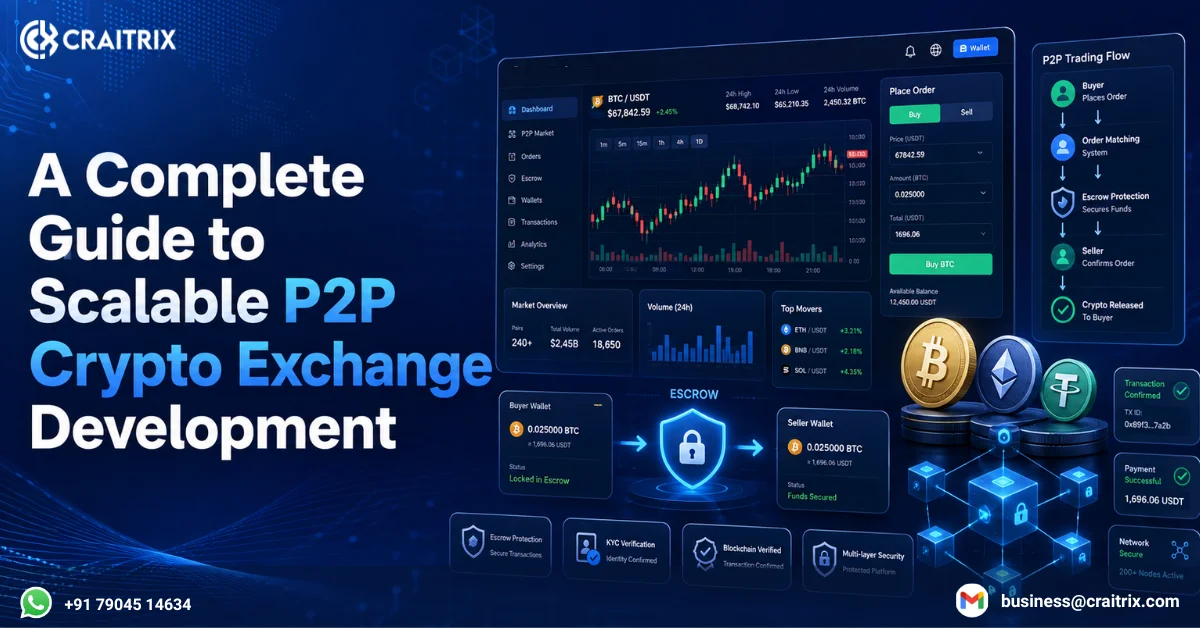
Have you wondered how people buy and sell cryptocurrency directly without relying on a traditional bank or exchange?
That’s where the peer-to-peer exchanges come in!
A P2P exchange connects the buyers and sellers by providing user control, flexible payment options, and better privacy. As the stablecoin adoption has surged, businesses are increasingly using USDT and USDC for faster and cross-border transactions.
Building a P2P exchange needs excellent engineering skills, and in this blog, we’ll explore how to build p2p crypto exchange, their benefits, risks, and why they’re becoming increasingly popular today.
Read the Blog to Explore More!
What is a P2P Crypto Exchange?
A P2P crypto exchange is an online marketplace where traders can trade their cryptocurrencies directly without any intermediaries. This method is far better than traditional exchanges. P2P platforms allow traders to negotiate prices, choose payment methods, and complete transactions on their own terms. These platforms usually include escrow systems for secure trading. As P2P crypto exchanges are more secure, it has become a preferred choice for users looking for greater control, convenience, and global trading opportunities in the crypto market.
End-to-End Workflow of a P2P Crypto Exchange Software
Most traders nowadays are more cautious about their payment protection. As there are many risks occurring in traditional trading systems, users don’t rely on conventional payment methods.
Every step in this process is crucial in building trust between the buyers and sellers to make sure that the crypto transaction is seamless across different payment methods and geographies.
User Onboarding
Initially, when a user wants to trade, the most important step is opening an account in a crypto exchange platform. The user needs to register themselves on the site by creating an account using their emails mobile number, and other details to log in. Additionally, this process also supports the user’s account with additional security features, such as 2FA, wallet preferences, anti-phishing codes, and many more. This step is responsible for a safe onboarding process and growth in the user base.
KYC Verification
Once the registration is done successfully, the next step is KYC verification. Traders have to submit their government identity proof, such as passports, PAN cards, or driving licenses, for secure authentication and to minimize threats. Advanced cryptocurrency trading software considers AI-based facial recognition along with anti-money laundering procedures.
Trade Ad Creation
After the completion of KYC, users are allowed to post advertisements for the sale of cryptocurrencies.
Users should provide the necessary details regarding the cryptocurrencies, for example, type, trading limits, etc. These ads will be displayed on the platform so that the buyers can browse and select the crypto that fits their budget requirements.
Trade Initiation
The actual smartness starts here. When the buyer enters the purchase amount the platform locks the seller’s crypto asset in escrow. Both buyer and seller are allowed to communicate during this phase to choose the appropriate payment method and complete the transaction. Until the transaction process is complete the cryptos are stored safely in escrow.
Escrow Payment Processing
In P2P platform escrow plays the major role. Following the completion of payments by the traders using the agreed mode of payment, the escrow system monitors the payment. Once the seller confirms the payment, the cryptocurrencies are released to the seller. The escrow system prevents fraudulent activities by ensuring the assets are securely locked until the payment is confirmed.
Asset Release
Once the escrow releases the cryptos to the trader wallet the transaction is marked as complete. Here, traders are allowed to leave the ratings and reviews of their trading experiences. This overall workflow helps to build trust within the P2P trading ecosystem and improves the platform’s reliability over time.

Importance of Escrow in P2P Exchanges
Various research report depict that the crypto exchange platform is growing exponentially and the number of traders are also increasing actively. So it is important to safeguard the transaction.
Secure Asset Protection During Transactions
Traders are more concerned about the security and privacy. As many disputes increases, traders are losing confidence in conventional P2P platforms where the trust depends on human honesty. To overcome this issue escrow payment processing is introduced, which creates a secure environment for traders and cryptocurrencies.
Fraud Prevention in P2P Trading
Instead of relying on promises, the escrow method offers protection automatically by keeping the crypto assets locked until the terms of payment are confirmed. This ensures no parties can manipulate the trade unfairly. Escrow improves user confidence and platform credibility.
Building User Trust in P2P Trading Platforms
Buyers gain assurance that the seller cannot disappear after receiving payment, while sellers are protected from false payment claims. By automating trade security and dispute handling, escrow systems enable faster, safer and more transparent cryptocurrency transactions making them essential for scalable and trustworthy P2P trading platforms.
P2P Crypto Exchange vs CEX vs DEX vs OTC Trading
Trading can be done in multiple ways, and each method serves different user needs. Some users prefer the speed of centralized exchanges, and others value the privacy of P2P platforms. Moreover, the OTC trading is used for large volume transactions. Understanding the differences between these trading models helps users choose the right platform. Here is the easy comparison of it:
| Feature | P2P Crypto Exchange | Centralized Exchange (CEX) | Decentralized Exchange (DEX) | OTC Trading |
| Trading Method | Direct user-to-user trading | The platform acts as an intermediary | Smart contract-based trading | Private large-volume trading |
| Control Over Funds | Users control transactions | Exchange controls user funds | Users keep full custody | Managed through brokers or dealers |
| Privacy | Higher privacy | Requires full KYC | Often minimal KYC | Depends on provider |
| Payment Methods | Multiple fiat payment options | Limited exchange-supported methods | Mostly crypto-to-crypto | Customized settlement methods |
| Transaction Speed | Depends on both parties | Usually instant | Blockchain network dependent | Negotiated manually |
| Liquidity | Moderate | High liquidity | Varies by platform | High for large trades |
| Fees | Generally lower | Trading and withdrawal fees | Network gas fees | Negotiated fees |
| Best For | Flexible peer trading | Fast and beginner-friendly trading | Decentralized asset swapping | Institutional and high-volume traders |
P2P Crypto Exchange Architecture
Every successful P2P crypto exchange needs an appropriate infrastructure. Due to the fact that such exchanges deal with instant trading and secure operations with user data and transactions, the exchange needs to have all these features.
- Trading Engine Infrastructure: The key element which deals with the process of order creation and execution, along with ensuring communication.
- Escrow Service Infrastructure: A secure environment which keeps cryptocurrencies safe in case the parties involved in trading do not finish payments.
- Crypto Wallet Management System: A mechanism of handling deposits, withdrawals, and crypto custody. Usually, hot wallets are used for transactions and cold wallets are for storing.
- API Gateway: Helps establish connections between the platform and other applications, including payment gateways, KYC providers, blockchain and market data platforms.
- Microservices Deployment Model: Microservices architectures imply the need for such a model to enhance system performance and stability.
Types of P2P Crypto Exchange Platforms
Before understanding the types, we must first come to know how these types have evolved.
Let’s consider this situation, imagine a buyer wants to buy a bitcoin, and the seller wants to sell. Here, both are interested in proceeding with the trading process.
The actual question comes here: Trust?
This is the major challenge in the crypto exchange platform. To address this gap, the two major P2P exchange types are introduced. And now let’s discuss it.
Custodial P2P Crypto Exchanges
Custodial P2P crypto exchange platforms use escrow services where the platform holds the users’ funds during the transaction. These platforms provide services for executing transactions and managing users’ wallet services easily and efficiently. P2P exchanges often include features such as customer support, dispute resolution, and enhanced security controls to reduce the risk. However, users must trust the platform to safeguard their funds and private keys. Popular custodial P2P exchanges are known for high liquidity, faster transactions, and simpler user onboarding.
Non-Custodial P2P Crypto Exchanges
Non-custodial crypto exchanges enable peer-to-peer transactions, where users can engage in direct trading from their own wallets without handing over control of their funds to another party. Non-custodial crypto exchanges utilize smart contracts or decentralized escrow mechanisms to conduct transactions, with no involvement by the platform on behalf of either the seller or the buyer. The users keep full control of their funds and private keys during any transaction conducted on such non-custodial platforms.
Benefits of P2P Crypto Exchange Development
As the crypto market grows across the globe, users are looking for active trading platforms that offer more freedom, flexibility, and control over their transactions. Traditional exchanges lack in providing these benefits as they often involve high fees, geographic restrictions, and centralized control, which limit user accessibility. This shift in user expectations has made P2P a more powerful and attractive business opportunity. There are various benefits in a P2P crypto exchange; let’s discuss one by one.
Global Accessibility
In a P2P crypto exchange, users are allowed to trade from different countries without any limitations. As the transactions mostly occur between the user and the platforms supports global participation. This accessibility helps businesses to reach international markets and increase the user base.
Lower Transaction Costs
Traditional exchanges heavily rely on intermediaries and centralized processing systems. P2P exchanges reduce the operational cost and transaction fees. Users can trade directly with each other, reducing the additional service charges. Lower trading costs make the platform more attractive to traders who are active in improving the retention rate.
Enhanced User Privacy
P2P exchanges have strong privacy and allow users to trade directly without exposing personal or financial information. Many platforms provide decentralized or minimal data identities and transaction details. This privacy-focused approach appeals to users who value secure and independent financial transactions.
Flexible Payment Methods
One of the biggest advantages of P2P crypto exchanges is the ability to support multiple payment methods. Users can choose from bank transfers, digital wallets, UPI payments, PayPal, gift cards, and other regional payment options based on their convenience. This flexibility improves user experience and makes crypto trading more accessible to diverse audiences worldwide.
Essential Features Required to Build a P2P Crypto Exchange
However, most companies prefer to use peer-to-peer exchanges that allow crypto trading and offer additional services. The development of a P2P cryptocurrency exchange platform needs high-tech characteristics to guarantee the security and comfort of trade and transaction processes.
- Escrow Management System: As already mentioned, this system temporarily stores cryptocurrencies until both trading partners have completed their payments.
- Real-Time Trading Engine: All information about the process is delivered right away to provide the most convenient trading experience.
- Multi-Currency Wallet Integration: Provides support for managing multiple types of cryptocurrency in one system.
- KYC AML Verification: Helps to maintain regulations via identity verification and detection of any unusual financial activity.
- Admin Dashboard Management: Includes special administrative options for users’ management and control of trading processes.
Security Measures in P2P Crypto Exchange Development
Effective security protocols are important in peer-to-peer exchange development to ensure the protection of users’ money, transactional data, and the platform.
- Multi-Signature Wallet Security: Multi-signature wallets offer extra security in your wallet by requiring multiple verification for each transaction.
- Two-Factor Authentication: Two-factor authentication will help you to protect your account by confirming your identity through a second form of verification.
- Anti-Fraud Monitoring: It involves identifying any unusual activities that would result in fraudulent transactions.
- Smart Contract Auditing: Smart contract audits will identify weaknesses in smart contracts to ensure secure and successful transaction execution.
- End-to-End Data Encryption: It will ensure that personal data and transaction data are not accessed illegally during communication and storage.
Advanced Features of Modern P2P Exchanges
Modern P2P exchanges integrate advanced technologies to improve security, automation, scalability, and overall trading efficiency.
- AI-Powered Fraud Detection: Uses artificial intelligence to spot anomalous trading behavior and minimize fraudulent activities.
- Cross-Chain Trading Support: Allow users to trade crypto across different blockchain networks without any hassle.
- Automatic dispute resolution: It simplifies conflict resolution by using systems that automatically validate and audit transactions.
- Liquidity Aggregation Engine: Consolidates liquidity from various sources, improving trading execution and market availability.
- Merchant Trading Automation: Enables merchants to automate trading operations, payment processing and transaction management efficiently.
Cost to Build a P2P Crypto Exchange Platform
The P2P crypto exchange platform development cost depends on various factors such as complexity, security customization, and blockchain integration. Typically, the cost ranges from $15,000 and $100,000, depending on various aspects as mentioned before. Moreover, the development cost also depends on whether the business is choosing a white-label crypto exchange solution or a fully custom-built exchange platform. The cost also varies based on the chosen technology stack, third-party integrations, and ongoing maintenance requirements.
White-Label P2P Exchange Development vs Custom Development
White-Label P2P crypto exchange development is a ready-made and a cost effective solutions that allows businesses to launch a P2P crypto exchange quickly with customizable branding features and basic modifications, reducing the development time and initial investment costs. Besides, the custom P2P crypto exchange development is a fully personalized platform, which is built from scratch. It has unique features with advanced functionalities. Most of the businesses opt for custom development due to its strong security, better scalability, and long-term growth goals.
| Feature | White-Label P2P Exchange Development | Custom P2P Exchange Development |
| Deployment Speed | Faster deployment | Longer development cycle |
| Development Cost | Lower investment | Higher investment |
| Customization | Limited customization | Full customization |
| Scalability | Moderate scalability | Advanced scalability |
| Ownership Control | Vendor dependency | Complete ownership |
| Business Flexibility | Standard functionality | Tailored business solutions |
Liquidity Strategies for P2P Crypto Exchanges
Maintaining liquidity is vital for the success of any P2P crypto exchange, as it impacts the trading speed stability and user satisfaction. By implementing an effective liquidity strategies, exchanges can ensure a seamless trade execution, attract more participants and create active trading ecosystem.
Market Maker Integration
Market maker integration maintains a healthy flow of trade orders on a P2P crypto exchange. The market makers benefit from placing competitive orders as this leads to lower bid-ask spreads, stabilizes the price, and allows the traders to execute the order in one swoop without experiencing price changes.
Liquidity Aggregation Engine
A liquidity aggregation engine combines liquidity from multiple internal and external sources into a unified order book. This enables traders to access deeper market liquidity and obtain better prices during periods of high trading volume. Exchanges can reduce slippage by sourcing liquidity from various providers to improve trade efficiency.
Merchant Incentive Programs
Merchant incentive programs encourage high-volume traders and liquidity providers to become active participants within the exchange environment. The incentives include transaction costs, trade rebates, loyalty rewards, among others, and serve to keep merchants actively engaged in trading.
Cross-Exchange Liquidity Routing
Cross-exchange liquidity routing allows a P2P platform to access liquidity from various cryptocurrency exchanges when internal liquidity is insufficient. This strategy helps exchanges handle growing user demand while maintaining a smooth and uninterrupted trading experience.
Revenue Models of P2P Crypto Trading Platforms
Revenue models are integrated to benefit the businesses by increasing the cash flow in the platform and surge the business profitability for long-term growth and support.
- Trading Transaction Fees: A certain percentage of fees is collected during every single trading operation in the platform.
- Merchant Subscription Plans: There are various advanced features in the platform and to use the traders should use subscription plans.
- Liquidity Provider Incentives: The liquidity providers can earn more income through increased trading.
- Advertisement Monetization: Next comes the advertisement monetization, where the revenues may be earned by the advertisement campaign inside the platform.
- Premium Listing Services: Extra money is generated by the companies when traders promote their trading offer in the platform.
Regulatory Compliance for P2P Exchanges
It is important for businesses in the crypto exchange platform to adhere to regulatory compliance while developing the P2P exchanges. This helps businesses to overcome if any security failures occur, which affects more than the user’s funds.
- KYC AML Verification: The platform always monitors suspicious activities and verifies user identities for a secure operation.
- FATF Compliance Standards: Ensures global crypto transactions follow Financial Action Task Force guidelines for anti-money laundering and cross-border transparency.
- MiCA Regulatory Compliance: Supports compliance with the Markets in Crypto-Assets (MiCA) framework for operating legally within European crypto markets.
- Transaction Monitoring System: The software monitors all actions and transactions to identify any fraudulent activities.
- Data Privacy Protection: The software has strong privacy and encryption measures to ensure the security of the user’s information and financial data.
- Cross-Border Regulatory Management: Helps the platforms comply with regulations for cryptocurrency in different countries/regions.
Real-World Use Cases of P2P Crypto Trading Platforms
Real-world financial applications are changing the way people trade their digital assets through providing a platform that is safe, flexible, and decentralized. People use this type of platform to carry out direct and online trading from centralized financial services into decentralized financial services through peer-to-peer exchanges. Their convenience, low transaction fees, and many other payment methods make these exchanges vital parts of the cryptocurrency and blockchain industry.
- Cross-Border Remittance Platforms
- Crypto Fiat Trading Marketplaces
- DeFi Trading Ecosystems
- Merchant Payment Networks
- Web3 Financial Applications
- Peer-to-Peer Lending Platforms
Challenges in Building a P2P Crypto Exchange
Developing a P2P crypto exchange involves several technical, security, and operational challenges that require careful planning.
- Liquidity Acquisition Complexity: The main challenge is the shortage of liquidity for the new exchange platforms. This can be addressed by liquidity aggregation.
- Fraud Prevention Risks: As cyber threats are increasing, preventing scams and suspicious transactions is critical for the platform, the use of AI risk monitoring can address this issue.
- Regulatory Uncertainty: As the crypto industry changes constantly, the regulations can impact the operations in the platform. To overcome this issue, AML automation is provided.
- Infrastructure Scalability: The platform must handle growing user activity and high transaction volumes efficiently, without any delay. Cloud-based infrastructure can be used for scalability.
- User Trust Management: A secure trading environment is essential for user retention and so the escrow protection and 2FA are used
Technology Stack Required for P2P Crypto Exchange Development
A reliable technology stack ensures smooth performance, security, scalability, and efficient crypto trading operations.
| Technology Category | Technology Stack |
| Frontend Development | Next.js, React.js, TypeScript, Tailwind CSS, WebSocket |
| Backend Development | Node.js, Golang, Python, Express.js, Microservices Architecture |
| Database Management | PostgreSQL, MongoDB, Redis, Elasticsearch, MySQL |
| Blockchain Integration | Ethereum, BNB Chain, Solana, Polygon, Web3.js |
| Cloud Infrastructure | AWS, Google Cloud Platform, Microsoft Azure, Docker, Kubernetes |
| Security Technologies | Multi-Signature Wallet, SSL Encryption, Two-Factor Authentication, DDoS Protection, Firewall Security Systems |
Step-by-Step Process to Develop a P2P Crypto Exchange
Building a P2P crypto exchange is not a easy task, as a leading crypto exchange development services provider, we need to follow a structured development process to ensure security, performance and scalability.
- Business Requirement Analysis: This is the initial step where the project goals, target audience, business model, and platform requirements are outlined.
- P2P Exchange Architecture Design: Our developers create the technical structure and workflow of the exchange platform.
- Escrow Workflow Development: For a secure and smooth transaction, our professionals develop secure escrow systems for safe peer-to-peer transactions.
- Wallet Payment Integration: We integrates crypto wallets and fiat payment gateways into the platform for enhanced trading operations.
- Security Compliance Testing: This is the critical phase where our professionals do a complete audit of the platform to verify that the software is ready to launch without any inefficiencies.
- Platform Deployment & Maintenance Support: The final step is the launch of the exchange platform along with the technical support.
Why Choose Craitix as Your P2P Crypto Trading Platform Development Company?
As a leading P2P crypto exchange development company, Craitrix understands every step in building this platform and supports real transactions across the regions. Highly experienced in blockchain technology, smart contract development, escrow integration and multi-currency wallet systems, the company delivers reliable exchange solutions designed for security and performance.
Moreover, as a trusted p2p crypto trading platform development, we focus on creating a user-friendly platform to support seamless transactions for the user. We also support enterprises to scale these systems, focused both on infrastructure development and security.
Frequently Asked Questions
Q1. What is a P2P crypto exchange platform?
Ans: A user can buy and sell cryptocurrencies directly with each other without any intermediary is known as a P2P crypto exchange platform.
Q2. How much does it cost to build a P2P crypto exchange?
Ans: Mostly, the P2P crypto exchange development cost depends on the feature you integrate, customization, scalability, and blockchain integration.
Q3. How long does it take to develop a P2P crypto exchange?
Ans: The time taken to build a P2P crypto exchange platform depends on the features integration, testing requirements and platform complexity.
Q4. Is white-label P2P crypto exchange software secure?
Ans: Yes, the white-label P2P crypto exchange software is more secure when built with strong encryption escrow systems and advanced security measures.
Q5. Why is escrow important in P2P crypto exchange development?
Ans: Escrow systems protect transactions by securely holding crypto assets till the transaction is completed successfully.
Q6. Which blockchain is best for P2P crypto exchange development?
Ans: Binance Smart Chain, Solana and Polygon are some popular blockchains for P2P exchanges.
Q7. How do P2P crypto exchanges manage liquidity?
Ans: Liquidity is managed via market makers, liquidity aggregation engines, merchant incentives and cross-exchange integrations.
Q8. How do KYC and AML work in P2P crypto exchanges?
Ans: KYC verifies user identification and AML systems monitors suspicious activities to ensure regulatory compliance and fraud prevention.
Q9. What payment methods can be integrated into a P2P exchange?
Ans: Bank transfers, UPI, credit cards, e-wallets, and various digital payment systems used in P2P exchanges.
Q10. How can startups launch a P2P crypto exchange platform?
Ans: Startups can launch a P2P exchange by choosing either white-label software or custom development based on their budget and business goals.