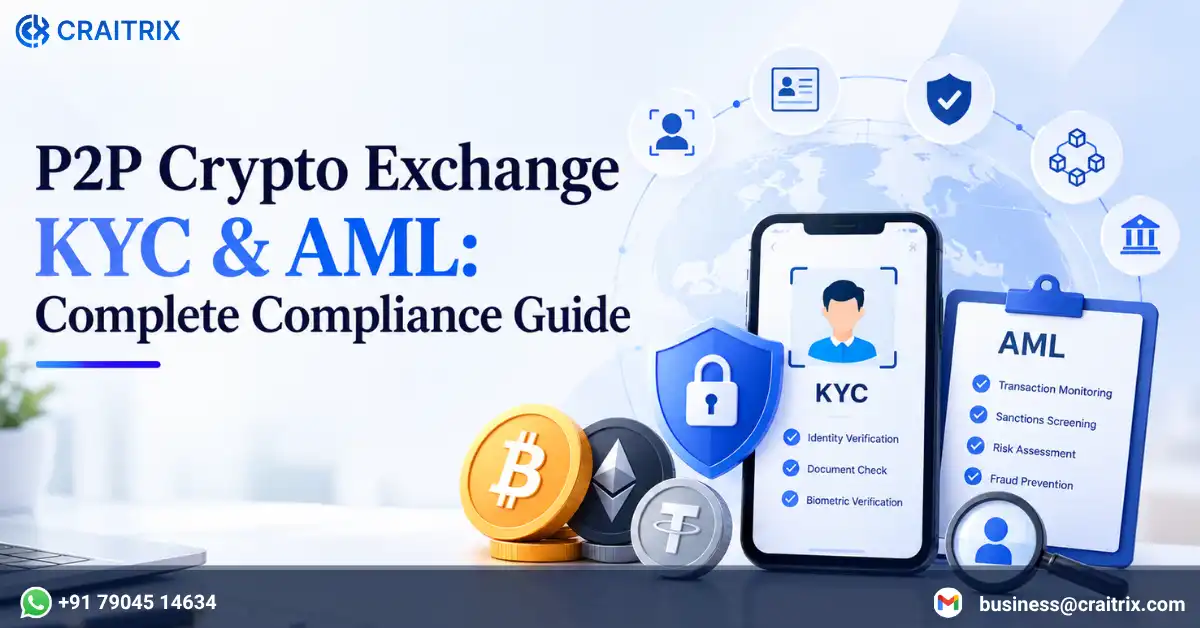
A P2P crypto exchange connects buyers and sellers directly, but that flexibility also creates compliance challenges. Without proper identity verification, transaction monitoring, and risk controls, a platform can become exposed to fraud, money laundering, sanctions violations, and suspicious trading activity.
KYC AML compliance for P2P crypto exchanges helps businesses verify users, assess risk, monitor transactions, screen crypto wallets, and respond to suspicious activity. Modern compliance goes beyond checking an ID during signup. It can involve KYC/KYB verification, sanctions and PEP screening, blockchain analytics, transaction monitoring, risk scoring, and ongoing customer due diligence.
For businesses planning to launch or scale a P2P crypto exchange, understanding these requirements is essential. This guide explains how P2P crypto exchange KYC and AML work, the key compliance requirements, common P2P risks, regulatory considerations, and the technology needed to build a compliance-ready exchange.
What Does KYC & AML Compliance Mean for a P2P Crypto Exchange?
A P2P crypto exchange needs to know who is using the platform, where funds are coming from, and whether transactions show signs of suspicious activity. KYC and AML controls work together to answer these questions while helping the platform meet applicable regulatory requirements.
KYC vs AML: What Is the Difference?
KYC (Know Your Customer) focuses on verifying a user’s identity before allowing access to certain exchange services. It may include government ID verification, address checks, liveness verification, and additional information based on the user’s risk profile.
AML (Anti-Money Laundering) covers the broader controls used to detect, prevent, and respond to potentially illicit financial activity. These controls can include transaction monitoring, sanctions screening, wallet screening, risk scoring, suspicious activity investigations, and regulatory reporting.
| KYC | AML |
| Verifies customer identity | Monitors financial activity |
| Mainly focused on onboarding | Continues throughout the customer relationship |
| Uses identity and verification data | Uses transaction, wallet, behavioural, and risk data |
| Helps establish customer risk | Helps identify and manage suspicious activity |
In a P2P exchange, both are important. KYC establishes who the trader is, while AML helps determine whether their activity presents a potential compliance risk.
Why P2P Exchanges Face Unique Compliance Risks
P2P platforms allow users to trade directly with counterparties and may support multiple payment methods, currencies, wallets, and trading regions. This creates additional points where fraudulent or suspicious activity can occur.
A strong compliance system needs to look beyond identity verification and monitor patterns that could indicate fraud, money laundering, account abuse, or other suspicious activity. These fraud and risk controls should work together with the platform’s broader crypto exchange security setup.
Fake or Multiple Accounts: Fraudsters may attempt to create multiple accounts using different credentials or compromised identities. Multiple accounts can also be used to bypass trading limits, manipulate offers, or move funds between connected accounts. KYC controls such as identity verification, duplicate detection, and device or behavioural signals can help identify potentially linked accounts for further review.
Third-Party Payments and Account Mismatches: A common P2P risk occurs when the payment account used in a transaction does not match the verified trader. For example, a buyer may use another person’s bank or payment account to complete a trade. Depending on the platform’s policies and applicable regulations, this can create additional fraud and compliance concerns.
Suspicious Wallet Exposure: Crypto transactions can involve wallets with previous exposure to potentially risky activity. Blockchain analytics can help identify relevant wallet relationships and provide risk signals for compliance teams, using available blockchain intelligence rather than relying only on a wallet’s current transaction.
Unusual Trading and Transaction Patterns: Suspicious activity is not always obvious from a single transaction. Patterns across multiple transactions provide stronger signals. Examples include sudden increases in trading volume, repeated high-value transactions, rapid movement of funds, unusual transaction frequency, activity inconsistent with the customer’s profile, repeated interactions with high-risk wallets, and attempts to avoid established transaction limits.
Sanctions or High-Risk Jurisdiction Exposure: Rapid movement or splitting of funds, along with exposure to sanctioned entities or high-risk jurisdictions, can also indicate mule or compromised accounts.
The goal is not to automatically label every unusual transaction as illegal activity. Instead, effective P2P exchange compliance uses risk signals to identify activity that may require further investigation.
How KYC Works on a P2P Crypto Exchange
KYC is the first major compliance layer in a P2P crypto exchange. It helps the platform establish that a user is genuine before giving them access to higher-risk activities such as trading, buying, selling, or withdrawing assets.
A well-designed P2P crypto exchange KYC process should be risk-based rather than treating every customer in exactly the same way. The platform can collect the required information, verify the customer’s identity, assess their risk, and apply suitable trading limits.
User Identity Verification
The KYC process typically begins when a user creates an account and provides identity information. Depending on the jurisdiction and risk level, the exchange may request government-issued identification, proof of address, selfie or liveness verification, and other customer information.
The verification workflow can include:
- Identity document verification
- Facial or liveness checks
- Email and phone verification
- Address verification
- Duplicate identity detection
- Sanctions and watchlist screening
- Verification status tracking
Automating these checks through a suitable KYC provider can reduce manual work while creating a consistent onboarding process.
Risk-Based KYC Tiers and Trading Limits
Not every customer presents the same level of risk. A P2P exchange can therefore use different verification tiers based on factors such as transaction volume, geography, account activity, and customer type.
| Verification Level | Typical Purpose |
| Basic | Account creation and limited access |
| Standard | Regular P2P trading |
| Enhanced | Higher trading or withdrawal limits |
| High Risk | Additional verification and manual review |
The exact requirements and limits should be determined according to the exchange’s business model and applicable regulations. This approach allows the platform to apply stronger checks where the risk is higher instead of creating unnecessary friction for every user.
KYB and Beneficial Ownership Checks for P2P Merchants
P2P platforms may also support professional traders, businesses, OTC desks, or merchants. These users may require KYB (Know Your Business) verification instead of relying only on individual KYC.
The exchange may need to verify:
- Business registration details
- Business address
- Directors and authorized representatives
- Ultimate beneficial owners (UBOs)
- Business activity
- Source of funds or wealth where required
- Applicable sanctions and watchlist information
This creates a more complete KYC compliance framework and helps the platform distinguish between individual traders and higher-volume commercial participants.
How AML Compliance Protects P2P Crypto Trading
KYC helps establish who the customer is, but AML controls focus on what the customer is doing with the platform. For a P2P exchange, this means monitoring customer behaviour, transactions, wallets, and counterparties for activity that may require further review.
A strong P2P crypto exchange AML framework combines automated screening with risk-based monitoring and human investigation where necessary.
Customer Risk Scoring
Customer risk scoring helps the exchange categorize users based on relevant risk factors rather than applying identical controls to everyone.
The risk profile may consider:
- Customer location and jurisdiction
- Account type and verification level
- Expected trading activity
- Transaction volume and frequency
- Payment methods
- Wallet exposure
- Previous compliance alerts
- Unusual changes in customer behaviour
A higher-risk profile can trigger enhanced due diligence, additional verification, tighter limits, or manual review, depending on the applicable compliance framework.
Sanctions, PEP and Watchlist Screening
P2P exchanges can screen customers against relevant sanctions lists, politically exposed person (PEP) databases, and other watchlists.
Screening can take place during onboarding and, where appropriate, continue throughout the customer relationship. This matters because a customer’s risk status can change after the initial verification.
If a potential match is identified, the platform can route the case for review instead of automatically treating every match as a confirmed violation.
Crypto Wallet and Blockchain Screening
Traditional customer screening alone is not enough for a crypto platform. A user’s blockchain activity can provide additional risk signals.
Wallet screening and blockchain analytics can help identify exposure to addresses or transaction patterns associated with potentially high-risk activity, depending on the capabilities of the selected analytics provider.
Platforms that need deeper blockchain infrastructure alongside compliance features can rely on blockchain development to build the systems that read and process on-chain transaction data.
Transaction Monitoring and Suspicious Activity Detection
Transaction monitoring looks for activity that does not fit the customer’s expected behaviour or established risk profile.
Examples include:
- Sudden increases in transaction volume
- Unusually frequent trades
- Rapid movement of funds
- Repeated transactions involving high-risk addresses
- Structured or unusual transaction patterns
- Significant changes in normal account behaviour
When a rule or risk model generates an alert, the compliance team can investigate the activity, request additional information, restrict activity where appropriate, and complete any required reporting.
This makes crypto exchange KYC and AML an ongoing process rather than a one-time verification step.
Compliance Records and Regulatory Reporting
A P2P exchange should maintain appropriate records of customer verification, risk assessments, transactions, alerts, investigations, and compliance decisions.
Where applicable, suspicious activity identified through the monitoring process may need to be escalated and reported to the relevant authority according to local requirements.
The key principle is that P2P crypto exchange compliance should be an ongoing operational process, not a checklist completed only when the user creates an account.
How KYC and AML Fit Into the P2P Exchange Workflow
KYC and AML become most effective when they are built directly into the P2P trading journey rather than operating as separate compliance tools.
Each stage of a trade can apply different checks based on the user’s identity, risk profile, transaction behaviour, and wallet activity.
Before a User Can Trade
Registration → KYC/KYB verification → Sanctions screening → Risk assessment → Account approval → Trading limits
Users can receive different access levels depending on their verification status and risk profile. Higher-risk users may require additional checks before receiving access to certain trading or withdrawal functions.
During a P2P Trade
Offer creation → Counterparty selection → Payment → Transaction monitoring → Escrow confirmation → Crypto release
The platform can monitor relevant transaction signals while also applying controls around payment confirmation, wallet risk, transaction limits, and unusual behaviour.
After the Transaction
Ongoing monitoring → Risk alerts → Compliance investigation → Account review → Appropriate action → Reporting and audit trail
For example, a user with previously normal activity may suddenly begin conducting unusually large or frequent transactions. That change can trigger an alert for further review.
This workflow-based approach makes P2P crypto trading compliance part of the exchange’s core operations rather than an isolated verification step.
P2P Crypto Exchange Regulations: What Changes by Jurisdiction?
P2P crypto exchange regulations are not identical across countries. Licensing requirements, AML obligations, customer verification standards, reporting rules, and travel-rule requirements can vary depending on where the exchange operates, where its customers are located, and what virtual-asset services it provides.
For this reason, businesses should define their target markets and obtain appropriate legal or compliance advice before launching. Businesses should also review a detailed crypto exchange license guide when evaluating the regulatory requirements that may apply to their target markets.
FATF and the Risk-Based Compliance Approach
The Financial Action Task Force (FATF) provides international AML/CFT standards that influence how many jurisdictions regulate virtual-asset businesses.
A key concept is the risk-based approach. Instead of applying exactly the same controls to every customer and transaction, businesses assess relevant risks and apply stronger measures where the risk is higher.
For a P2P exchange, this can influence customer due diligence, enhanced due diligence, transaction monitoring, wallet screening, sanctions screening, suspicious activity reporting, and record keeping.
U.S. Requirements for P2P Crypto Businesses
In the United States, certain businesses involved in transmitting or exchanging virtual currency can fall within FinCEN’s regulatory framework as money transmitters or other money services businesses, depending on their activities and circumstances.
FinCEN has specifically addressed peer-to-peer virtual-currency exchangers in its guidance and enforcement actions. Therefore, a business targeting U.S. customers should assess whether its P2P model creates applicable Bank Secrecy Act and AML obligations.
UAE and Other Regulated Markets
The UAE provides another example of a jurisdiction where virtual-asset businesses can face specific AML/CFT requirements.
For example, VARA’s framework addresses areas such as customer due diligence, risk assessment, transaction monitoring, sanctions screening, and blockchain-related controls for regulated virtual-asset service providers.
Other markets can impose different licensing, reporting, customer-protection, and AML requirements.
Therefore, businesses should plan their crypto exchange development around the specific regulatory requirements of each target jurisdiction, rather than using a single compliance model for every market.
Building a Compliance-Ready P2P Crypto Exchange
KYC and AML should be part of the exchange architecture from the beginning, not added after the platform is already built.
A compliance-ready P2P exchange connects identity verification, risk assessment, transaction monitoring, wallet screening, and compliance operations across the user journey.
Essential Compliance Integrations
A P2P exchange can integrate specialized compliance providers and internal controls based on its target market and risk requirements.
Key integrations can include:
- KYC and KYB verification
- Sanctions and PEP screening
- Blockchain and wallet analytics
- Transaction monitoring
- Customer risk scoring
- Case management
- Suspicious activity reporting workflows
- Compliance and audit logging
These integrations allow the exchange to automate routine checks while giving compliance teams access to the information needed for investigation and decision-making.
Compliance Controls Inside the Admin Panel
The admin panel should give authorized compliance teams a centralized view of customer and transaction risk.
Useful capabilities can include:
- Customer verification status
- Risk scores and risk factors
- Screening results
- Transaction alerts
- Wallet risk information
- Investigation and case management
- Account restrictions
- Transaction history
- Compliance notes
- Audit trails
Role-based access controls, built into the platform’s overall security architecture, help ensure sensitive compliance information stays visible only to authorized personnel.
Automated Compliance vs Manual Review
Automation can handle repetitive checks such as identity verification, watchlist screening, transaction-rule evaluation, and risk alerts.
However, not every alert should automatically result in an account rejection or restriction. Potential matches and unusual activity may require human investigation, particularly when context is needed to determine whether an alert represents a genuine compliance concern.
A practical approach is:
Automated screening → Risk detection → Alert generation → Human review → Appropriate action → Audit record
This combination helps create a more efficient P2P crypto exchange AML workflow while keeping compliance decisions aligned with the exchange’s policies and applicable regulatory requirements.
P2P Exchange KYC/AML Compliance Checklist
Before launching a P2P crypto exchange, businesses should verify that their compliance framework covers the complete customer and transaction lifecycle.
Define the Regulatory Scope
- Identify target countries and customer markets
- Determine applicable licensing and AML obligations
- Define supported virtual-asset services
- Establish compliance policies and responsibilities
Set Up Customer Verification
- Implement KYC for individual users
- Add KYB for business and merchant accounts
- Verify beneficial owners where required
- Configure risk-based verification levels
- Establish appropriate trading and withdrawal limits
Configure AML Controls
- Add sanctions and PEP screening
- Implement customer risk scoring
- Integrate transaction monitoring
- Add crypto wallet and blockchain screening
- Define suspicious-activity alert rules
- Establish escalation and investigation procedures
Prepare Compliance Operations
- Create a compliance case-management workflow
- Maintain customer and transaction records
- Implement audit logs
- Define account-review and restriction procedures
- Configure applicable regulatory reporting processes
- Periodically review and update compliance rules
Test Before Launch
The compliance workflow should be tested using different customer profiles, transaction scenarios, risk levels, and alert conditions before the exchange goes live.
A strong KYC &AML compliance for P2P crypto exchanges framework should therefore cover more than onboarding. It should connect identity verification, risk assessment, transaction monitoring, investigation, reporting, and ongoing customer review across the entire platform.
Future of KYC & AML Compliance for P2P Crypto Exchanges
P2P crypto compliance is moving toward more continuous, data-driven monitoring rather than relying only on one-time identity verification.
As trading activity, blockchain networks, and regulatory expectations evolve, exchanges will need compliance systems that can respond to changing customer and transaction risk.
AI-Assisted Transaction Monitoring
- AI and machine-learning systems can help analyze large volumes of transaction and behavioural data to identify unusual patterns and prioritize alerts for compliance teams.
- Instead of relying only on fixed rules, advanced monitoring systems can combine multiple signals to help identify activity that deserves further investigation.
- Businesses interested in integrating AI into exchange infrastructure can also explore AI-powered crypto exchange development.
Continuous and Behaviour-Based KYC
- KYC is increasingly becoming an ongoing process rather than something completed only during registration.
- A customer’s risk profile can change because of new trading behaviour, geographic changes, transaction volume, or other relevant factors.
- Continuous monitoring can help exchanges identify when additional verification or review may be appropriate.
Real-Time Blockchain Risk Intelligence
- Blockchain analytics can provide faster insight into wallet activity and transaction exposure.
- As P2P exchanges support more assets and networks, real-time or near-real-time risk signals can become increasingly important for transaction screening and compliance decisions.
- The broader direction is toward continuous KYC, automated risk detection, blockchain intelligence, and integrated compliance operations working together rather than functioning as separate systems.
Why Choose Craitrix for P2P Crypto Exchange KYC & AML Compliance?
Craitrix helps businesses build compliance-ready P2P crypto exchanges with KYC/KYB verification, AML screening, transaction monitoring, wallet screening, risk management, and secure trading infrastructure.
Our team can integrate essential compliance tools into the exchange based on your business model, target market, and platform requirements. From exchange development and wallet integration to compliance workflows, security controls, testing, and deployment, we provide end-to-end support for building a scalable P2P trading platform.
Ready to launch your P2P crypto exchange? Explore our P2P crypto exchange development services and discuss your KYC, AML, trading, and compliance requirements with Craitrix.
Frequently Asked Questions
Q1. Is KYC mandatory for a P2P crypto exchange?
Ans: KYC requirements depend on the exchange’s business model, target market, services, and applicable regulations. Businesses should determine the requirements that apply to their specific jurisdictions before launching.
Q2. What KYC information does a P2P crypto exchange need?
Ans: Depending on the applicable requirements, a P2P exchange may collect identity details, government-issued documents, address information, liveness verification, and additional information for higher-risk customers or business accounts.
Q3. Can a P2P crypto exchange operate without KYC?
Ans: Whether a P2P exchange can operate without KYC depends on the jurisdiction, business model, services, and applicable regulatory requirements. Before choosing a no-KYC model, the business should assess its legal and compliance obligations for every target market.
Q4. What is KYB in a P2P crypto exchange?
Ans: KYB (Know Your Business) verifies business customers such as merchants, professional traders, and OTC desks. It can involve checking business registration, ownership structure, directors, authorized representatives, and beneficial owners.
Q5. Why is wallet screening important for P2P exchanges?
Ans: Wallet screening provides blockchain-based risk signals that customer identity checks alone cannot provide. It can help identify exposure to wallets or transaction activity associated with potentially high-risk sources before assets are released or transferred.
Q6. How can a P2P exchange detect suspicious transactions?
Ans: A P2P exchange can combine transaction volume, frequency, customer behaviour, payment details, wallet activity, counterparty relationships, and risk scores to identify unusual patterns. Alerts can then be routed to compliance teams for investigation.
Q7. What happens when a P2P transaction triggers an AML alert?
Ans: The transaction or account can be flagged for review based on the platform’s compliance rules. A compliance team may examine transaction history, customer information, wallet activity, and other available context before deciding whether additional verification, restrictions, escalation, or reporting is appropriate.
Q8. Can KYC and AML checks be automated on a P2P exchange?
Ans: Yes, Many routine compliance tasks can be automated through KYC/KYB providers, sanctions screening, blockchain analytics, transaction monitoring, and risk-scoring systems. Human review remains important for complex alerts, potential matches, and cases requiring additional context.
Q9. How often should a P2P exchange review customer risk?
Ans: There is no single review frequency that applies to every customer or jurisdiction. Review timing can depend on customer risk, changes in activity, transaction behaviour, regulatory requirements, and events that trigger a risk reassessment.
Q10. What technology is needed for P2P exchange KYC and AML?
Ans: A compliance-ready platform may use identity verification, KYB, sanctions and PEP screening, blockchain analytics, transaction monitoring, risk scoring, case management, audit logging, and secure compliance administration tools.
Q11. How can P2P exchanges reduce false positives in AML screening?
Ans: Exchanges can combine multiple data points, apply risk-based rules, maintain accurate customer information, and use human review for potential matches. This helps distinguish genuine compliance concerns from alerts that require additional investigation.