The majority of businesses do not fail because of a lack of ideas. They fail as they are developing the wrong product or they are structuring it in the wrong way.
A recent report by Statista shows that the size of the global mobile app market has already crossed $935 billion in 2023 and is expected to reach over 1.3 trillion by 2026. Mobile-first approaches are also helping B2B businesses to close sales cycles much more quickly.
This change has already passed beyond experimentation. It has become an essential aspect of how businesses attract, engage, and retain users.
And yet, even with this change, founders, product managers, and even enterprises are grappling with the same questions.
- Where do you start?
- How much will it cost?
- Which platform should you choose?
- Who should you trust to build it?
The Mobile App Development Guide has been built to provide answers to those questions with more clarity.
Let’s get into it.
What is Mobile App Development?
Mobile app development is the end-to-end process of creating software applications that run on smartphones and tablets. It covers everything from initial planning to design, development, testing, and deployment across platforms like iOS, Android, or cross-platform frameworks.
Practically, the development of mobile apps in 2026 is a multi-disciplinary product activity. You’re not just writing code. You are constantly making decisions about user behavior, device constraints, platform guidelines, security tradeoffs, and business model alignment simultaneously.
Why Every Business Needs a Mobile App in 2026
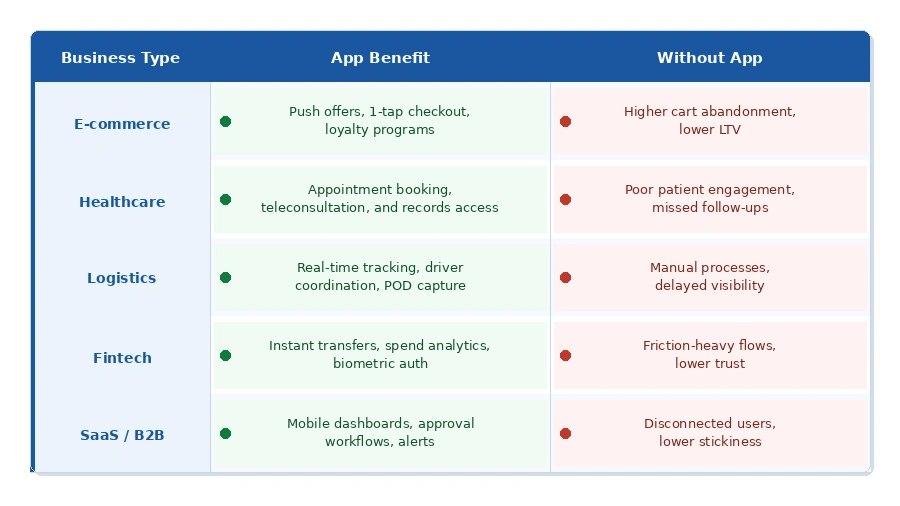
By 2026, mobile apps will be much more than a convenience; they will be the driver of retention, data intelligence, and customer expectation in all industries.
Mobile is the Primary Computing Environment
An average individual spends around 4.8 hours daily on their smartphone, and more than 90% of the time is in apps and not browsers. Your customer is probably doing all of that on a phone when they compare your pricing, place an order, and even when they contact support. A web presence alone doesn’t capture that behavior with the same depth or retention.
Apps Create Retention Loops
Push notifications, personalized dashboards, offline access, and biometric authentication aren’t only features, but they’re core mechanisms. An effective app keeps your brand constant in the mind of customers even when they are not thinking about you.
The Data Advantage
Apps provide you with more detailed and actionable behavioral data. You can understand user flow through your product, dropping points, features that lead to retention, and the moments leading up to a purchase. The data loop (build, measure, improve) helps to separate the products that grow rapidly and lagging one.
Customer Expectations Have Shifted
In 2026, if your competitor has an app and you don’t, that gap is visible to every customer who has to make a decision. It is particularly true in retail, healthcare, finance, logistics, and hospitality industries, where the product experience provided by the app represents a significant portion of your audience.
Top Mobile App Development Trends in 2026
Mobile app development technology trends are short-lived technologies; what used to be a lead in 2022 is now becoming table stakes. Here’s what is actually influencing the way apps are being built and what users are demanding at present.
1. On-Device AI and Personalization Engines
AI has moved from the cloud to the chip. Now, the Neural Engine of Apple and AI accelerators of Qualcomm allow models to run directly on the device without any latency, and data leaving the phone. This facilitates real-time personalization, predictive interfaces, and intelligent searching without a round-trip to a server.
2. Super Apps Are Expanding Globally
The WeChat model, which is one app for messaging, payments, food delivery, and commerce, is no longer just a Southeast Asian phenomenon. Western super apps are emerging in fintech, healthcare, and enterprise SaaS.
3. 5G-Native App Experiences
Now that 5G coverage is mainstream in most tier-1 and tier-2 cities around the world, developers can build experiences that would have been impractical before two years, including real-time AR overlays, ultra-high-definition video calls, and real-time cloud transfer of massive files. Applications that are developed based on 5G latency profiles are treated as completely different products.
4. Foldable and Multi-Screen Adaptation
Google, Motorola, and Samsung have all invested in lineups of foldable devices. This isn’t a niche anymore. Apps should be developed with flexible layouts that elegantly accommodate various screen ratios and folded/unfolded positions. The majority of apps developed in 2022 continue to fail on foldables.
5. Privacy-First Architecture
The days of aggressive data collection by third-party devices are structurally over with the implementation of the Apple App Tracking Transparency and Google Privacy Sandbox. Applications developed in 2026 will require first-party data strategies integrated on day one and not embedded as an audit.
6. Voice and Conversational Interfaces
Voice is no longer restricted to smart speakers. Users are increasingly engaging with apps via voice commands, especially when searching, navigating, or working hands-free. Incorporating voice as a first-class input, and not an accessibility feature. It is emerging as a productivity, logistics, and health applications differentiator.
7. Instant Apps and Progressive Experiences
Google has introduced Instant Apps, which enable users to gain access to the functionality of core apps without any installation. This reduces the friction of acquisition significantly and is especially effective with e-commerce, travel, and utility apps, where intentions are high, but commitments are low at first contact.
Types of Mobile Apps and How to Choose Your Platform
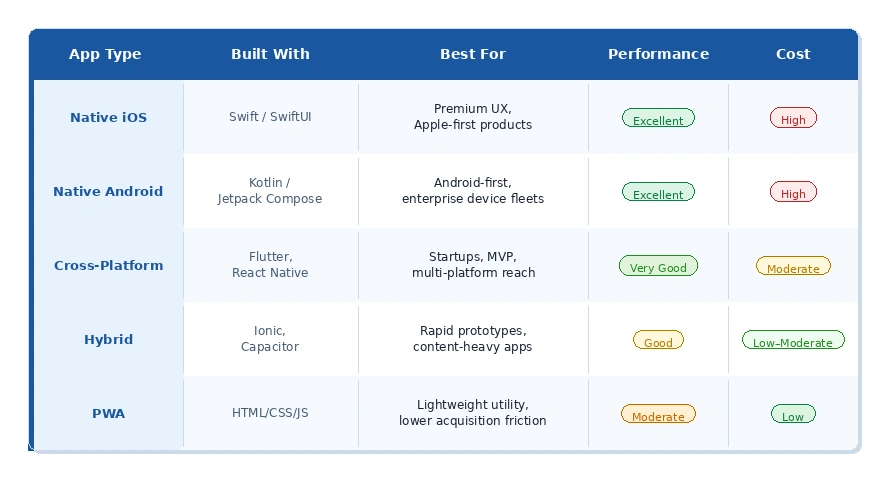
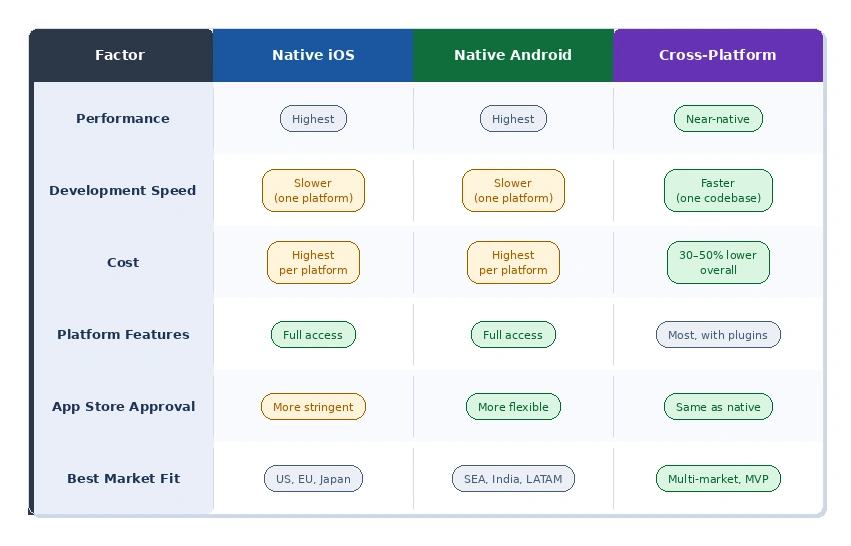
Platform strategy is one of the most impactful early choices when working on any app project. When you do it wrong, you may be either spending excessively on disconnected codebases or under-delivering on performance. Here’s the honest breakdown.
iOS vs Android vs Cross-Platform
This is one of the most controversial questions in mobile product strategy, and it truly lies in your audience, budget, and timeline.
When to Go Native iOS First
- Your target customers will be mostly in North America, Western Europe, or Japan, where the iOS market share stands at 55-70 percent.
- Your app includes complicated animations, ARKit features, or extensive Apple ecosystem capabilities (Siri, HealthKit, Apple Pay).
- You are in a premium segment where the greater average revenue per user (ARPU) of the iOS justifies the platform focus.
- You can afford to develop the native Android as the second phase.
When to Go Native Android First
- You are in the market in Southeast Asia, South Asia, Latin America, or Sub-Saharan Africa, where Android is predominant at 80-90%+.
- You are developing for enterprise device management (MDM) scenarios on certain hardware.
- Your product requires intensive Android modding, such as a replacement launcher or a system-level integration.
When Cross-Platform Makes the Most Sense
- You must access both iOS and Android customers with a limited budget and time.
- Your application does not need intensive platform-specific APIs.
- You’re validating a product idea and would like testing with real users before over-investing in native builds
- You are a start-up or scale-up that focuses on development velocity
AI-Powered Mobile App Development
AI is simultaneously reshaping the development of mobile applications in two ways. It is transforming the capabilities of apps for the users and how developers create those apps.
AI Features Inside Mobile Apps
- Personalization: Recommendation engines, dynamically ordered content, and adaptive interfaces that learn user patterns. Imagine Spotify’s Discover Weekly, but relevant to any product category.
- Computer Vision: In-app cameras are capable of scanning documents, recognizing products, reading bar codes, detecting faces, or translating text in real-time. The use cases cut across retail, healthcare, logistics, and education.
- Conversational AI: Support, onboarding, and complex question chatbots and voice assistants that run on LLM and do not require human intervention.
- Predictive Analytics: Applications that predict subsequent actions, such as auto-fills, recommended routes, and pre-filled content depending on historical behavioral patterns.
AI in the Development Process
- AI-assisted code generators like GitHub Copilot, Cursor, and others have measurably reduced development times. In 2024 research, developers with AI pair-programming tools were 55% faster in code tasks (GitHub). This is not an advantage in 2026; it is a starting point.
- Beyond code generation: AI is being applied to automated test generation, UI accessibility scanning, performance profiling, and even intelligent sprint planning. Development teams who lacked the implementation of AI tooling in their workflow are working at a structural disadvantage in both speed and cost.
Security & Compliance for Mobile App Development
Security in mobile app development is one of the topics that most individuals consider as the final checklist or a thing you add at the last moment of launch. That is the wrong mental model, and it has turned many companies into serious trouble.
The enhanced framing of security is an architectural choice. The cost of retrofitting is three to five times higher than building it from the start, and by the time you get it retrofitted, you have frequently already had an incident.
The Threat Landscape in 2026
- Lack of secure data storage (the most prevalent vulnerability in mobile apps)
- Weaknesses in API authentication, particularly in applications using third-party backends.
- Attacks based on reverse engineering against apps that contain embedded credentials.
- Apps that lack adequate certificate pinning are susceptible to man-in-the-middle attacks.
- Third-party SDK vulnerabilities may break your security as strongly as your most used library.
Compliance Frameworks
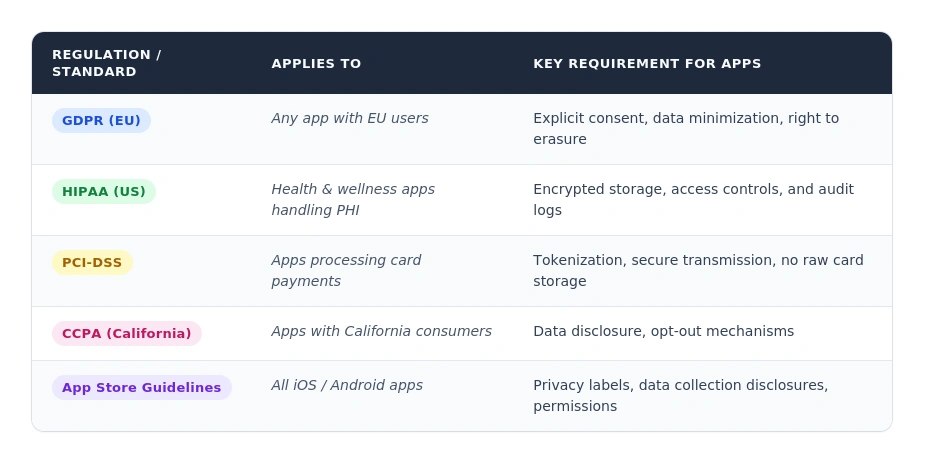
Security-by-Design Practices
- Use OAuth 2.0 / OpenID Connect authentication, not application-specific authentication flows.
- Use encrypted storage (AES-256) on any sensitive local data.
- Turn on certificate pinning to avert interception of the SSL.
- Perform a static code analysis (SAST) within your CI/CD pipeline.
- Conduct regular penetration testing at least once before significant releases.
- Use runtime application self-protection (RASP) to protect high-stakes applications.
When your development partner does not discuss security during scoping or not during preparations to launch, then that’s a signal worth paying attention to.
Business Benefits of Mobile App Development
Websites generate traffic, whereas mobile applications generate business. The benefits that have been stated below are the most straightforward and measurable reasons why businesses with specific apps will always outperform, outretain, and outgrow their competitors in 2026.
Increased Customer Retention Rates
The apps generate touchpoints every day that cannot be replicated by websites. Individualized push notifications, loyalty schemes, and in-app messaging ensure customers interest and retention. Companies that have dedicated apps have always recorded 2-3 times higher customer lifetime value than those that use websites.
Efficient Internal Processes
Enterprise mobile app development for field teams, inventory management, and internal communication can significantly reduce operational friction. Companies that automate the field activities using custom applications indicate quantifiable productivity improvements and a substantial decrease in administrative overhead.
Stronger Brand Visibility
One of the most valuable pieces is being present on a user’s home screen. Your brand icon is in sight every time a person opens their phone. That regular passive exposure creates recall that no paid advertisement can match at the same price.
Faster Customer Support
Chatbots, help centers, and one-tap contact options serve as in-app support, which helps users to resolve problems before negative reviews. The shorter response time increases customer satisfaction ratings and lessens the burden on the human support team.
New Revenue Streams Unlocked
Monetization models of mobile app development are not present in traditional websites. In-app purchases, subscriptions, freemium access, affiliate product placement, and marketplace commissions are all potential income streams that can be facilitated through apps that would not be available when using a browser experience.
Smarter Marketing with Data
Smarter segmentation, retargeting, and product decisions are directly informed by first-party data in your app. In contrast to tracking based on third-party cookies, app analytics data belongs to the business, is more precise, and is much more actionable.
ROI of Building a Mobile App
Developing a mobile application is not an expense; it is a calculated investment that offers constantly lower acquisition costs, greater order values, lower operational overhead, and a complete development payback in 12 to 24 months.
Lower Cost Per Acquisition
After an app has been installed, engaging that user again is a fraction of the cost of engaging a new user via paid channels. The conversion rate and cost-effectiveness of push notifications, in-app messages, and email campaigns aimed at app users are always much higher than those of cold acquisition campaigns.
Push Notifications Drive Revenue
In the case of e-commerce and subscriptions, timely push notifications on abandoned carts, price reductions, and exclusive deals are direct drivers of incremental revenue. Research on retail app categories demonstrates that push notification campaigns yield up to 0.50 to 1.50 incremental revenue per active user per month at median conversion rates.
Higher Average Order Value
Users of the apps are more likely to spend more on transactions compared to visitors of a site. The addition of saved payment methods, customized recommendations, and reduced checkout friction consistently drives increased average order values. This delta alone is worth the investment to many e-commerce businesses.
Reduced Operational Costs
The app of automating customer service, order tracking, appointment scheduling, and information delivery saves human effort to deal with these interactions. To service businesses, this may be six-figure savings each year once an application hits significant user adoption.
Typical Payback Timeline
The majority of consumer-facing applications in e-commerce, services, and SaaS achieve a complete payback on the development cost in 12 to 24 months of operation, given adequate user acquisition investment and a product that provides real value. The payback in internal operational apps is usually quicker because it leads to instant productivity.
Cost to Develop a Mobile App
This is the question that every business asks initially, and the answer is largely dependent on scope, complexity, and its builders. The following is a real-world estimation of the cost of mobile app development as of 2026.
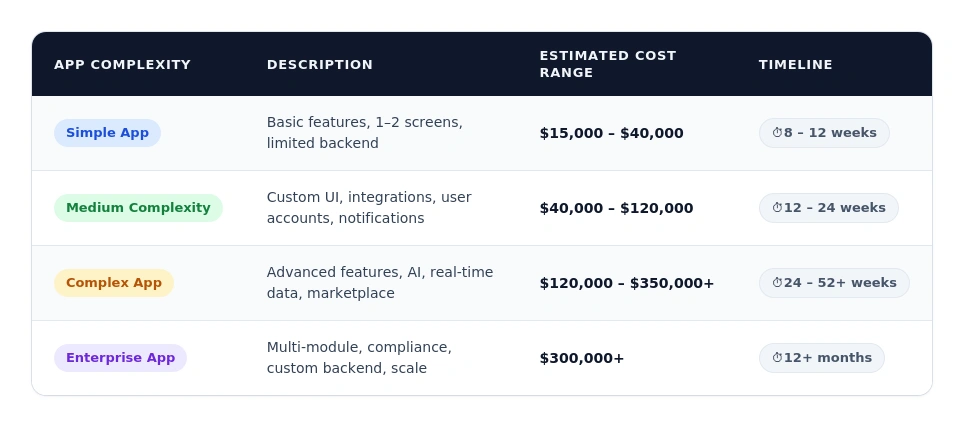
These are ranges that are made under the assumption of an experienced team or professional agency. Freelance costs may be less, but have increased risk of project management. These figures also fail to accommodate maintenance, which usually runs 15% to 20% of the initial build cost per year.
Maintenance Costs for Mobile App Development
Apple and Google, respectively, have major updates to their OS that are released once a year and minor updates that are released periodically, with an average of 4-6 weeks. Every update would be a possible breaking change. Libraries deprecate. APIs change behavior. Devices that were not present when you released your app now have to execute your app correctly. Maintenance cannot be optional; it is the price of staying in the App Store and remaining functional to the users who already downloaded it. The maintenance budget of the mobile app development will be 15 to 20% of the original cost of building it annually. In the case of a $100,000 app, it would be 15,000-20,000 annually prior to the development of new features. This figure is not covered in the majority of business plans, which is why apps usually take 12 or more months to get a update, and subsequently fall off the corresponding device OS compatibility list. The maintenance is mostly included OS compatibility updates (iOS 19 / Android 16 and further), Third-party SDK updates and security patches, updates to App Store policy, performance monitoring and crash fix, minor UX improvements, depending on user feedback. An app that has not been maintained in 18 months will most likely need a rewrite to become current, not due to incorrect concept, but due to the technical debt that has accrued over the whole dependency.
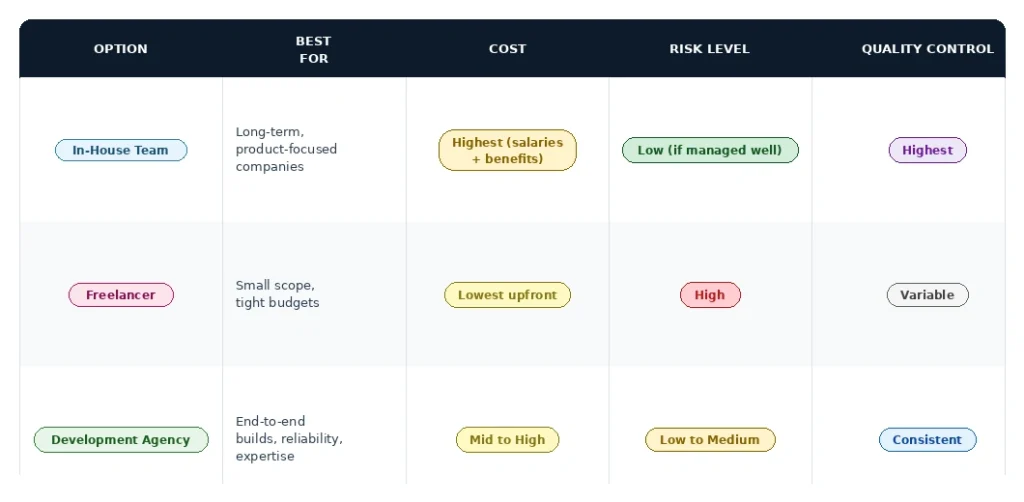
In-House vs Freelancer vs Agency
To the majority of businesses that develop their first mobile application, a development agency is the best risk-to-value candidate. You have a complete team, including designers, developers, QA engineers, and project managers, without the burden of hiring them separately.
Common Mistakes to Avoid While Developing a Mobile App
The distinction between a mobile app development that succeeds and the app that quietly fades away is often talent or budget, but in most cases, it is the absence of a predictable list of choices that causes even a well-funded project to fail.
Skipping the Discovery Phase
The most costly error in app development is going directly into design and development without an adequate discovery phase. Discovery includes the process of validating the idea, creating user personas, user journey mapping, and even technical architecture, prior to any single screen being created. Those teams that bypass this phase will regularly find out the underlying mistakes halfway through development, which lead to expensive revisions.
Building for Every Platform First
The desire to launch both iOS and Android at the same time is a wise coverage consideration, but doubles your starting budget and schedule. The majority of successful applications are released on a single platform and receive feedback, develop the product, and extend. Choose the platform upon which your target customers are most concentrated.
Ignoring Performance and Speed
Users give up on applications that take longer than three seconds to open. Performance is not a post-launch optimization activity. It must be designed at its core with the help of effective data retrieval, optimization of images, lazy loading, and clean design. It is much more costly to fix bugs in production than it is to fix bugs in development.
No Post-Launch Plan
The launch of an application is not the destination. It is the starting pistol. Companies that approach the development of their apps as a one-time project and not as a continuous product investment quickly lose interest after the initial wave of downloads. You require a roadmap to update, gather user feedback process and a budget for ongoing development.
Overcrowding the First Version
The bloat of features kills apps before they even have a chance to be successful. The initial release of any application must perform one primary task very well. All the rest are future releases. Apps are not abandoned by users due to a lack of features. They abandon them since the features that exist are confusing, slow, or unreliable.
Choosing Based on Price Alone
The lowest quote is hardly ever the best one when it comes to app development. A company that only charges 40% of the market rate is either inexperienced, cuts corners on testing and architecture, or intends to recover margin on change orders. The overall cost of ownership, which includes after-launch maintenance and bug fixes, nearly always causes the cheaper choice to be costlier over time.
Our Process to Develop a Mobile App
The following phases provide you with full visibility of how your app is being researched, designed, built, tested, launched, and supported by a team responsible at each level.
Discovery and Strategy
Each build starts with an extensive discovery phase that includes business objectives, target user research, competitor analysis, and feature prioritization. The deliverable is a comprehensive product requirements document and project road map that aligns the stakeholders before development.
UI/UX Design and Prototyping
The design phase creates wireframes, high-fidelity UI designs, and interactive prototypes that can be tested with actual users, prior to any actual code being written. This is the stage in which usability problems are identified at low cost, before they become development rework.
Tech Stack and Architecture
Scalability, maintainability, and the next few years performance all depend on the decisions made here in architecture. The engineering team specifies the backend infrastructure, API architecture, database structure, third-party integrations, and security architecture.
Agile Development Sprints
The development process proceeds on a two-week cycle with frequent client reviews, progress reports, and backlog refinement. This ensures the project stays focused on the business goals and enables corrections to be made on the course without stalling the entire build.
QA Testing and Security
Quality assurance spreads across development and not just at the end. This involves unit testing, integration testing, UI automation testing, performance benchmarking, and security penetration testing prior to any public release.
App Store Submission
The submission of App Store and Google Play includes more than uploading a build. Metadata optimization, screenshot design, category selection, compliance with privacy policy, and compliance with review guidelines all influence approval speed and organic discoverability after launch.
Launch and Monitoring
Staged rollouts, real-time crash monitoring, analytics validation, and the immediate response to user feedback are known as the launch week. The first 72 hours following the launch period are very crucial in identifying a problem before it reaches a large number of people.
Ongoing Post-Launch Support
A loyal development partner does not disappear after launch. Continuous support is provided in the form of frequent updates of maintenance, compatibility with the OS version, monitoring of their functioning, development of the features according to the users feedback, and constant security patches.
Tech Stack and Frameworks Used for Mobile App Development
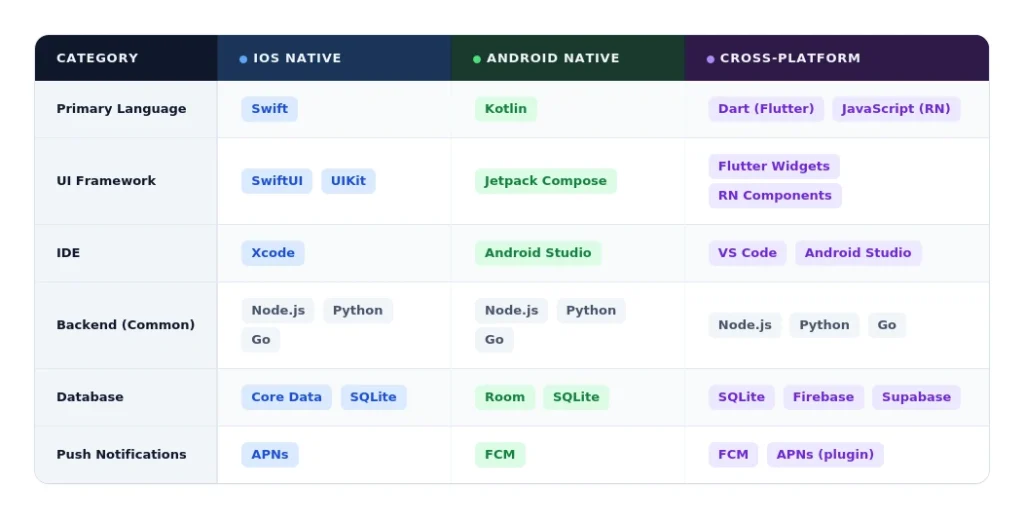
The proper tech stack will depend on the needs of your product, the expertise of your team, and the long-term maintenance policy. Flutter has experienced extensive growth in the adoption of cross-platform development because of its performance features and the expanding community. React Native is a viable option for JavaScript-first companies.
How to Choose a Mobile App Development Partner
The most frequent and expensive errors that businesses make during the process of app development are the selection of an inappropriate development partner. This is what one has to consider besides the portfolio and price.
- Deep understanding of the full stack, not just frontend design.
- Clear discovery and scoping process prior to any contract being signed.
- Testimonials of previous clients within your industry or category of apps.
- Well-defined communication rhythms and project management methodology.
- The contract terms of post-launch support and maintenance.
- The source code and IP are owned and referred to in the agreement.
- Evidence of security practices and compliance experience.
Why Choose Craitrix as Your Mobile App Development Partner?
Every business has a vision. Not all the development partners are deep enough to make it live. At Craitrix, we fill that gap by integrating product thinking, technical accuracy, and industry experience to create mobile apps that truly move the needle. We have a working experience in fintech, healthcare, retail, and logistics, hence we know the stakes, not just specs. As a best mobile app development company, we have assisted businesses in the fintech, healthcare, and retail industries in transforming complex ideas into well-performing mobile products within time, budget, and sustainability.
Frequently Asked Questions
Q1. How much does it cost to develop a mobile app in 2026?
Ans: Simple applications cost around $15,000 to develop, whereas more complex, highly featured products are in the range of $150,000 or higher to develop. A medium-complexity consumer app has the most common range of between $40,000 to $120,000. Prices can be very different depending on platform, functionality, design complexity, and team experience level.
Q2. How long does it take to build a mobile app?
Ans: An application that can perform only basic functions will take 8 to 12 weeks. A medium complexity app has a time requirement of 12-24 weeks. Applications with enterprise or heavy feature capabilities can require 12 months or more to deploy. These timelines are based on the assumption of adequate discovery and scoping before development takes place.
Q3. What is the difference between native and cross-platform app development?
Ans: Native development implies the creation of a separate codebase on iOS (Swift) and Android (Kotlin), with the highest possible performance and integration of the platform. Cross-platform development is based on a single codebase (Flutter or React Native) that can be compiled on both platforms, which is less expensive and quicker, but can perform almost as well as native applications in the majority of applications.
Q4. Should I build an iOS app, an Android app, or both?
Ans: Begin with the platform where you have the largest number of target users. In North America and Europe, iOS has a stronger proportion of premium and high-income users. Android has a leading role in emerging markets in Asia, Africa, and Latin America. Cross-platform development on Flutter or React Native would enable you to release on both platforms simultaneously with similar budgets.
Q5. What is a mobile app MVP, and how much does it cost?
Ans: A Minimum Viable Product (MVP) refers to a version of your application that has the essential features required to validate your idea with actual users. MVPs usually cost between $20,000 to $60,000 and will require 8 to 16 weeks to develop. It is the most intelligent initial investment when businesses are entering the app market for the first time.
Q6. What are the hidden costs of mobile app development?
Ans: In addition to the build cost, businesses must plan to spend on app store developer accounts, backend infrastructure and hosting, third-party API and service charges, ongoing maintenance (15 to 20% of build cost per year), marketing and user acquisition, and future feature development. The cumulative cost of ownership after 3 years is normally 2x to 3x the original build cost.
Q7. How do I choose the right mobile app development company?
Ans: Evaluate partners in their discovery process, technical in-depth, post-launch support terms, client references, and code ownership clauses. Price is an element, but must not be the leading element. The right company asks intelligent questions, communicates effectively, and has a track record of delivering products within your category.
Q8. Is it worth building a mobile app for a small business in 2026?
Ans: Yes, when your customers engage with your business on a regular basis. Apps are best applicable to businesses that have repeat purchase models, service booking, membership packages, or any other scenario where retention and direct communication are more beneficial. The MVP approach will ensure that initial capital remains under control and the concept is tested before a full development.
Q9. Can AI be integrated into any type of mobile app?
Ans: Nowadays, AI can be incorporated into any type of application. Personalized recommendations, conversational support interfaces, image recognition, predictive search, and behavioral analytics are the most practical implementations. The right AI capabilities will vary based on the needs of the user and the data your application will produce.
Q10. What programming languages and frameworks are used for mobile app development?
Ans: iOS applications are developed in Swift using SwiftUI or UIKit. Kotlin with Jetpack Compose is used for Android applications. Cross-platform applications are developed with Flutter (Dart) or React Native (JavaScript/TypeScript). Back-end services are typically implemented in Node.js, Python, or Go. The correct option lies in the needs of your product and the knowledge of your development team.