Have you compared spot vs. margin vs. futures trading before placing your first trade? A lot of traders end up selecting a trading market they are not familiar with, which will affect their success. Besides, if traders are unaware of these markets’ risks, their profits will be diminished, and losses will mount.
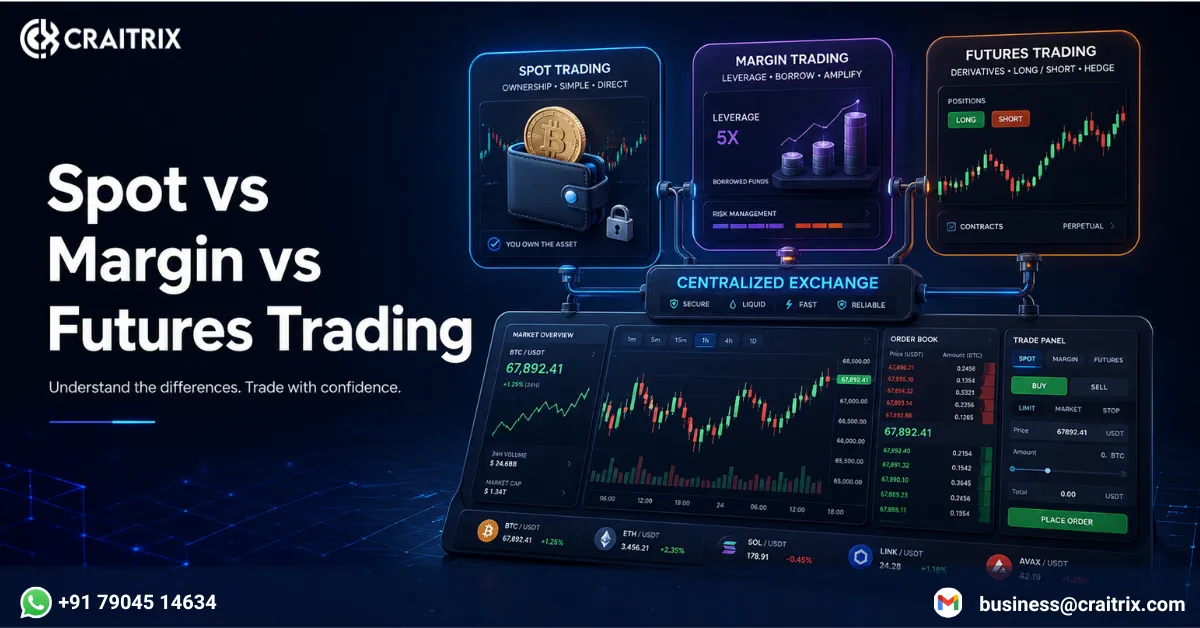
Centralized crypto exchange platforms provide three main trading opportunities for different purposes. Spot trading enables you to purchase and physically hold cryptocurrencies. Margin trading involves the use of borrowed money to take bigger positions. Futures trading allows you to trade contracts without actually owning the coins. All three methods have their own set of advantages, risks, and strategies. Being aware of these distinctions will equip you to select the appropriate trading method. It will also enhance your risk control and increase your confidence in trading.
This Spot vs Margin vs Futures Trading blog breaks down ownership leverage, liquidation, trading fees, and the best cases of use. You will decide which CEX trading mode aligns best with your level of experience, personal investment objectives, and the amount of risk you are willing to take after reading this blog.
| Feature | Spot Trading | Margin Trading | Futures Trading |
| Asset Ownership | Yes | Yes (borrowed) | No |
| Leverage | No | Up to 10x | Up to 125x |
| Liquidation Risk | No | Yes | Yes |
| Risk Level | Low | Medium-High | High |
| Fees | Taker/Maker | Interest + Trading | Funding + Trading |
| Ideal For | Beginners | Intermediate | Advanced |
| Best Use Case | Long-term holding | Short-term amplified gains | Hedging & speculation |
What is Spot Trading?
Spot trading is the simplest method to purchase and sell cryptocurrencies directly. You acquire the actual asset and have complete ownership of it right away. Earnings are made through price increases over time. It is still considered the safest way to start for any new trader.
How Spot Trading Works on a CEX
You make a buy order on the exchange at the current market price. The transaction is completed instantly when the seller is found. Your crypto purchase is instantly available in your exchange wallet. Spot trading is straightforward with no borrowing, contracts, or other complexities.
Advantages and Limitations of Spot Trading
Advantages: Spot trading does not expose traders to liquidation risks. After each trade, you get full ownership of the asset. It is very easy to learn and use with a minimal, straightforward interface.
Limitations: Profits mainly depend on asset price fluctuations only. Since spot trading is unleveraged, you may experience slower increases in your capital during bull markets. To achieve significant trading returns, one needs to have a large amount of capital.
Thus, a spot trading exchange is an excellent option for investors who want to park their money securely instead of looking for quick gains. One can consider it the basis for the development of future advanced trading skills.
What is Margin Trading?
Margin trading gives you borrowed capital to increase your trading power. This way, your position size can exceed the amount that your own balance could afford. Plus, coming with the potential for better profits, this is a highly risky approach, as it includes interest charges and liquidation threats, requiring that you be very careful with your risk management. It is a good fit for traders who not only know how to buy and sell but also understand the market well. Margin trading is essentially loaning money from the exchange to make bigger trades.
How Margin Trading Works
You put down funds in the form of collateral, and the exchange lends you a larger sum. With a set leverage ratio, your buying power rises sharply. When your position size goes up, so do your gains and losses, which happen at the scale of your borrowings. If your account balance drops below the minimum margin, the system will liquidate your position without warning.
Cross Margin vs Isolated Margin
Cross Margin:
In a cross margin, you always use your entire account balance as collateral. While this lessens liquidation risk, it also puts your whole account at risk.
Isolated Margin:
An isolated margin, but it restricts collateral to one trade only. Because of these limits, it limits your maximum loss to only that position.
Benefits and Risks of Margin Trading
Benefits:
When the market moves strongly in one direction, margin trading can help you increase your profits significantly. It allows traders to use a small amount of capital to achieve large results. During bearish cryptocurrency market conditions, short selling becomes an option.
Risks:
Regardless of how careful you are, liquidation can occur within a couple of minutes, and you may end up losing your entire collateral. On borrowed positions, the interest charges are heavy and short-term. Having others as the biggest reason for your financial losses is a difficult emotion to cope with.
Margin trading relies on your ability to control your emotions and manage risk, and through this, it can interest and reward you. Check your liquidation price first before you go into a margin position.
What is Futures Trading?
Futures trading involves speculating on cryptocurrency prices without actually acquiring the assets. In fact, leverage can be as high as 125x on some large platforms. Instead, you trade contracts that reflect the price movements of the underlying assets. Perpetual contracts, leverage options, and funding fees characterize this type of trading. It is mainly targeted to traders who have experienced long and short positions.
How Crypto Futures Trading Works
Opening a long position means that you anticipate the asset price will go up. Opening a short position implies that you think the price will go lower. Your gains and losses are adjusted only based on the difference in prices of the contracts. Higher leverage means every result is hugely magnified on CEX futures platforms.
Perpetual Futures vs Traditional Futures
Perpetual Futures:
Perpetual contracts do not have an expiry date, and this is the case on all CEX platforms. Long and short traders are given the funding fees at regular intervals. Now, most crypto traders use perpetual futures, as it allows them to manage their positions quite flexibly.
Traditional Futures:
Traditional futures contracts always come with a settlement date after which they expire. These futures are typically used to hedge one’s crypto position effectively. The price may not be equal to the spot price due to premium differences over time.
Benefits and Risks of Futures Trading
Benefits:
Trading futures makes it very easy to profit from an upward or downward move of the market. One’s return on investment can be multiplied by high-leverage trading even with limited initial funds. Crypto futures contracts can be used very efficiently for hedging a portfolio.In addition to speculation, futures trading is commonly used by institutional traders and professional investors to hedge their crypto portfolios against adverse market movements. By taking offsetting positions, they can reduce potential losses during periods of high market volatility.
Risks:
Under the conditions of the highly leveraged trade, liquidation may occur very rapidly. Funding fees may get very expensive when holding futures contracts for a long time. Without a good understanding of futures trading, beginners risk losing all their capital.
High leverage, such as 50x to 125x offered by some CEX platforms, can significantly increase liquidation risk, as even small market movements may result in substantial losses. For this reason, such leverage levels are generally unsuitable for beginners and should only be considered by experienced traders with a well-defined risk management strategy.
Hence, futures trading is a great tool for experienced pros involved in the crypto market. It is wise to use leverage cautiously at all times when trading futures to avoid serious losses.
Spot vs Margin vs Futures Trading: Detailed Comparison
Comparing spot vs margin and futures trading is essential. This comparison helps traders select the right trading method confidently.
| Comparison Factor | Spot Trading | Margin Trading | Futures Trading |
| Asset Ownership | Buy and own real crypto assets. | Own crypto using borrowed funds. | Trade contracts without owning crypto. |
| Leverage | Not available. | Moderate leverage available. | High leverage available. |
| Capital Requirement | Full trade value required. | Lower capital with borrowed funds. | Small margin controls larger positions. |
| Liquidation Risk | No liquidation risk. | Liquidation during heavy losses. | High liquidation risk with leverage. |
| Risk Level | Low to moderate. | High due to borrowing. | Very high because of leverage. |
| Profit Potential | Limited to market growth. | Higher returns through leveraged positions. | High in rising or falling markets. |
| Loss Potential | Limited to the invested amount. | Can exceed initial investment. | Losses grow quickly with leverage. |
| Trading Fees | Standard trading fees. | Trading fees plus interest. | Trading and funding fees. |
| Market Direction | Best in bullish markets. | Mostly bullish strategies. | Supports long and short positions. |
| Volatility Exposure | Moderate market exposure. | Higher price sensitivity. | Highest volatility exposure. |
| Holding Period | Short- or long-term. | Mostly short-term. | Mainly short-term trading. |
| Best Use Case | Investing and holding assets. | Boosting buying power. | Hedging and market speculation. |
| Suitable For | Beginners and investors. | Experienced traders. | Advanced and professional traders. |
Thus, understanding these differences helps traders choose the right market, manage risk better, and build a smart crypto trading strategy.
Which Trading Type is Right for You?
Choosing the right trading type depends entirely on your own financial circumstances. You have to consider your level of experience, your willingness to take risks, and how much money you have at your disposal. Doing a practical evaluation of yourself will be more effective than blindly following generic trading advice you find in any source.
Best Choice for Beginners
Spot trading is by far the most secure area where the newbies can become engaged with the trading market. Buying directly without a risk of liquidation or borrowed money is really appealing. To develop your abilities and become more self-assured, you can use spot trading on a centralized exchange (CEX) platform. In fact, the combination of minimum risk and simplicity of implementation characterizes it as the ideal starting option for a novice.
Best Choice for Intermediate Traders
Margin trading is a good fit for intermediate traders who have grasped the concept of price fluctuations in the market. Since leverage increases the profit potential, it equally increases risk, requiring margin traders to be excellent at risk management at all times. Cross and isolated margins are the two types available that offer more freedom in managing your positions. Only after you have mastered the essential spot trading concepts should you consider using leverage, and only to a small degree.
Best Choice for Advanced Traders
The ability to accurately interpret complex market signals is what will make futures trading profitable for a skilled trader. Perpetual contracts and high leverage require deep technical analysis knowledge always. Smart advanced traders employ crypto futures trading not only for hedging purposes but also for speculation. You should not attempt trading in the futures markets until you have a comprehensive understanding of the risks and mechanics involved in margin trading.
Clearly, you should align your trading type with your current expertise and objectives. Risk exceeding your capacity or trading with borrowed money is the quickest way to failure.
Real Trading Examples: Spot vs Margin vs Futures
Trading concepts become a lot more understandable with numbers than with theory only. Let’s accompany a simple $1,000 trade through three trading types. Identical capital, identical market movement, and completely different results are waiting for you in all three cases.
Example: How a $1,000 Trade Performs in Spot, Margin, and Futures
The current market price for Bitcoin is $50,000. You want to invest your whole $1,000 capital using three different methods which is spot, margin, and futures. Now, let’s suppose Bitcoin’s price increases by 10% to $55,000.
Spot Trading $1,000 Investment
You decide to buy Bitcoin using $1,000 at its spot price. You receive 0.02 BTC in your wallet after the trade.
- A 10% rise in the price will give you a $100 profit.
- After the price change, your portfolio’s total value will be $1,100.
- You will not be at risk of liquidation at any time during this trade.
- You don’t pay any interest, nor are there any funding costs for this type of trading.
Spot trading offers secure, modest returns each time.
Margin Trading $1,000 Investment at 5x Leverage
You put down $1,000 as your deposit to borrow $4,000 from the exchange. So, you will be able to trade $5,000 worth of Bitcoin.
- A 10% increase in the price will earn you $500 from the leveraged position.
- The interest fees that are attached to the loan of $4,000 will slightly reduce your final profit.
- The liquidation process will be activated if Bitcoin’s price were to fall by about 20% from your entry point.
- Your net earnings after fees and other costs will be roughly between $480 and $490.
Margin trading will give you multiplied profits, but at the same time, it will give you liquidation risk.
Futures Trading: $1,000 Investment at 10x Leverage
You place a long futures contract to control $10,000 worth of Bitcoin. You do not buy Bitcoin at any stage of this trade.
- A 10% increase in the price will earn you approximately $1,000 before fees.
- There are funding charges during your contract period.
- Liquidation will be triggered if Bitcoin falls by 10% from where you bought it.
- If the liquidation price is reached, you will lose your entire $1,000 capital.
- Futures trading has the highest reward with the highest risk.
One single $1,000 capital can generate completely different financial results. Know your liquidation price at all times, especially when you trade on leverage.
Risk Management Strategies for Every Trading Type
Proper risk management is the key to distinguishing winning traders from losing traders on any central exchange platform. In the long run, consistent risk management is far more important than using higher leverage. Successful traders focus on protecting their capital through disciplined position sizing, stop-loss strategies, and controlled exposure rather than chasing oversized returns.
Position Sizing and Capital Allocation
Never use more than 2% of the total amount of money you have for one trade only. The correct sizing of positions will help you avoid losses in your portfolio with the help of spot, margin, and futures trading regularly.
Managing Leverage, Stop-Losses, and Liquidation Risk
It is a must that you put stop-loss orders before making any leveraged crypto trading position at all. Using very low leverage can help to decrease the risk of being liquidated by a large amount on margin and futures trading platforms.
Common Mistakes to Avoid
Today, using a very high leverage is still the major reason why people end up losing in crypto futures and margin trading. Making decisions while trading emotionally is the fastest way that you can lose your trading capital, even without any negative market movement.
A well-planned risk management approach is the key to unlocking the doors of opportunity and achieving sustainable profitability that extends beyond a single trading type in crypto.
Conclusion
Understanding the differences is a must for every crypto trader in 2026. Spot trading is still the safest pick for newcomers who value owning the asset and protecting their capital. Margin trading fits an intermediate trader who is willing to use borrowed funds to increase gains, but it should be done responsibly. Futures trading gives the opportunity to experienced traders who have a good understanding of perpetual contracts and market speculation.
Each kind of trading on a CEX platform is completely different from the others. Your finest trading method is always in line with your knowledge level, objective, and risk tolerance. Never jump into leveraged trading if you don’t have a very strong knowledge base first. Begin with spot trading, get a good understanding of the basics, then move on to margin and futures trading. Having a disciplined risk management strategy counts as the most important thing among the three different types of trading.
For businesses looking beyond trading and planning to launch their own CEX platform, understanding these trading models is equally valuable. A well-planned crypto exchange development strategy ensures seamless integration of spot, margin, and futures trading while delivering a secure and scalable trading experience for users.
Make your decision carefully, trade responsibly, and always make sure that you have protected your capital first before looking at any profit-making opportunity.
Frequently Asked Questions
Q1. What is the main difference between Spot, Margin, and Futures Trading?
Ans: Spot Trading grants you ownership of the asset. Margin trading is borrowing-dependent. Futures trading deals with contracts and doesn’t involve holding the cryptocurrency directly.
Q2. Which trading type is safest for beginners?
Ans: Spot is the most secure for beginners since it’s straightforward without leverage, reducing liquidation risk and simplifying the handling of cryptocurrencies.
Q3. Can you lose more money with Margin or Futures Trading?
Ans: Absolutely. Both margin and futures are leverage-based, meaning your earnings may be magnified, but so can your losses, mainly when the market is moving quickly.
Q4. Is Futures Trading riskier than Margin Trading?
Ans: Generally, yes. The risk level of futures trading is higher due to the ability to use higher leverage, the greater level of price changes, and the speed at which you can be liquidated.
Q5. Do you own cryptocurrency in Futures Trading?
Ans: Not really. Futures trading is about exchanging agreements whose values correspond to those of cryptocurrencies without the buyer being the owner of any digital assets directly.
Q6. What leverage should beginners use?
Ans: The very best advice for first-timers is to steer clear of leverage that is ‘too high.’ In the event it is necessary, then even a low leverage of 2x should be employed to scale down the risk and safeguard the capital.
Q7. Can I switch between Spot, Margin, and Futures on the same CEX?
Ans: Yes, most of the centralized exchanges enable trading of spot, margin, and futures from a single trading platform.
Q8. Which trading type is best for long-term investors?
Ans: Choosing spot trading would be a good option for long-term investors, as it gives ownership of cryptocurrencies, and you don’t have to worry about leverage, borrowing costs, or liquidation risk.