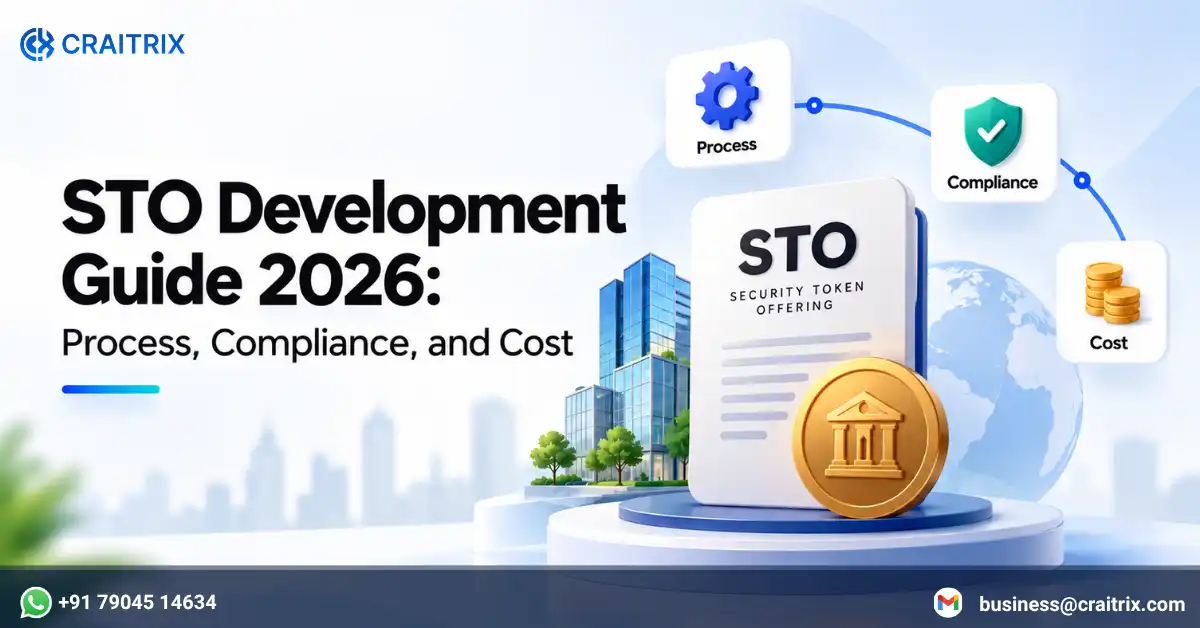
Launching a security token is not simply a matter of putting an asset on a blockchain. The real challenge is connecting the asset, investor rights, regulatory requirements, smart contracts, investor onboarding, and future trading into one workable system.
That is where STO development comes in.
A well-designed Security Token Offering can represent interests in assets such as real estate, equity, debt, funds, or other eligible investments through blockchain-based tokens. But the development process must account for more than token creation. Legal structuring, token economics, KYC/AML, investor eligibility, transfer restrictions, smart-contract security, issuance, and secondary-market readiness all need to work together.
For businesses exploring security token development, the key question is not only how to create the token, but how to build an STO infrastructure that can support compliant issuance and ongoing management.
This guide explains the STO development process, technology, compliance considerations, cost factors, and what to evaluate when choosing an STO development company.
STO Development Explained: Definition and Core Workflow
STO development is the process of building the technology and infrastructure used to issue, manage, and potentially trade blockchain-based security tokens.
A security token represents a security or financial interest whose legal and economic rights depend on the underlying offering structure. That could mean ownership, repayment rights, income, voting rights, or another contractual entitlement.
An STO brings that financial interest into a blockchain-based environment. The work usually begins with the underlying asset and investor rights, then moves through token design, compliance architecture, smart contracts, investor verification, issuance, and ongoing management.
A typical workflow looks like this:
Asset and legal structure → Token design → Compliance architecture → Smart contract → Investor verification → Issuance → Ongoing management → Secondary-market readiness
The important point is that token creation comes after the business and legal model are understood. Businesses exploring token creation need to define what the token actually represents before deciding how it should behave on-chain.
STO vs ICO vs Traditional Securities
STO, ICO, and traditional securities differ in how the underlying asset, investor access, infrastructure, and compliance requirements are handled.
| Factor | STO | ICO | Traditional Securities |
| Asset/token purpose | Represents a security or financial interest | Often represents a utility or crypto asset; treatment varies | Represents a legally recognized security |
| Infrastructure | Blockchain/DLT-based | Commonly blockchain-based | Conventional financial infrastructure |
| Investor eligibility | Based on offering and jurisdiction | Depends on token design and jurisdiction | Based on applicable securities rules |
| Transfer controls | Can be built into token infrastructure | Varies by project | Usually handled through established systems |
| Compliance | Core part of the offering structure | Depends on the asset and jurisdiction | Governed by applicable securities rules |
The defining difference is the combination of blockchain infrastructure and a securities framework. Putting a security on-chain does not automatically turn it into a different legal category.
If a project is instead considering a utility-token model, ICO development covers a different token-launch structure.
How to Plan an STO Before Development Begins
The strongest STO projects settle the important questions before developers start writing smart contracts. Otherwise, technical decisions often have to be changed later.
Choose the Asset and Define Investor Rights
Start with the asset.
It could be a real-estate interest, company equity, debt instrument, fund interest, or another eligible financial interest. Then define exactly what the investor receives. Ownership, income, repayment, voting rights, redemption rights, and distribution terms all affect the token model.
This step sounds basic, but it shapes almost everything that follows.
Select the Jurisdiction and Regulatory Framework
An STO offered to investors in one jurisdiction may face a very different set of requirements from an offering targeting another market.
The development plan therefore needs to account for the relevant securities framework, investor restrictions, disclosures, reporting requirements, transfer conditions, and licensing considerations. Legal professionals should confirm these requirements before technical implementation begins.
Define Token Economics and Investor Eligibility
Next, settle the commercial model: token supply, pricing, fundraising target, distribution method, ownership representation, and investor eligibility.
For example, a retail-focused offering needs a different onboarding experience from an institutional-only offering. Those differences eventually flow into KYC, access control, transfer logic, and investor dashboards.
The STO Development Process: From Token Design to Exchange-Ready Launch
Once the offering structure is clear, development becomes a series of connected technical and compliance stages.
1. Legal Structuring and Security Token Classification
The first development input is the legal and commercial structure.
The asset, investor rights, ownership model, jurisdiction, and offering restrictions determine what the platform has to enforce. That includes eligibility rules, transfer restrictions, disclosures, and investor records.
The technical team should not have to guess these requirements halfway through development.
2. Token Economics and Design
The next step turns those requirements into a token model.
Define supply, pricing, distribution, ownership representation, investor rights, and transfer conditions. A security token should reflect the underlying legal structure rather than copy the economics of a conventional cryptocurrency.
3. Smart Contract Development and Compliance Logic
Smart contracts handle functions such as issuance, transfers, ownership records, and programmed restrictions.
This is also where compliance logic can connect with token activity. For instance, a transfer can be checked against investor eligibility or jurisdictional restrictions before the transaction proceeds.
That makes smart contract development one of the most important technical stages in an STO.
Security-token standards such as ERC-1400, ERC-3643, and ERC-1404 address different implementation needs. ERC-3643 focuses on permissioned, identity-aware token infrastructure, while ERC-1400 provides a broader framework for security tokens and ERC-1404 addresses transfer-restriction mechanisms.
For the current ERC-3643 specification and ecosystem information, refer to the ERC-3643 Association.
4. STO Platform and Investor Portal Development
The investor portal becomes the operational front end of the offering.
A typical portal can handle registration, offering information, verification status, documents, token balances, transaction history, and investment details. On the issuer side, administrators need tools for investor management, token supply, ownership records, distributions, and offering administration.
The experience should feel like a financial platform, not simply a crypto wallet with an extra dashboard.
5. KYC/AML and Investor Eligibility Integration
Investor onboarding is where compliance controls meet the actual product.
Consider a retail STO targeting EU investors. Identity verification and eligibility checks need to happen before an investor participates or receives transferable tokens. An institutional offering can follow a different onboarding process, but its investor records still need to connect cleanly with access and transfer controls.
This integration is easy to underestimate. In practice, the challenge is not just verifying an identity; it is making that verification meaningful throughout the token lifecycle.
6. Testing, Security Audit, and Deployment
Before launch, the smart contracts and platform need functional, security, and integration testing.
Test the important paths: token issuance, transfers, access controls, compliance checks, wallet interactions, administrator permissions, recovery procedures, and upgrade mechanisms where applicable.
A security review or smart contract audit can identify weaknesses before real assets and investor funds enter the system.
7. Token Issuance and Investor Distribution
Once the required legal, compliance, and technical checks are complete, tokens can be issued according to the approved offering structure.
Verified investors can receive tokens through supported wallets or platform infrastructure. At the same time, the system needs reliable ownership records and transaction histories so the issuer can track who holds what.
8. Secondary-Market and Exchange Readiness
Secondary trading should be considered during the initial architecture if it forms part of the business model.
An exchange-ready security token needs more than a trading interface. Transfer restrictions, investor eligibility, wallet controls, ownership records, custody, settlement, and trading infrastructure all have to work together.
Designing this layer late in the project often creates unnecessary rework. It is much easier to account for future trading requirements while the token and compliance architecture are still being designed.
What Technology Stack Is Needed for STO Development?
An STO stack connects blockchain infrastructure with smart contracts, wallets, compliance services, investor management, and external APIs.
Blockchain and Security Token Standards
The blockchain provides the infrastructure for issuing and managing tokens. Ethereum-compatible networks are one common option because they support programmable smart contracts and established token standards.
The right blockchain development company approach depends on transaction costs, performance, custody, transfer restrictions, compliance requirements, and integrations.
Smart Contracts and Wallet Infrastructure
Smart contracts manage issuance, transfers, ownership, and programmed restrictions.
Wallet infrastructure handles the asset itself. Depending on the model, the platform could use custodial or non-custodial wallets, multisignature controls, key recovery, custody integrations, and transaction monitoring.
Compliance and Investor Management APIs
The platform can connect with external services for identity verification, KYC/AML, custody, payments, analytics, and investor management.
The important part is the connection between them. A verified investor should not become “verified” only inside a separate KYC dashboard; that status needs to flow into the relevant platform permissions and token-transfer controls.
How Does an Exchange-Ready STO Stay Compliant After Launch?
Issuing the token is only the beginning.
Managing Transfers and Investor Eligibility
Security-token transfers can be restricted by investor type, jurisdiction, offering terms, or other conditions. The platform needs a reliable way to check those conditions when transfers occur.
Corporate Actions and Ownership Records
Some securities involve distributions, voting, redemptions, interest payments, or other corporate actions.
The platform needs accurate holder records to support those activities. Blockchain records can help, but the overall ownership and operational model still has to match the legal structure of the offering.
Compliance Monitoring and Maintenance
Investor status changes. Integrations change. Regulations evolve.
The platform therefore needs ongoing monitoring, maintenance, security reviews, and controlled upgrades rather than a “launch once and leave it” approach.
STO Regulatory Landscape in 2026
Regulation remains central to STO development because tokenization does not automatically remove existing securities obligations.
On January 28, 2026, staff from three SEC divisions issued a statement on tokenized securities. It explains different tokenization models and notes that tokenized securities remain subject to the applicable federal securities framework; the statement itself is a staff statement rather than a rule or regulation.
IOSCO published its Final Report on the Tokenization of Financial Assets on November 11, 2025. The report describes tokenization as an emerging area and highlights challenges including interoperability and settlement infrastructure.
FATF’s July 16, 2026 targeted update reports that 83% of surveyed jurisdictions had passed legislation implementing the Travel Rule, while also identifying continuing gaps in supervision, licensing or registration, enforcement, and oversight of offshore VASPs.
For an STO project, the practical takeaway is clear: investor eligibility, transfer restrictions, disclosures, KYC/AML, custody, and reporting need to be designed around the specific jurisdiction and offering structure.
What Does STO Development Cost in 2026?
The STO development cost in 2026 depends on the scope of the platform rather than a single fixed price. A basic security token issuance setup may require fewer components, while an enterprise STO platform can involve investor portals, compliance integrations, smart contracts, custody, payment systems, and secondary-market connectivity.
Key Factors That Affect STO Development Cost
Several factors influence the overall security token development cost, including:
- Token complexity: Supply, ownership structure, transfer rules, and investor rights.
- Blockchain choice: Network, infrastructure, transaction model, and integrations.
- Smart-contract requirements: Issuance, compliance logic, transfers, distributions, and other functions.
- Compliance infrastructure: KYC/AML, investor eligibility, jurisdiction-specific controls, and reporting.
- Platform features: Investor dashboard, issuer dashboard, wallet integration, payment processing, and token management.
- Security requirements: Testing, audits, monitoring, access controls, and deployment architecture.
- Exchange integration: Requirements for secondary-market or trading infrastructure.
| Scope | Typical Components |
| Basic STO | Token contract, investor portal, wallet integration, essential compliance integrations |
| Mid-Level STO | Issuer dashboard, investor dashboard, KYC/AML, custody, payments, distribution features |
| Enterprise STO | Advanced compliance automation, multi-jurisdiction support, custody, secondary-market integrations, reporting, corporate actions, multi-chain infrastructure |
Because every STO has different legal, technical, and business requirements, STO development pricing should be estimated after defining the asset, jurisdiction, investor model, token functionality, and required platform features.
A detailed scope provides a more realistic development estimate than using a generic package price.
Where Can STO Development Be Used?
STO development can be applied to different asset classes where ownership or financial interests can be represented through compliant digital securities.
The right structure depends on the asset, legal framework, investor rights, and offering model.
Real Estate, Equity, Debt, and Fund Tokenization
Security tokenization can support several use cases, including:
- Real estate tokenization: Represent eligible ownership or economic interests in property-related assets.
- Equity tokenization: Digitally represent ownership interests in eligible companies.
- Debt tokenization: Represent debt instruments with defined repayment or income rights.
- Fund tokenization: Digitize eligible interests in investment funds or similar structures.
- Asset-backed securities: Represent qualifying interests linked to underlying assets.
Why Businesses are Exploring Security Tokenization
Businesses are exploring tokenization to create more programmable and digitally managed investment infrastructure.
Depending on the structure, blockchain-based securities can support transparent ownership records, automated transfer rules, streamlined investor management, and integration with digital financial infrastructure.
However, tokenization does not automatically make an asset liquid or remove regulatory obligations. Liquidity, investor eligibility, legal structure, custody, and secondary-market access still need to be addressed as part of the STO strategy.
For this reason, an effective security tokenization platform should be designed around the complete asset lifecycle, from issuance and investor onboarding to ownership management and potential secondary trading.
How to Choose an STO Development Company
Choosing an STO development company involves more than checking whether a team can create a blockchain token. The development partner should understand the technical infrastructure, investor-management requirements, security considerations, and compliance integrations involved in an STO platform.
Check Security Token Development Expertise
Look for experience in security token development, smart contracts, investor portals, KYC/AML integrations, wallets, and blockchain solutions.
A complete development partner should be able to connect these components into one platform rather than focusing only on token creation.
Review Regulatory and Compliance Experience
STO platforms often require investor verification, eligibility controls, transfer restrictions, and compliance-related integrations.
Ask whether the development team has experience implementing these technical requirements and working with compliance workflows. Legal and regulatory decisions should still be confirmed by qualified professionals for the relevant offering and jurisdiction.
Evaluate Smart Contract and Security Practices
Security should be considered throughout development. Review how the company approaches smart-contract testing, code review, access controls, wallet security, system monitoring, and deployment.
For projects involving valuable digital assets, understanding the team’s security and testing practices can help identify technical risks before launch.
Check for Relevant STO Platform Experience
Review the company’s previous work in STO platforms, security tokens, tokenization solutions, or related blockchain projects.
Where possible, evaluate whether its experience covers the type of infrastructure your project requires, such as investor dashboards, token management, compliance integrations, wallet connectivity, or secondary-market readiness.
Look for Post-Launch Support and Maintenance
STO infrastructure may require ongoing maintenance after deployment. Smart contracts, integrations, compliance systems, security controls, and platform infrastructure may need monitoring and updates.
Ask what post-launch support the development company provides, including technical maintenance, issue resolution, system monitoring, and controlled platform upgrades.
Launch Your Security Token Platform with Craitrix
Building an STO platform requires the right combination of security token standards, smart contracts, investor onboarding, compliance workflows, wallet infrastructure, and secure platform architecture.
Craitrix helps businesses develop custom STO platforms based on their asset structure, investor requirements, and business goals. From token issuance and investor management to KYC/AML integration and secondary-market readiness, each component can be designed to support the complete security token lifecycle.
Whether you are planning to tokenize real estate, equity, debt, or another eligible financial interest, the technology can be structured around your specific STO model.
Ready to discuss your project? Connect with Craitrix STO Development Company to plan the technology and infrastructure required for your security token platform.
Frequently Asked Questions
Q1. What is STO Development?
Ans: STO development is the process of building the technology and infrastructure required to issue, manage, and potentially trade security tokens. It can include smart contracts, investor portals, KYC/AML integrations, wallets, token management, and compliance-related controls.
Q2. How Long Does It Take to Develop an STO?
Ans: STO development can take several weeks to several months, depending on the project’s complexity. The timeline can vary based on the blockchain, smart-contract requirements, platform features, compliance integrations, security testing, and secondary-market integrations.
Q3. How Much Does STO Development Cost in 2026?
Ans: STO development cost depends on the project’s technical, business, and compliance requirements. Major factors include token complexity, blockchain selection, smart contracts, investor portals, KYC/AML integrations, wallet infrastructure, security requirements, and secondary-market integrations.
Q4. Which Assets Can Be Tokenized Through an STO?
Ans: Several eligible assets and financial interests can potentially be represented through security tokens, including real estate, equity, debt instruments, investment funds, and asset-backed interests. The appropriate structure depends on the asset and applicable legal framework.
Q5. What Compliance Is Required for an STO?
Ans: STO compliance can involve KYC/AML, investor verification, eligibility checks, transfer restrictions, disclosures, reporting, and ongoing monitoring. The exact requirements depend on the jurisdiction, asset, investor type, and offering structure.
Q6. Which Blockchain Standards Are Used for Security Tokens?
Ans: ERC-1400, ERC-3643, and ERC-1404 are among the standards that may be considered for security token development. The appropriate standard depends on the project’s transfer rules, compliance requirements, blockchain, and technical architecture.
Q7. Can Security Tokens Be Listed on an Exchange?
Ans: Security tokens can potentially be listed and traded on suitable compliant trading venues. However, listing and trading depend on the token’s legal structure, applicable regulations, investor eligibility, transfer restrictions, and the requirements of the relevant trading venue.
Q8. What Is the Difference Between an STO and an ICO?
Ans: An STO represents a security or financial interest, while an ICO generally involves issuing a crypto or utility-oriented token. The legal treatment of either model depends on its specific structure and the applicable jurisdiction.
Q9. Is an STO cheaper than a traditional IPO?
Ans: STO and IPO costs can differ significantly depending on the jurisdiction, offering structure, legal requirements, intermediaries, technology infrastructure, and investor model. An STO may change some issuance and operational costs, but it still requires legal structuring, compliance, technology development, security, and ongoing administration.