Picture a decentralized exchange that handles $10 million in trades during a single month and still finishes in the red. This is possible because the protocol may retain only a small share of each trading fee, while still covering security audits, liquidity incentives, and ongoing development.
A decentralized exchange (DEX) uses smart contracts to execute trades, often allowing users to swap tokens directly from their wallets without handing custody to a centralized operator. That raises an obvious question: where does the money come from?
The short answer is a mix of swap fees, protocol-level fees, routing charges, cross-chain services, derivatives, and paid add-ons. However, a fee paid by a trader rarely reaches the protocol in full. Liquidity providers and other participants may receive a share first.
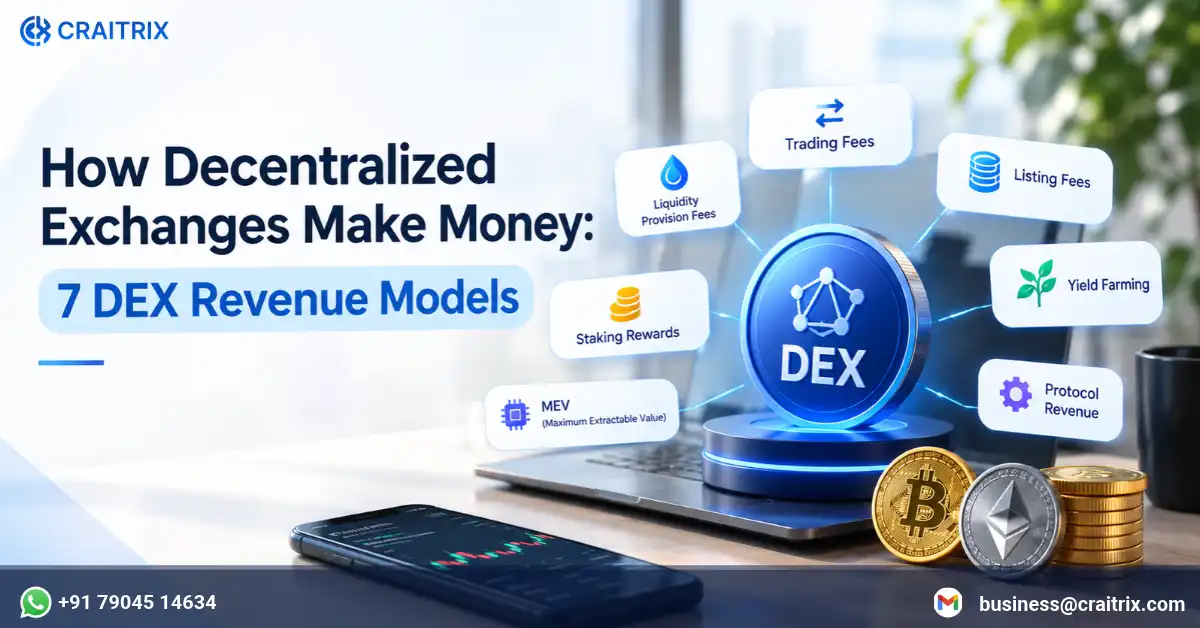
This article explains how decentralized exchanges make money through seven DEX revenue models, real-world examples, and a simple calculation to help you assess profitability before building an exchange.
Understanding the DEX Revenue Model
A DEX earns through trading fees and services related to token trading. Some protocols retain a share of swap fees, while others generate revenue through derivatives, aggregation, or additional products.
The main revenue streams are:
- Swap fees: Charged when users exchange one token for another.
- Protocol fees: The portion of trading fees retained by the protocol.
- Token launchpad fees: Potential income from token launches and fundraising services.
- Cross-chain fees: Charges for transferring or swapping assets across blockchains.
- Routing fees: Fees or service income from trade execution across liquidity sources.
- Derivatives fees: Trading fees from perpetuals and similar products.
- Add-on services: APIs, licensing, integrations, and paid promotions.
No two platforms combine these streams in the same way. Earnings depend on contract design, governance decisions, fee distribution, trading activity, and the products offered.
7 Revenue Models: How Decentralized Exchanges Make Money
Decentralized exchanges generate revenue in different ways depending on their trading features, fee structure, and business model. Some rely mainly on swap fees, while others earn through aggregation, derivatives trading, or additional services.
Here are seven common DEX revenue models and how they work.
1. Swap Fees
Every swap on an automated market maker (AMM) carries a fee determined by the pool or protocol rules. A trader exchanging ETH for USDC, for example, pays that fee as part of the transaction.
In many AMMs, most or all of the swap fee goes to liquidity providers. The protocol may retain a portion if its fee mechanism is enabled. Uniswap illustrates how these arrangements vary between versions. Its official fee documentation explains how fees are allocated between liquidity providers and the protocol.
Swap fees can provide a consistent revenue stream for a DEX when trading activity is strong. However, the amount the protocol earns depends on its fee structure and how much of the collected fees it retains after accounting for liquidity providers and other participants.
Founder takeaway: Swap fees can provide recurring income when trading activity is consistent, but excessive fees may push traders toward cheaper alternatives.
2. Protocol Fees
A protocol fee is the portion of trading fees retained by the protocol rather than distributed to liquidity providers. Smart contracts and governance rules determine whether the fee applies, how much is collected, and how the proceeds are used.
Uniswap provides an example. Its official fee documentation describes protocol fees on v2 pools and selected v3 pools. The exact configuration and distribution mechanism depend on the protocol’s rules.
Uniswap Labs also charges fees on certain swaps made through its own interface. These are separate from liquidity-provider fees and protocol fees. Decrypt reported, citing DefiLlama figures, that this interface-related income reached $52.75 million between April 1 and September 30, 2024. This is a historical figure, not a current revenue estimate. For updated data, consult DefiLlama’s Uniswap Labs dashboard.
Founder takeaway: A protocol fee determines how much trading activity translates into protocol income. Balance that income against the need to maintain competitive fees and sufficient liquidity.
3. Token Launchpad Fees
Some decentralized exchanges generate income by offering token launchpad services. These platforms help new blockchain projects raise funds and connect with early users through token sales.
Depending on the platform’s business model, revenue may come from token sale fees, project listing services, or other launch-related services. However, not every launchpad fee becomes operating revenue. For example, PancakeSwap’s CAKE.PAD mechanism has used fees that are burned rather than retained as platform income.
Founder takeaway: Before counting launchpad fees as a revenue source, founders should check how the platform handles collected fees and whether they are retained, distributed, or burned.
4. Cross-Chain Swap Fees
A cross-chain swap allows users to exchange assets across different blockchain networks, typically through a bridge or routing layer. A DEX may charge a service fee or receive a share of a partner’s fee. Bridge charges, network gas, and the DEX’s own service fee are separate costs and should be presented clearly.
The technical challenges include failed transfers, bridge security, and uneven liquidity across networks. These factors affect both user experience and operating costs.
Founder takeaway: Supporting additional chains can expand your audience, but cross-chain services generate income only when their fee structure and delivery costs are sustainable.
5. Aggregation and Routing Fees
A DEX aggregator checks multiple liquidity pools and exchanges to find suitable trade routes. It may split an order across several sources to improve execution without maintaining all the liquidity itself.
1inch and Jupiter are well-known examples. Their monetization can involve routing fees, integrator fees, or other arrangements. Not every route carries an additional fee, so check the platform’s current documentation before quoting specific rates.
The best route is not always the one with the lowest quoted price. Slippage, gas costs, and pool depth all affect the amount a trader receives.
Founder takeaway: Aggregation can provide access to deeper liquidity without funding every pool, but its value depends on competitive execution and a sustainable fee arrangement.
6. Perpetuals and Derivatives Fees
Perpetual futures allow traders to speculate on asset prices without owning the underlying tokens. Unlike basic spot swaps, these products generate fees through order execution and product-specific trading mechanisms.
dYdX offers decentralized perpetual trading, and its published fee documentation describes maker and taker fees. Funding payments generally move between traders rather than becoming protocol revenue, unless a specific product explicitly captures a share.Derivatives also require liquidation mechanisms, reliable price oracles, margin rules, risk controls, and careful legal review.
Founder takeaway: Derivatives can generate additional trading-fee income, but they require more sophisticated engineering and risk management than a basic swap platform.
7. Other Value-Added Services
Beyond trading, a DEX business may offer services to traders, developers, and other companies:
- API access: Market data and trading endpoints under paid plans.
- White-label licensing: Licensing platform components to other businesses.
- Fiat on-ramps: Commissions from payment partners.
- Featured placements: Paid promotional visibility under clear listing rules.
- Developer services: Custom integrations, analytics, and infrastructure.
1inch illustrates the API model through 1inch Business, which offers developer access and paid plans with different usage limits. These services generate revenue only when customers are willing to pay enough to cover delivery and maintenance costs.
Founder takeaway: Additional services can diversify revenue when they solve a clear problem for a defined customer group.
How Popular DEXs Generate Revenue
Major DEXs use different trading models and fee mechanisms. The table below summarizes their general approaches, rather than promising a particular level of income.
| DEX | Main trading model | Revenue approach |
| Uniswap | Automated market maker (AMM) | Swap fees, with protocol fees on eligible pools |
| PancakeSwap | AMM and multichain trading | Trading-related fees and protocol mechanisms; CAKE.PAD participation fees are burned |
| Curve Finance | Pools for similar-value assets | Pool trading fees and crvUSD-related interest revenue |
| SushiSwap | AMM and aggregation | Trading fees and other product-specific mechanisms |
| dYdX | Order-book perpetual trading | Maker and taker fees under the applicable schedule |
Fee settings and governance decisions can change, so verify current documentation before publication or financial planning.
Curve’s fee documentation explains how its DAO revenue can include pool trading fees and CRVUSD market interest, with distributions governed by its mechanisms. SushiSwap’s V2 pools use a 0.30% swap fee, with 0.25% allocated to liquidity providers and 0.05% allocated to SUSHI holders under the documented fee structure. See DefiLlama’s SushiSwap dashboard for its protocol metrics.
Equal trading volume does not mean equal revenue. Fee design, liquidity arrangements, and operating costs determine how much each platform retains.
Are Decentralized Exchanges Profitable?
They can be, but profitability is not guaranteed. A DEX earns a profit only when its relevant revenue exceeds expenses such as operations, security, liquidity incentives, and development. High trading volume alone does not ensure positive returns.
What Affects DEX Profitability?
- Trading activity: Higher volume can increase revenue, but only the retained share counts.
- Fee design: Rates must balance income with competitive trading costs.
- Liquidity incentives: Token rewards can attract liquidity but reduce net earnings.
- Security and maintenance: Audits, monitoring, and upgrades require ongoing investment. Effective crypto exchange liquidity management helps platforms maintain sufficient liquidity while managing the cost of incentives and rewards.
- User retention: Competitive fees, reliable execution, and deep liquidity encourage repeat trading.
- Additional products: Routing, derivatives, and integrations can add income when demand exists.
- Treasury and governance: Fee allocation and spending decisions influence the remaining funds.
Selecting from the best DEX development companies can help you assess development expertise and technical capabilities before investing in your platform.
Example of a DEX Revenue Calculation
The following example uses hypothetical figures to show how retained protocol revenue affects DEX profitability. The 0.05% and 0.08% rates represent the share of trading volume the protocol retains as revenue, not the total fees paid by traders. Actual earnings depend on the fee structure, liquidity provider allocations, and other protocol-specific arrangements.
| Metric | Scenario A | Scenario B |
| Monthly trading volume | $10,000,000 | $10,000,000 |
| Retained protocol revenue rate | 0.05% | 0.08% |
| Monthly protocol revenue | $5,000 | $8,000 |
| Estimated monthly operating expenses | $5,500 | $5,500 |
| Estimated monthly profit/loss | -$500 | $2,500 |
In Scenario A, the protocol generates $5,000 in monthly revenue but spends $5,500, resulting in a $500 loss. In Scenario B, the higher retained revenue rate generates $8,000, leaving an estimated $2,500 after operating expenses.
These figures are illustrative, not industry benchmarks. Actual profitability depends on fee distribution, infrastructure, security audits, maintenance, liquidity incentives, and other operating costs. Development costs, taxes, and additional overhead may also affect the final result.
DEX vs CEX: How Each Exchange Makes Money
Both decentralized and centralized exchanges enable crypto trading, but their custody, execution, and operational structures differ. These differences influence their revenue opportunities and costs.
| Factor | Decentralized exchange (DEX) | Centralized exchange (CEX) |
| Trade execution | Smart contracts, liquidity pools, or on-chain order books | Exchange-managed systems and order books |
| Asset custody | Usually non-custodial | Often custodial |
| Main revenue sources | Protocol fees, where enabled, and on-chain services | Trading commissions and exchange services |
| Additional products | Aggregation, cross-chain swaps, derivatives, integrations | Margin, derivatives, and custody-related services |
| Technical requirements | Smart contract security, blockchain integrations, protocol maintenance | Trading infrastructure, custody security, compliance, and support |
| Key challenge | Building liquidity and retaining protocol revenue | Attracting traders while managing operational, custody, and compliance costs |
Which Exchange Model Offers Better Revenue Potential?
Neither model guarantees higher profits. A CEX may earn from trading, margin products, and other exchange services, while a DEX may generate income through protocol fees, routing, and on-chain products. Compare expected revenue, liquidity requirements, security costs, and ongoing operations before choosing.
Building a DEX? Craitrix DEX development services can help you evaluate suitable architectures and trading features.
Understanding the DEX Business Model: What to Consider Before You Build
A DEX business model explains how a platform attracts traders, sources liquidity, collects fees, and covers expenses. Before choosing a model, consider four questions:
- Who pays? Traders, liquidity providers, partners, or other customers.
- What earns? The specific fee or service and how the proceeds are distributed.
- What does it cost? Development, security, infrastructure, incentives, and operations.
- Will it scale? Whether the model remains sustainable as users, trading volume, and supported networks grow.
Before launch, assess these factors:
- Trading model and fees: Choose between AMMs, order books, and derivatives, then establish a competitive fee structure.
- Liquidity plan: Estimate the costs of acquiring and retaining liquidity, including rewards and partnerships.
- Security funding: Budget for audits, monitoring, upgrades, and incident response.Security funding: Budget for audits, monitoring, upgrades, and incident response, supported by strong crypto exchange security practices.
- Legal review: Derivatives and token launch services may create additional obligations in your target markets.
- Financial monitoring: Track trading volume, retained revenue, liquidity depth, user retention, incentives, and operating expenses.
Start with the revenue mechanisms that suit your target market, and add other services when demand is established. Working with a decentralized exchange development company can help you plan suitable trading features, fee structures, and liquidity strategies around your business goals.
Unsure which model suits your project? Talk to Craitrix about your trading model, fee structure, and liquidity plan before development begins.
What Does It Cost to Build a DEX?
DEX development cost depends on the trading model, feature scope, number of blockchains, integrations, and security requirements. A basic AMM is generally less complex than a multichain platform with advanced routing, governance, or perpetual trading.For a broader cost breakdown, read our crypto exchange development cost guide.
The main cost factors include:
- Trading architecture and smart contracts: AMM swaps, order books, fee logic, and derivatives require different levels of engineering.
- Frontend and blockchain integrations: Wallet connections, indexing, price feeds, and additional networks increase implementation and maintenance work.
- Security and maintenance: Independent audits, monitoring, upgrades, and ongoing fixes need dedicated budgets.
- Liquidity and operations: Rewards, partnerships, infrastructure, and ongoing operating expenses sit alongside software development costs.
White-label solutions can reduce initial development effort, while custom builds offer more control over functionality. Both still require security testing, liquidity planning, and maintenance. Along with the budget, understanding the DEX development timeline helps you plan the project stages and prepare for launch.
Conclusion
DEXs can generate income through swap fees, protocol fees, routing, cross-chain services, derivatives, and additional products. The right combination depends on the platform’s design, target audience, and fee-sharing arrangements.
Collecting fees is not the same as making a profit. A DEX must retain enough revenue to cover incentives, security, development, and operations. Choosing the right revenue model and planning costs carefully can help build a sustainable platform.
Planning to launch your own DEX? Talk to Craitrix about your revenue model, trading features, liquidity strategy, and development requirements.
Frequently Asked Questions
Q1. How do DEXs make money?
Ans: DEXs generate income through swap fees, protocol fees, routing, cross-chain services, derivatives, and paid add-ons. The applicable revenue streams depend on the platform’s design and fee-sharing rules.
Q2. Are decentralized exchanges profitable?
Ans: They can be profitable when retained revenue exceeds operating expenses. Fee distribution, liquidity incentives, security, development, and trading activity all affect the result.
Q3. What is the best business model for a DEX?
Ans: It depends on the target market. An AMM typically relies on swap fees, an aggregator may earn through routing arrangements, and a derivatives platform can earn trading fees. Each model requires a suitable liquidity and cost plan.
Q4. How does DEX revenue differ from CEX revenue?
Ans: A DEX may earn protocol fees and on-chain service income, while a CEX may generate revenue from trading commissions, margin products, and custody-related services. Neither model guarantees higher profits.
Q5. Do all DEX trading fees go to the platform?
Ans: No. Liquidity providers, token holders, treasuries, or other participants may receive a share, depending on the protocol’s contracts, fee configuration, and governance.
Q6.What does it cost to build a decentralized exchange?
Ans: Costs depend on trading architecture, smart contract complexity, blockchain integrations, security requirements, and project scope. Custom and white-label solutions differ in development effort and flexibility.
Q7. How can a DEX earn without high swap fees?
Ans: A DEX may add routing, cross-chain services, derivatives, API access, or other paid offerings. These generate sustainable income only when demand justifies their delivery and maintenance costs.