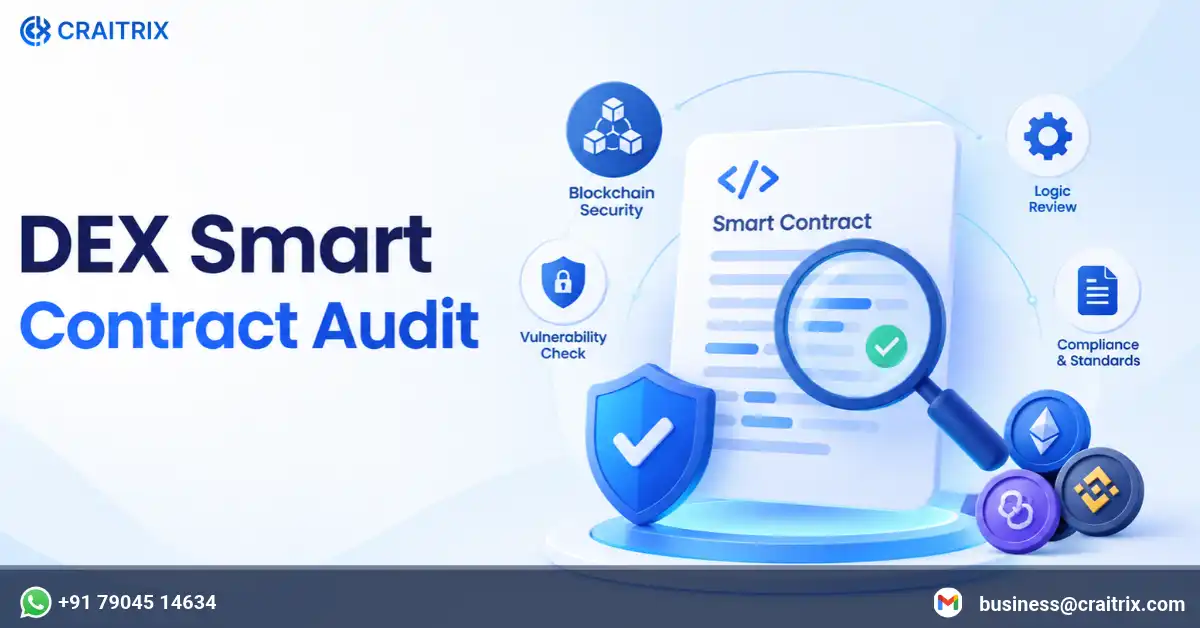
A decentralized exchange depends on smart contracts to execute trades, distribute fees, and manage liquidity without a central operator. Security flaws or incorrect business logic can expose these contracts to attacks that manipulate transactions, drain liquidity, or disrupt protocol operations. A DEX smart contract audit helps identify such weaknesses by examining contract code, interactions, and transaction behavior.
A DEX smart contract audit can cover swap mechanisms, liquidity calculations, access controls, and relevant external dependencies. Understanding how these audits work helps teams plan security before launch and prioritize fixes with confidence.
What is a DEX Smart Contract Audit?
A DEX smart contract audit is a security assessment of the code that powers a decentralized exchange. It checks whether contracts execute trades correctly, manage liquidity, enforce permissions, and handle unexpected inputs safely.
The assessment may combine manual code review, automated analysis, and targeted security testing. Its scope depends on the exchange architecture, blockchain network, contract complexity, and external integrations.
How a DEX Security Audit Protects User Funds
A DEX security audit is an important part of crypto exchange security, helping identify weaknesses that could affect trading, pricing, permissions, or liquidity management. The review may examine:
- Swap execution: Whether trades follow the intended pricing and slippage rules.
- Liquidity management: Whether deposits, withdrawals, pool accounting, and fee calculations work correctly.
- Access controls: Whether sensitive functions are restricted to authorized users.
- External integrations: Whether relevant dependencies, such as oracles and token contracts, introduce security risks.
Finding these issues before deployment or after significant upgrades gives developers an opportunity to address them before they affect users.
When Should You Audit a Decentralized Exchange?
A DEX should undergo a security audit before its initial deployment, especially when its contracts handle user assets or execute financial transactions. Additional reviews may be needed when the protocol changes core trading logic, introduces new features, integrates external systems, or upgrades existing contracts.
For example, adding a new liquidity pool mechanism may change reserve calculations and fee distribution. Expanding to another blockchain can also introduce new dependencies and trust assumptions. The audit scope should reflect these changes.A detailed DEX development guide can help teams understand the development stages and technical considerations involved in building a decentralized exchange.
What Does a DEX Smart Contract Audit Cover?
A DEX smart contract audit examines the contracts responsible for trading, liquidity management, token transfers, and protocol operations. The review focuses on whether these functions behave as intended and whether their implementation creates exploitable weaknesses.
AMM, Swap, and Liquidity Pool Security
Automated market makers (AMMs) use smart contracts to calculate swap prices and manage liquidity pools. Errors in pricing formulas, reserve calculations, or token accounting can create opportunities for exploitation.
A DEX security audit may review:
- Swap execution: Token exchange calculations, slippage controls, and transaction validation.
- Liquidity deposits and withdrawals: Pool balances and liquidity provider positions.
- Fee distribution: How trading fees are collected, recorded, and allocated.
- Pool accounting: Whether reserve updates and token balances remain consistent during transactions.
These checks help identify flaws that could result in incorrect trades, withdrawal errors, or unexpected losses. Understanding crypto exchange liquidity management is also important for maintaining accurate pool balances, liquidity provider positions, and fee calculations.
Token, Router, and Access Control Checks
DEX contracts interact with token contracts and routers that direct trades between liquidity pools. Weaknesses in these components can affect asset handling, transaction execution, and protocol permissions.
The audit may assess token transfer handling, approval mechanisms, routing logic, and restrictions on sensitive functions. It also examines whether administrative privileges are correctly configured and whether unauthorized users could change critical settings.
Special attention may be necessary when the exchange supports tokens with unusual transfer behavior, including fee-on-transfer mechanisms. Compatibility checks depend on the tokens supported and the agreed audit scope.
Oracle, Bridge, and External Integration Security
Some DEXs rely on external systems for price data, cross-chain transfers, or additional protocol functionality. These dependencies can introduce risks beyond the exchange’s own contracts.
The review may include:
- Price oracles: Whether price data is validated and stale or abnormal values are handled safely.
- Bridge integrations: Relevant verification and message-handling logic when cross-chain functionality is included.
- External protocol calls: How contracts handle failed calls, unexpected return values, and dependency changes.
- Failure handling: Whether unavailable or compromised dependencies could cause unsafe transactions.
The audit report should identify which external components were reviewed and which remain outside the assessment.
Common DEX Smart Contract Vulnerabilities
DEX vulnerabilities can result from coding errors, incorrect assumptions, or business logic that fails under unexpected conditions. Following established smart contract security best practices helps developers understand how contract behavior could affect user funds and protocol operations.
Reentrancy, Access Control, and Arithmetic Errors
These vulnerabilities can affect how smart contracts process transactions and enforce protocol rules.
- Reentrancy: An external contract call allows an attacker to re-enter a vulnerable function before the original operation finishes, potentially causing unauthorized withdrawals or incorrect state changes.
- Access control flaws: Incorrect permissions may allow unauthorized users to change settings, access restricted functions, or withdraw assets.
- Arithmetic errors: Incorrect calculations involving balances, fees, exchange rates, or liquidity shares can produce inaccurate results.
- Unsafe state updates: Incorrect update sequences may leave contract records inconsistent during transactions.
A security review examines these functions and tests how they behave under normal and unexpected conditions.
Flash Loan, Oracle Manipulation, and MEV-Related Risks
Some DEX vulnerabilities arise from interactions between smart contracts, market prices, and transaction ordering.
Flash loan attacks use assets borrowed within a single transaction to exploit weaknesses in pricing, accounting, or protocol logic. Flash loans are not inherently unsafe, but vulnerable contracts may be exposed to these attacks.
Oracle manipulation occurs when an attacker influences price data used by a contract. For example, a protocol that relies on a manipulable spot price from a low-liquidity pool may be exposed to temporary price distortions.
Maximal extractable value (MEV) involves gaining value by influencing transaction ordering, inclusion, or exclusion. One example is a sandwich attack, in which an attacker places transactions around a user’s swap to benefit from the resulting price movement.
An audit evaluates relevant pricing assumptions, slippage protections, and transaction validation based on the DEX’s design.
Business Logic and Liquidity Accounting Flaws
Some vulnerabilities occur because the code implements incomplete or incorrect business rules, even when individual functions execute as written.
Common examples include:
- Incorrect fee calculations: Trading fees are applied or distributed incorrectly.
- Liquidity accounting errors: Pool reserves, liquidity provider shares, or withdrawal amounts do not reflect the assets held by the contract.
- Faulty reward distribution: Incentive calculations allow users to claim more rewards than intended.
- Transaction edge cases: Small trades, rounding, or unusual token behavior produce unexpected results.
- Incomplete validation: Contracts accept inputs or transaction sequences that violate protocol rules.
Reviewing both individual functions and complete trading flows can help identify logic flaws that automated scanners may miss.
Building or upgrading a DEX? Craitrix can review your contracts for these risks before launch. Request an audit scope call.
How a DEX Smart Contract Audit Works
A structured audit combines code analysis, automated tools, manual testing, and follow-up verification. The process depends on the DEX architecture, codebase size, and agreed scope.Understanding the crypto exchange development process also helps teams plan security reviews, testing, and remediation before deployment.
Codebase Review and Threat Modeling
The process begins with a review of smart contracts, protocol documentation, and key system components. The goal is to understand how the exchange handles swaps, liquidity, fees, permissions, and external interactions.
The review identifies critical functions, trust assumptions, and potential attack paths. This helps prioritize areas where vulnerabilities could have the greatest impact.
Automated Scanning and Manual Security Testing
Automated tools help detect common coding issues and known vulnerability patterns. However, they may not identify complex business logic flaws or risks involving multiple interacting contracts.
Manual testing complements automated analysis by examining contract behavior and protocol-specific scenarios. Depending on the scope, checks may include access controls, swap and fee calculations, token transfers, input validation, and oracle dependencies.
Vulnerability Validation and Severity Classification
Potential vulnerabilities are investigated to determine whether they are genuine and how they could affect the protocol. The assessment considers exploitability, required conditions, and potential impact.
Findings are commonly classified as critical, high, medium, low, or informational, depending on the audit methodology. Clear severity ratings help developers prioritize fixes.
Remediation, Retesting, and Final Reporting
The development team addresses identified vulnerabilities using the recommendations provided. Retesting then checks whether the fixes resolve the original issues without introducing new problems.
The final report documents findings, severity levels, remediation status, reviewed code versions, and assessment limitations. Significant changes made after the audit may require further testing or another review.
What Does a DEX Smart Contract Audit Report Include?
An audit report documents the vulnerabilities identified during the assessment and explains their potential impact. It helps developers prioritize fixes and track remediation before deployment or an upgrade.
Vulnerability Findings and Risk Ratings
Each finding should describe the weakness, affected contract or function, and conditions under which it could be exploited. A useful report typically includes:
- Vulnerability description: What the issue is and how it occurs.
- Affected components: The relevant contracts, functions, or code locations.
- Potential impact: Possible consequences for user funds or protocol operations.
- Severity rating: The relative risk based on the audit methodology.
- Technical evidence: Supporting details or a proof of concept, where appropriate.
Fix Recommendations and Retesting Status
The report should provide practical recommendations for resolving confirmed vulnerabilities. After fixes are implemented, retesting verifies whether the original issues have been addressed.
Findings should be marked clearly as fixed and retested, unresolved, or requiring further review. The report should also identify the reviewed code version, audit scope, and exclusions so the team understands what the assessment does and does not cover.
How to Choose the Right DEX Smart Contract Audit Company
Choosing a DEX smart contract audit company involves more than comparing prices. The provider should understand decentralized exchange architecture and deliver findings that developers can act on.
DEX Security Expertise and Testing Methodology
Look for a provider familiar with the components used by your exchange, such as AMMs, liquidity pools, swap routers, token contracts, and pricing mechanisms. A team that also offers decentralized exchange development can better understand how these components are designed and how they interact.
Before selecting a provider, check whether it offers:
- Relevant technical expertise: Familiarity with your DEX model and blockchain network.
- Combined testing methods: Manual code review, automated analysis, and targeted security testing.
- A defined audit scope: Clear identification of the contracts, features, and integrations included.
- Transparent reporting: Clear vulnerability descriptions, severity ratings, and remediation guidance.
- Retesting options: A process for checking fixes after vulnerabilities are addressed.
The provider should explain the limitations of the assessment rather than guarantee complete security.
Audit Transparency and Post-Audit Support
Before starting, confirm the deliverables, estimated timeline, fees, and responsibilities. Ask which contracts and integrations are included, how findings are classified, whether retesting is available, and what work may require additional fees.
Compare providers based on technical scope, testing methodology, reporting quality, and support, not price alone. A clearly defined engagement helps your team understand which risks have been assessed and which require further attention.
Request a DEX Smart Contract Audit
Planning to launch a decentralized exchange or upgrade an existing protocol? A DEX smart contract audit can help identify security weaknesses in critical contract functions and provide guidance for remediation.
Craitrix can discuss audit requirements based on your DEX architecture, smart contract codebase, trading mechanisms, and relevant integrations. Prepare details about your blockchain network, deployment status, and recent upgrades to help define the project scope.
Contact Craitrix to request a project-specific DEX audit estimate.
Frequently Asked Questions
Q1. How much does a DEX smart contract audit cost?
Ans: The cost depends on codebase size, contract complexity, blockchain network, and testing requirements. A project-specific quote provides a more accurate estimate.
Q2. How long does a DEX security audit take?
Ans: An audit may take a few days to several weeks, depending on protocol complexity, codebase size, and the number of findings. Fixes and retesting can extend the overall timeline.
Q3. Can an audited DEX still be hacked?
Ans: Yes. An audit reduces security risks but cannot guarantee complete protection against every vulnerability, attack, or future code change.
Q4. What is the difference between automated testing and a DEX audit?
Ans: Automated testing uses tools to detect potential code issues. A DEX audit combines automated analysis with manual review and protocol-specific security testing.
Q5. Should smart contracts be audited again after an upgrade?
Ans: Yes. Changes to trading logic, liquidity management, permissions, or external integrations may introduce new vulnerabilities and should be assessed according to their impact.
Q6. What should I prepare before requesting a DEX audit?
Ans: Prepare the smart contract code, technical documentation, blockchain details, DEX architecture, external integrations, and deployment plans. Existing test results and known issues can also help define the audit scope.