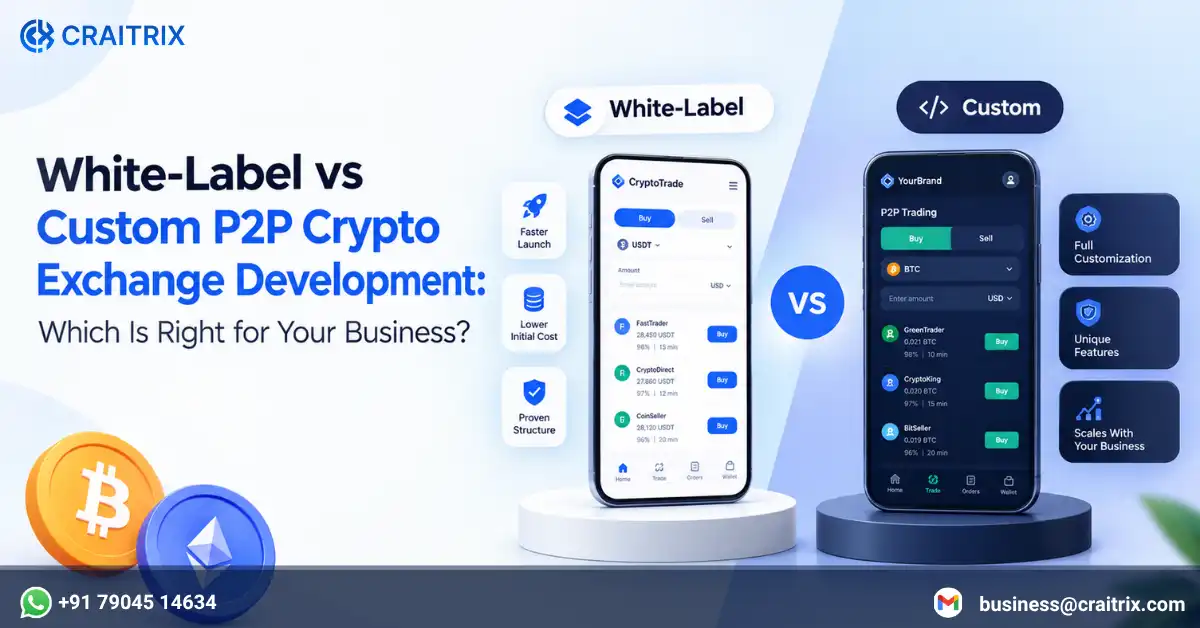
Choosing between white-label vs custom P2P crypto exchange development is an important decision for businesses entering the peer-to-peer cryptocurrency trading market. White-label P2P exchange software helps businesses launch using an existing platform, while custom P2P crypto exchange development offers greater control over features, trading workflows, integrations, and platform architecture.
The right approach depends on your budget, launch timeline, target market, and long-term business goals. Development costs, escrow functionality, payment integrations, security requirements, regulatory obligations, and ongoing maintenance also influence which solution suits your business.
This comparison examines white-label and custom P2P crypto exchange development across costs, launch speed, customization, features, security, and long-term ownership to help you choose the right approach.
Understanding White-Label and Custom P2P Crypto Exchange Development
White-label and custom P2P crypto exchange development are two approaches to launching a peer-to-peer trading platform. White-label solutions use existing software, while custom development builds the platform around your business requirements.
What Is a White-Label P2P Crypto Exchange?
A white-label P2P crypto exchange is a ready-made trading platform that businesses can launch under their own brand. It typically includes user registration, trading advertisements, escrow functionality, order management, payment integrations, and an administrative dashboard.
This approach helps startups and established businesses enter the market without building every component from scratch. However, customization options, source-code access, licensing terms, and upgrade capabilities depend on the provider.
What Is Custom P2P Crypto Exchange Development?
Custom P2P crypto exchange development involves building a platform around specific business goals, trading workflows, and operational requirements. Businesses can define features such as escrow rules, payment methods, dispute management, trading fees, risk controls, and third-party integrations.
Although custom development offers greater flexibility, it generally requires a higher initial investment, a longer development timeline, and ongoing technical maintenance.
How Do Both Development Approaches Work?
The main difference lies in how the platform is created, configured, and maintained.
White-label development process:
- Select a software provider and suitable platform.
- Configure branding and available features.
- Set up supported payment methods and integrations.
- Configure security and administrative controls.
- Test the platform and prepare for launch.
Custom development process:
- Define business requirements and project scope.
- Design the platform architecture and user experience.
- Develop trading, escrow, and administrative workflows.
- Integrate payment services and security controls.
- Test the platform, deploy it, and plan ongoing maintenance.
Both approaches require security testing, payment verification, dispute handling, and compliance planning before launch.
Businesses planning a platform from the ground up can also read this guide on how to build a P2P crypto exchange platform for more information about the development process.
Common P2P Crypto Exchange Models
Businesses can choose different P2P trading models based on their target market and operating requirements.
- Advertisement-based P2P exchange: Users publish buy and sell offers with their preferred prices, order limits, and payment methods.
- Escrow-enabled P2P exchange: Cryptocurrency is held in escrow until the required transaction conditions are met.
- Hybrid exchange: Combines peer-to-peer trading with other exchange functions, such as spot trading.
These models can be implemented through white-label or custom development, depending on the software’s capabilities and the agreed project scope. Before selecting a solution, confirm that it supports your preferred trading model, payment methods, security requirements, and future expansion plans.
White-Label vs Custom P2P Crypto Exchange: Key Differences
The main differences between white-label and custom P2P crypto exchange development involve launch speed, initial investment, customization, source-code ownership, maintenance, and long-term control.
| Comparison Factor | White-Label P2P Exchange | Custom P2P Exchange |
| Launch timeline | Often weeks to a few months | Often several months or longer |
| Initial investment | Generally lower upfront cost | Generally higher upfront cost |
| Customization | Limited to supported features and extensions | Tailored to business requirements |
| Source-code ownership | Depends on licensing terms; often retained by the provider | Defined by the development contract |
| Maintenance | Often handled partly or fully by the provider | Managed in-house or by a development partner |
| Scalability | Depends on architecture, provider, and plan | Can be designed around expected growth |
| Best suited for | Startups, MVPs, and faster market entry | Businesses with specialized requirements |
Timelines and costs are indicative. Actual estimates depend on project scope, integrations, testing, licensing, and provider terms.
Time to Market and Launch Speed
White-label software can shorten launch time because core components already exist. Businesses can configure branding, supported features, and integrations before preparing the platform for release.
Custom development requires requirements analysis, architecture design, implementation, integration, and testing. Although this process generally takes longer, it allows the platform to follow specific business workflows from the beginning.
If speed is your primary concern, white-label software may be suitable. If your business needs functionality that existing products cannot support, custom development may justify the additional time.
Customization, Source-Code Ownership, and Control
White-label platforms typically support branding, fee settings, payment options, and selected feature configurations. Advanced changes may require provider approval or additional development fees.
Custom development offers greater control over trading rules, escrow workflows, user permissions, integrations, and the feature roadmap. However, source-code ownership is not automatic. Businesses should confirm intellectual property rights, code access, licensing, and handover requirements in the development contract.
Scalability, Maintenance, and Vendor Dependency
White-label scalability depends on the platform architecture, provider support, infrastructure, and subscription terms. Before committing, review transaction limits, upgrade options, maintenance responsibilities, data portability, and support availability.
A custom P2P exchange can be designed around expected traffic, transaction volumes, and future features. However, it still requires infrastructure management, performance monitoring, security updates, and ongoing maintenance.
Neither approach guarantees scalability. The underlying architecture and quality of implementation matter more than the development model alone.
White-Label vs Clone Script vs Custom Development
Vendors sometimes use the terms white-label software and clone script interchangeably, but their licensing, support, and customization options can differ.
- White-label software: An existing platform configured with your branding, often with provider support and updates.
- Clone script: Software modeled on an existing exchange, with quality, licensing, customization, and security varying by provider.
- Custom development: A platform built around your requirements, with source-code and intellectual property rights defined by contract.
Before selecting a clone script, review code quality, security testing, update procedures, licensing, documentation, and potential legal risks associated with copied branding or protected designs.
When Should You Choose White-Label P2P Crypto Exchange Software?
White-label P2P crypto exchange software suits businesses that want to enter the market without building an entire platform from scratch and can work within the provider’s existing capabilities.
Best Business Use Cases for White-Label Solutions
A white-label P2P crypto exchange may suit the following businesses:
- Startups and market testers: Launch with standard features and evaluate demand, payment preferences, and user behavior before investing in extensive customization.
- Established brands expanding into crypto: Introduce P2P trading under an existing brand using a ready-made platform.
- Businesses with standard requirements: Use established trading, escrow, payment, and administrative functions without developing specialized workflows.
- Businesses working with limited development resources: Reduce the need to build and maintain every platform component internally.
The suitability of white-label software depends on whether its features, licensing terms, and technical capabilities match your operating model.
Benefits of Ready-Made P2P Crypto Exchange Software
Ready-made P2P crypto exchange software reduces development effort because core components already exist. Businesses can focus on branding, user acquisition, payment options, and launch preparation instead of implementing every feature from the beginning.
Depending on the provider, the package may also include technical support, maintenance, software updates, and integration assistance. Confirm these deliverables before signing a contract, as they are not guaranteed across all white-label solutions.
Limitations to Consider Before Choosing White-Label Development
Ready-made software may restrict advanced customization, third-party integrations, source-code access, and changes to trading workflows. Businesses may also depend on the provider for updates, technical support, and new features.
Before committing, check the escrow workflow, security controls, data portability, licensing terms, recurring fees, and scalability. If you require unique trading logic or extensive platform control, custom P2P crypto exchange development may be a better fit.
Businesses planning to launch a peer-to-peer trading platform can explore our P2P crypto exchange development services to find a solution that aligns with their business model, budget, and platform requirements.
When Is Custom P2P Crypto Exchange Development the Better Choice?
Custom P2P crypto exchange development suits businesses whose operational requirements cannot be met by existing software or whose long-term plans require greater control over platform functionality.
Business Requirements for a Custom-Built P2P Trading Platform
A custom-built P2P trading platform may be the better choice when you need:
- Unique trading and administrative workflows: Tailored escrow rules, dispute resolution, fee structures, fraud monitoring, and reporting.
- Specialized payment integrations: Regional payment methods, payment verification workflows, or specific reconciliation requirements.
- Flexible platform functionality: Features designed around your target audience and operating model.
- Long-term expansion: Architecture planned for new markets, additional integrations, and increasing transaction volumes.
These requirements are easier to accommodate when the platform is designed around them from the start.
Benefits of Custom P2P Crypto Exchange Development
Custom development allows businesses to shape the user experience, trading rules, integrations, and feature roadmap around their target market. It also provides greater flexibility when introducing new functionality or changing operational processes.
Depending on the contract, businesses may obtain source-code ownership or specific intellectual property rights. Custom development can also reduce reliance on a single software vendor, provided the business has the necessary documentation, technical access, and maintenance arrangements.
Challenges of Building and Maintaining a Custom Platform
Custom development generally requires a higher initial budget and a longer implementation timeline. Businesses must also plan for quality assurance, security audits, infrastructure, software updates, and technical support after launch.
Changes to requirements during development can increase costs or delay delivery. To manage these risks, define the minimum viable product (MVP), establish project milestones, document acceptance criteria, and agree on maintenance responsibilities and source-code rights before development begins.
White-Label vs Custom P2P Crypto Exchange Development Cost
The cost of P2P crypto exchange development depends on the platform type, features, integrations, security requirements, and ongoing support. White-label solutions generally require less upfront investment, while custom development costs more when extensive functionality must be built from scratch.
| Cost Factor | White-Label P2P Exchange | Custom P2P Exchange |
| Indicative development cost | $15,000 – $40,000 | $50,000 – $150,000+ |
| Advanced platform cost | Depends on provider and customization | Can reach $100,000 – $250,000+ |
| Recurring expenses | Licensing, subscriptions, and upgrades | Maintenance, infrastructure, and support |
| Customization | Additional charges may apply | Depends on the agreed development scope |
These figures are illustrative budgeting estimates, not standardized market prices or a Craitrix quotation. Actual costs depend on platform features, integrations, security requirements, licensing terms, and project scope. Obtain current vendor quotations before setting a project budget.
Also Read: Crypto Exchange Development Cost
White-Label Crypto Exchange Cost Factors
White-label pricing depends on the provider’s licensing model, included features, customization options, and support package.
Additional expenses may include:
- Branding and user interface customization
- Payment gateway and third-party service integrations
- KYC/AML verification services
- Hosting and infrastructure
- Premium features and software upgrades
- Recurring licensing or subscription fees
Review transaction charges, support fees, renewal terms, and restrictions on future modifications before selecting a provider.
Custom P2P Crypto Exchange Cost Factors
Custom P2P crypto exchange development cost depends on the complexity of the platform and the scope of work.
A basic platform with user accounts, trading advertisements, and escrow functionality generally requires less development effort than an advanced exchange with multiple payment integrations, automated risk controls, detailed administrative tools, and multi-market support.
UI/UX design, blockchain and wallet integrations, testing, infrastructure requirements, and team experience also influence the final budget.
Why P2P Exchange Cost Estimates Vary
Published estimates can range from a few thousand dollars to several hundred thousand because providers do not always include the same deliverables. One quotation might cover a basic software licence, while another includes custom workflows, mobile applications, security audits, integrations, and post-launch support.
Compare quotations line by line. Check what is included, excluded, licensed, delivered as source code, and charged separately.
Hidden Costs: Licensing, Upgrades, Maintenance, and Compliance
The initial quotation may exclude legal advice, applicable licences, identity verification, infrastructure, software upgrades, customer support, and ongoing compliance activities.
Maintenance expenses depend on the platform architecture, security requirements, infrastructure, and support agreement. Request a separate estimate for software updates, monitoring, bug fixes, security testing, and technical support instead of relying on a fixed percentage of the original development cost.
Long-Term Cost of Ownership and Return on Investment
Compare the total cost of ownership over three years rather than focusing only on the launch price. White-label software may reduce initial spending but introduce recurring licence fees. Custom development requires a larger initial investment but offers more flexibility over future changes.
Include development or licensing, maintenance, infrastructure, security, and support in your calculations. Then compare these costs with realistic revenue projections from trading fees, advertisements, and other permitted services.
The right approach is the one that supports your business objectives within a sustainable budget, not necessarily the one with the lowest initial price.
P2P Exchange Features: What Can You Customize in White-Label vs Custom?
Both white-label and custom P2P crypto exchanges can support essential trading features, but the level of customization depends on the software and development scope. White-label platforms generally provide predefined functionality, while custom development allows businesses to tailor workflows to their operating requirements.
Core Features Included in Both Approaches
Both approaches can support the essential functions needed to operate a P2P trading platform.
- User accounts and verification: Registration, identity verification, account management, and access controls.
- Trading advertisements: Buy and sell offers with prices, order limits, and accepted payment methods.
- Escrow management: Hold cryptocurrency until the required transaction conditions are met.
- Payment integration: Connect supported payment methods and provide payment-status workflows.
- Order management: Track active trades, pending payments, completed transactions, and cancellations.
- Administrative dashboard: Manage users, transactions, advertisements, and platform activity.
- Dispute management: Review reported transactions and resolve disagreements using documented procedures.
The exact functionality available in a white-label package varies by provider. Confirm which features are included, which require additional development, and which depend on external services.
Advanced Trading, Escrow, and Payment Integration Options
Businesses with specialized requirements may need customized escrow rules, automated trade workflows, regional payment integrations, configurable trading fees, and advanced dispute management.
White-label software may support some of these capabilities through existing settings or paid extensions. Custom P2P crypto exchange development offers greater flexibility to build workflows around specific markets and operational needs.
Payment integrations should support appropriate transaction verification and reconciliation rather than relying solely on screenshots or user-submitted confirmations. Businesses should also define how the platform handles delayed payments, failed transactions, cancellations, and disputes.
Security, Fraud Prevention, and Dispute Management
Security is essential regardless of the development approach. Important capabilities include multi-factor authentication, role-based access controls, suspicious-activity monitoring, secure wallet integration, audit logs, and a structured dispute-resolution process.
White-label platforms may provide built-in security tools, but businesses should verify their scope, update process, testing history, and incident-response procedures. Custom development allows security controls to be designed around the platform’s risks, but it still requires regular testing, monitoring, and maintenance.
When comparing solutions, assess the actual security controls and operational procedures rather than assuming that either white-label or custom development is automatically more secure.
How to Choose the Right P2P Crypto Exchange Development Partner
Choosing the right P2P crypto exchange development partner involves more than comparing quotations. Evaluate the company’s relevant experience, security practices, technical capabilities, project management, and ability to support your platform after launch.
Evaluate Business Goals, Budget, and Target Market
Define your business model, target users, launch budget, and expected growth before selecting a development approach.
If you need to validate market demand quickly with standard features, white-label software may be suitable. If your business requires specialized trading workflows or extensive customization, custom development may be a better fit.
Ask potential partners to explain their recommended approach, project timeline, deliverables, and pricing. A reliable partner should connect the proposed solution to your business requirements rather than automatically recommending the most expensive option.
Assess KYC/AML and Regulatory Requirements
P2P crypto exchange operators need to assess the legal and compliance obligations that apply to their business model and target markets.
Discuss identity verification, transaction monitoring, suspicious-activity controls, recordkeeping, data protection, and applicable licensing requirements with qualified compliance professionals. Businesses can also refer to the FATF Recommendations for international standards on anti-money laundering and counter-terrorist financing.
For further information, read our guide to KYC/AML compliance for P2P crypto exchanges. Confirm whether the proposed platform supports the necessary integrations and operational controls. Software features alone do not guarantee regulatory compliance.
Compare Development Companies, Support, and Upgrade Options
Before choosing a P2P crypto exchange development company, review its relevant project experience, development process, security testing, documentation, and post-launch support.
Clarify the following points before signing a contract:
- Source-code and data rights: Confirm ownership, licensing, access, and data-export options.
- Maintenance and upgrades: Understand response times, update schedules, and support charges.
- Security and testing: Ask about vulnerability testing, audit logs, access controls, and incident response.
- Project deliverables: Define milestones, acceptance criteria, integrations, and handover responsibilities.
- Scalability and performance: Understand infrastructure requirements, performance targets, and upgrade options.
- Vendor dependency: Check whether your business can migrate data or change providers if necessary.
Compare providers against the same requirements so you can assess overall value, not just the initial development cost.
Final Verdict: White-Label or Custom P2P Crypto Exchange?
The right choice depends on your budget, launch timeline, customization requirements, and long-term business goals. White-label software suits businesses prioritizing faster market entry and standard features, while custom development is better for platforms requiring specialized functionality and greater control.
Best Choice for Startups and MVP Launches
A white-label P2P crypto exchange is often a practical starting point for startups with limited budgets and standard trading requirements. It allows businesses to test market demand before investing in extensive development.
Before committing, review licensing terms, customization limits, recurring expenses, and future migration options. Make sure the platform can support your immediate business needs and a realistic path for expansion.
Best Choice for Established Businesses and Long-Term Growth
Custom P2P crypto exchange development is worth considering when your business needs unique trading workflows, specialized integrations, or a platform tailored to expansion plans.
The higher initial investment should be weighed against the flexibility, technical responsibilities, and long-term maintenance involved. Define your future requirements carefully so the platform architecture supports your planned growth.
Can You Start with White-Label Software and Move to Custom Development?
Yes, migration is possible, but it is not always straightforward. Moving to a custom platform may require data migration, rebuilding integrations, transferring user records, testing trading workflows, and arranging access to relevant data and software components.
Your ability to migrate depends on the original provider’s contract, technical architecture, data-export options, and licensing restrictions. If you anticipate moving to custom development later, discuss migration requirements before signing the initial agreement.
Launch Your P2P Crypto Exchange with Craitrix
Planning to launch a P2P crypto exchange? Craitrix helps businesses plan and build platforms around their trading model, target market, budget, and growth goals.
Whether you need a white-label solution for faster market entry or a custom-built platform for specialized workflows, choosing the right P2P exchange development approach is essential for meeting your business requirements. Craitrix helps you plan essential features, escrow functionality, payment integrations, security controls, and platform requirements to support your launch strategy.
Frequently Asked Questions
Q1. What is the difference between white-label and custom P2P crypto exchange development?
Ans: White-label P2P crypto exchange development uses ready-made software, while custom P2P crypto exchange development builds a platform around specific business requirements. White-label solutions support faster launches, whereas custom platforms offer greater control over features, integrations, and trading workflows.
Q2. Which is better for startups: white-label or custom P2P crypto exchange development?
Ans: White-label P2P crypto exchange software is generally better for startups with limited budgets and standard trading requirements. Custom development is more suitable for startups that need unique features, specialized integrations, or greater platform control.
Q3. How much does P2P crypto exchange development cost?
Ans: White-label P2P crypto exchange development may cost around $15,000 – $40,000, while custom development may cost $50,000 – $150,000 or more. Actual costs depend on features, integrations, security requirements, and maintenance.
Q4. How long does it take to develop a P2P crypto exchange?
Ans: A white-label P2P crypto exchange can often launch within a few weeks to a few months, while custom development typically takes several months or longer. The timeline depends on platform complexity, integrations, testing, and compliance requirements.
Q5. Is a white-label P2P crypto exchange secure?
Ans: A white-label P2P crypto exchange can be secure when it includes properly implemented escrow, authentication, access controls, transaction monitoring, and regular security updates. Businesses should verify the provider’s security practices before launch.
Q6. Can I customize white-label P2P crypto exchange software?
Ans: Yes, white-label P2P crypto exchange software typically supports branding, trading fee settings, and selected payment integrations. Advanced customization depends on the provider’s software, licensing terms, and additional development options.
Q7. What are the essential features of a P2P crypto exchange?
Ans: The essential features of a P2P crypto exchange include user registration, identity verification, buy and sell advertisements, escrow management, payment integration, order tracking, dispute resolution, and an administrative dashboard. Fraud monitoring and access controls also help protect transactions.
Q8. What is the difference between a white-label P2P exchange and a clone script?
Ans: A white-label P2P exchange is existing software licensed for branded use, while a clone script is software modeled on an existing exchange. Their customization, support, security, and ownership terms vary by provider.
Q9. Can I migrate from a white-label P2P exchange to custom development?
Ans: Yes, businesses can migrate from white-label software to a custom P2P exchange, provided they can access and transfer the required data and integrations. The process may involve data migration, workflow redevelopment, testing, and service transition.
Q10. How do I choose a P2P crypto exchange development company?
Ans: Choose a P2P crypto exchange development company with relevant experience, strong security practices, escrow and payment integration expertise, transparent pricing, clear source-code rights, and reliable post-launch support.
Q11. Does a P2P crypto exchange require KYC/AML compliance?
Ans: A P2P crypto exchange may need to meet KYC/AML and licensing requirements based on its business model and operating jurisdictions. Consult qualified compliance professionals to identify the applicable obligations before launch.
Q12. Which is better for long-term growth: white-label or custom P2P crypto exchange development?
Ans: Custom P2P crypto exchange development is generally better for businesses that need specialized features and greater control over future upgrades. White-label software is suitable when standard features, faster deployment, and lower initial investment are the main priorities.