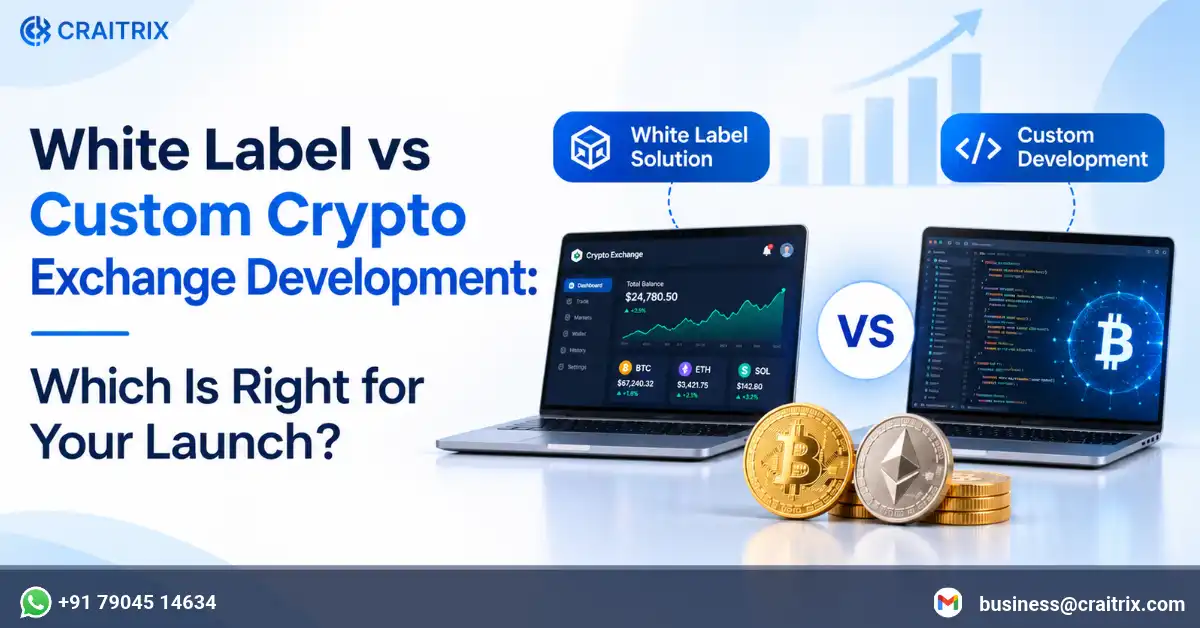
Launching a cryptocurrency exchange involves several important decisions. You need suitable trading features, reliable security, the right technology, and a clear development plan to turn your business idea into a working platform. One of the first decisions is whether to choose a white-label crypto exchange or invest in custom development.
A white-label crypto exchange uses ready-made software that businesses can customize with their branding and launch relatively quickly. In contrast, custom crypto exchange development involves building a platform around specific business requirements, offering greater control over its features, architecture, and functionality.
But which approach makes more sense for your business? The answer depends on your budget, launch timeline, technical requirements, and long-term growth plans. Let’s compare both options to help you choose the right foundation for your crypto exchange.
White Label vs Custom Crypto Exchange Development: Understanding the Differences
White-label and custom crypto exchange development are two different approaches to building a cryptocurrency trading platform. The main difference lies in how the software is created, customized, managed, and controlled.
What Is White Label Crypto Exchange Development?
White-label crypto exchange development allows businesses to launch a trading platform using existing exchange software. They can adapt the platform’s branding and selected features to match their business requirements instead of developing everything from the ground up. Instead of developing the entire platform from scratch, businesses start with an existing solution that includes essential exchange components.
These components typically include a trading engine, user dashboard, wallet integration, admin panel, and trading features. Depending on the provider, businesses can also customize the interface, integrate payment gateways, and configure trading pairs. To understand the available software components and customization options, explore our guide to white-label crypto exchange software.
This approach reduces development time and allows startups to enter the cryptocurrency market without building every component independently. However, customization options, source code access, and infrastructure control depend on the provider’s offering and licensing terms.
What Is Custom Crypto Exchange Development?
Custom crypto exchange development involves designing and building an exchange platform according to specific business requirements through a tailored blockchain development solution. . Instead of relying on a predefined software solution, businesses work with developers to create the platform’s architecture, features, and functionality.
This approach allows businesses to define their trading engine, wallet infrastructure, user interface, liquidity integrations, security mechanisms, and administrative features.
Custom development is suitable for businesses that require specialized trading functionality, greater technical control, or a platform designed for long-term expansion. However, it generally requires more development time, technical resources, and initial investment.
Transition: Both approaches can help launch a cryptocurrency exchange, but their differences become clearer when comparing development cost, launch time, customization, ownership, and scalability.
White Label vs Custom Crypto Exchange: 8 Key Differences Compared
Choosing between white-label and custom crypto exchange development requires looking beyond the initial development process. Factors such as investment, launch time, customization, ownership, and long-term maintenance can influence how well the platform supports your business.
Here are eight important differences to consider before making a decision.
Development Cost and Long-Term Investment
White-label crypto exchange software generally requires a lower initial investment because the core platform is already developed. Businesses typically pay for software licensing, branding, configuration, and additional integrations.
Custom crypto exchange development involves higher initial costs because the platform requires dedicated design, development, testing, and deployment. However, businesses have greater flexibility to build features according to their requirements.
The right choice depends on whether you prioritize lower upfront expenses or greater control over your long-term technology investment.
Development Time and Time to Market
White-label solutions offer a faster route to market because businesses can start with existing exchange infrastructure. Most of the essential components are already available, reducing the amount of development required.
Custom development takes longer because the team needs to design the architecture, develop trading functionalities, integrate services, and test the complete platform before launch. Understanding the crypto exchange development process can help businesses estimate the work involved in planning, building, testing, and deploying their platforms.
For businesses targeting an early market entry, white-label software can be a practical option. Custom development is more suitable when specific functionality requires additional development time.
Customization, Source Code Ownership and Control
Most white-label platforms offer options to adjust the brand identity, interface design, supported trading pairs, and selected platform features. However, deeper modifications depend on the provider’s software architecture and licensing agreement.
Custom development provides greater flexibility to modify the trading engine, platform architecture, user experience, and business-specific functionalities. Source code ownership can also be negotiated as part of the development agreement.
If complete technical control is important to your business, custom development offers more flexibility.
Scalability, Security and Maintenance
The ability to handle business growth depends on how each exchange platform is designed and the infrastructure supporting its operations.
White-label solutions rely on the provider’s technical capabilities for software upgrades, infrastructure improvements, and maintenance, depending on the service agreement.
Custom platforms allow businesses to plan infrastructure around their expected trading volume, user growth, and performance requirements. However, the business must arrange ongoing maintenance, security updates, monitoring, and technical support.
A secure exchange requires proper testing, controlled access, wallet protection, and reliable operational procedures. Businesses should also implement suitable crypto exchange security measures to safeguard user accounts, trading activities, and digital assets.
Quick comparison:
| Factor | White-label exchange | Custom exchange |
| Initial investment | Generally lower | Generally higher |
| Launch time | Faster | Longer |
| Customization | Provider-dependent | Extensive |
| Source code ownership | Contract-dependent | Negotiated |
| Technical control | Provider-dependent | Greater control |
| Scalability | Architecture-dependent | Built around requirements |
| Maintenance | Often provider-supported | Business-managed or outsourced |
| Vendor dependency | Generally higher | Generally lower |
Key takeaway: White-label development prioritizes faster deployment and lower initial investment, while custom development prioritizes flexibility, technical control, and business-specific functionality. The better option depends on your exchange’s requirements and long-term goals.
White Label vs Custom Crypto Exchange Cost: What Should You Budget For?
The investment required to launch a crypto exchange varies based on your chosen development model, platform features, infrastructure requirements, and ongoing maintenance needs. White-label solutions generally have lower upfront costs because the core software is already available, while custom development requires a larger investment in design, engineering, testing, and deployment.
Before choosing either option, consider these expenses:
- Software licensing: White-label providers may charge setup fees, licensing fees, or recurring subscription costs.
- Customization and integration: Branding, payment gateways, liquidity providers, and third-party services can add to the investment.
- Infrastructure and security: Hosting, monitoring, security testing, and wallet protection require ongoing resources.
- Maintenance and upgrades: Both approaches involve expenses for technical support, software updates, and platform improvements.
The initial development price is only one part of the investment. Evaluate the total cost of ownership to understand which approach offers better value as your exchange grows.
For a detailed breakdown of pricing, development packages, and cost factors, read our guide on White Label Crypto Exchange Software Cost.
White Label vs Custom Crypto Exchange: Which Is Right for Your Business Model?
The right development approach depends on your business stage, available budget, technical requirements, and expansion plans. A startup entering the crypto market has different priorities from an established business planning to launch an exchange with specialized trading features.
When to Choose White Label Crypto Exchange Development
White-label crypto exchange development is a practical choice for businesses that want to enter the cryptocurrency market without building the entire platform from scratch.
Consider this approach if you:
- Are launching a startup: Start with existing exchange infrastructure instead of investing heavily in building every component.
- Want faster market entry: Reduce development time by using pre-built trading and administrative functionalities.
- Have a limited development budget: Avoid the initial engineering investment associated with building a complete exchange independently.
- Want to validate your business idea: Launch a platform, understand user demand, and refine your business strategy before making larger technology investments.
For example, a startup planning to launch a regional cryptocurrency exchange can use white-label software to establish its trading platform and focus on customer acquisition, liquidity, and business operations.
When to Choose Custom Crypto Exchange Development
Custom crypto exchange development is better suited to businesses that need greater control over their platform’s functionality, architecture, and future development.
Consider custom development if you:
- Need specialized trading features: Build advanced order types, trading mechanisms, or business-specific functionality.
- Want greater technical independence: Control your platform architecture, integrations, and development roadmap.
- Plan for long-term expansion: Design infrastructure around your expected trading activity, user base, and operational requirements.
- Have unique business requirements: Develop features that existing white-label solutions cannot adequately support.
For example, an established financial technology company planning to operate a multi-market exchange with specialized trading features may prefer custom development to meet its technical and business requirements.
Choose white-label development when faster deployment and lower initial investment are priorities. Choose custom development when specialized functionality, greater technical control, and long-term flexibility matter more.
Can You Switch From a White Label to a Custom Crypto Exchange Later?
Yes, businesses can transition from a white-label crypto exchange to a custom-built platform as their requirements evolve. Starting with white-label software does not necessarily mean using the same infrastructure forever. However, the transition depends on the provider’s licensing terms, source code access, API availability, and data portability.
A gradual migration can help businesses expand their platform without replacing every component at once.
How to Transition From White Label to Custom Exchange Infrastructure
A planned migration generally involves the following steps:
- Review existing infrastructure: Evaluate the current exchange software, licensing agreement, API access, and available source code.
- Identify components to replace: Determine whether the trading engine, wallet system, user interface, or administrative panel needs custom development.
- Develop custom modules: Build the required components and integrate them with the existing platform where technically possible.
- Plan data migration: Prepare user accounts, transaction records, trading information, and other essential data for secure migration.
- Test before switching: Validate transaction accuracy, wallet operations, security, and platform performance before moving users to the new infrastructure.
For example, a startup might initially use white-label software to launch its exchange. As trading activity increases, it could invest in a custom trading engine and additional platform functionality.Starting with a platform that supports future integrations and customization can make long-term expansion easier.
What to Look for in a White Label or Custom Crypto Exchange Development Company
Choosing the right development partner is just as important as selecting the development approach. A reliable company should understand your business requirements and provide the technical capabilities needed to build, launch, and maintain your exchange. Before making a decision, learn how to choose a crypto exchange development company by evaluating its technical expertise, development experience, and post-launch support.
Before selecting a development partner, evaluate these factors:
- Development experience: Look for experience in building white-label and custom cryptocurrency exchange platforms.
- Trading engine capabilities: Check whether the company can provide reliable order matching, trading functionality, and performance optimization.
- Wallet and liquidity integration: Ensure the solution supports secure wallet infrastructure and integration with suitable liquidity providers.
- Security implementation: Evaluate its approach to access controls, wallet security, penetration testing, and smart contract audits where applicable.A strong provider should also follow recognized standards such as the NIST Cybersecurity Framework for managing security risks.
- Customization options: Check whether the company can adapt platform features, integrations, and architecture to your business requirements.
- Post-launch support: Confirm the availability of maintenance, software updates, monitoring, and technical assistance.
At Craitrix, businesses can access white-label crypto exchange development services and custom exchange development solutions based on their launch requirements. From platform customization to trading functionality and integrations, the development approach can be aligned with your business goals.
Frequently Asked Questions
Q1. Which is better white-label or custom crypto exchange?
Ans: White-label crypto exchange development is generally better for businesses prioritizing faster deployment and lower initial investment. Custom development is more suitable for businesses requiring specialized features, greater technical control, and flexibility. The right choice depends on your budget and business goals.
Q2. Is a white-label crypto exchange suitable for startups?
Ans: Yes. White-label crypto exchange software can help startups enter the cryptocurrency market without developing an entire trading platform from scratch. It provides access to existing exchange infrastructure, allowing businesses to focus on branding, customer acquisition, and operations.
Q3. How much does white-label crypto exchange development cost compared to custom development?
Ans: White-label development generally has a lower initial cost because the core software is already available. Custom development requires additional investment in architecture, engineering, testing, and deployment. The final cost depends on features, integrations, infrastructure, and ongoing support.
Q4. Can I own the source code of a white-label crypto exchange?
Ans: Source code ownership depends on the provider’s licensing agreement. Some providers offer access to source code or ownership options, while others provide software through restricted licenses. Always clarify intellectual property rights before signing an agreement.
Q5. Can I upgrade a white-label crypto exchange with custom features?
Ans: Yes, provided the software supports the required integrations and modifications. Businesses can add custom trading features, payment integrations, and administrative functionalities. However, the available customization depends on the provider’s architecture and API access.